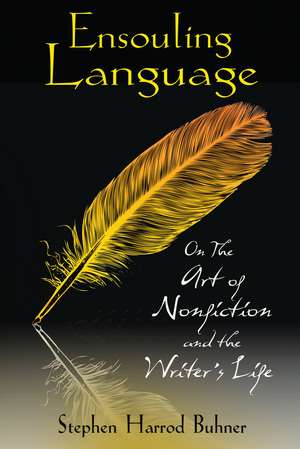
Ensouling Language: On the Art of Nonfiction and the Writer's Life
Autor Stephen Harrod Buhneren Limba Engleză Paperback – 23 aug 2010
• Shows how nonfiction, especially how-to and self-help, can take on the same power and luminosity as great fiction
• Develops processes to reliably induce the dreaming state from which all writing comes
• Teaches the skill of analogical thinking that is the core perceptual tool for writers
• Explores the subtle techniques of powerful writing, from inducing associational dreaming in the reader, to language symmetry, sound patterning, foreshadowing, feeling flow, and more
Approaching writing as a sacred art, Stephen Buhner explores the core of the craft: the communication of deep meaning that feeds not just the mind but also the soul of the reader. Tapping into the powerful archetypes within language, he shows how to enrich your writing by following “golden threads” of inspiration while understanding the crucial invisibles essential to the art of both fiction and nonfiction: how to craft language with feeling and vision, employ altered states of mind to access the writing trance, clear your work by recognizing the powerful sway of clichéd thinking and hidden baggage, and intentionally generate duende--that physical/emotional response to art that gives you chills, opens up unrecognized aspects of reality, or simply resonates in your soul. Covering some very practical aspects of writing such as layering and word symmetry, the author also explores the inner world of publishing--what you really will encounter when you become a writer. He then shows how to develop a powerful and engaging book proposal based on understanding the proposal as a work of fiction--the map is never the territory, nor is the proposal the book that it will become.
This book, written using all the techniques discussed within it, offers a powerful, experiential journey into the heart of writing. It does for nonfiction what John Gardner’s books on writing did for fiction. It is one of the most significant works on writing published in our time.
Preț: 116.79 lei
Preț vechi: 214.36 lei
-46%
Puncte Express: 175
Carte disponibilă
Livrare economică 20 noiembrie-02 decembrie
Livrare express 30 octombrie-05 noiembrie pentru 139.38 lei
Livrare prin curier în România Termenul estimat este afișat lângă disponibilitate.
Transport gratuit de la 400.00 lei Plată online sau ramburs, în funcție de opțiunile comenzii.
Retur gratuit în 14 zile Comandă securizată și suport în română.
Specificații
ISBN-13: 9781594773822
ISBN-10: 1594773823
Pagini: 480
Dimensiuni: 152 x 229 x 28 mm
Greutate: 0.64 kg
Ediția:Original edition
Editura: Inner Traditions/Bear & Company
Colecția Inner Traditions
ISBN-10: 1594773823
Pagini: 480
Dimensiuni: 152 x 229 x 28 mm
Greutate: 0.64 kg
Ediția:Original edition
Editura: Inner Traditions/Bear & Company
Colecția Inner Traditions
V-ar putea interesa
-
 Preț: 110.09 lei
 -
 Preț: 114.43 lei
 -
 How to Be a Writer: Splendiferous StoriesRoald DahlPreț: 74.30 lei
 -
 -26%Preț: 101.10 lei135.72 lei
 -
 Becoming a WriterDorothea BrandePreț: 79.44 lei
 -
 Advanced Creative Nonfiction: A Writer's Guide and AnthologyDr Sean Prentiss-13%Preț: 173.86 lei199.70 lei
 -
 Philosophy of WritingProf. David Arndt-17%Preț: 123.29 lei148.27 lei
 -
 The Book of Practical DreamcraftSahar Huneidi PalmerPreț: 149.62 lei
 -
 -45%Preț: 93.32 lei169.53 lei
 -
 -17%Preț: 67.00 lei80.66 leiRecomandat
 -
 The Book of AlchemySuleika Jaouad-17%Preț: 113.76 lei137.54 leiRecomandat
 -
 The Soul of PlaceLinda LappinPreț: 97.21 lei
 -
 -14%Preț: 117.89 lei137.44 leiRecomandat
 -
 Dear WriterMaggie SmithPreț: 136.67 lei
 -
 Writing Creativity and SoulSue Monk KiddPreț: 122.27 lei
 -
 The Art of Spiritual WritingEirene PalmerPreț: 91.36 lei
 -
 -20%Preț: 107.96 lei134.77 leiRecomandat
 -
 Beat the BotsJane K. Cleland-21%Preț: 126.25 lei159.44 lei
 -
 Preț: 98.08 leiRecomandat
Notă biografică
Stephen Harrod Buhner (1952–2022) was the author of 13 books of nonfiction and 1 of poetry. His books have been translated into 14 languages and have been nominated for 11 awards, winning 8. He was a member of PEN and the Authors Guild.
Extras
Chapter Eight
Following Golden Threads
I feel ready to follow even the most trivial hunch.
--William Stafford
The term “golden thread” was coined by William Blake but developed as a theme in writing by the poet William Stafford, someone whose poetry I like very much.
To the alert person, a golden thread may emerge from any ordinary thing and open a doorway into the imaginal, and through it, the mythic. Because no one can know when or where or from what it will emerge, the writer remains attentive to everything that is encountered, always paying close attention to how everything, even the tiniest little thing, feels. Light pours through a window in a particular way, a person moves their body slightly, you enter a summer field and experience it as a property of mind. Something inside those things brushes against you. . . . Ripples flow up from the depths of the unconscious and touch your conscious mind. A particular feeling envelops you and you stop and focus your whole attention on what is right in front of you. Notitia. The touch of a golden thread.
You can begin to follow it then by simply writing down as concretely as you can what you are experiencing, what you are feeling, what you are seeing, hearing, sensing. Bly describes this, brilliantly, as “following the tiny impulses through the meadow of language.” It must be done slowly. Carefully. Feeling your way. Tiny movement by tiny movement.
It is the feeling equivalent of catching the hint of an elusive scent. You lift your nose to the slight breeze, a delicate touching. Seeking. Ah, there. Your feet move of their own accord as you trail what you have sensed through the meadow in front of you. You twist and turn slightly, following where the scent leads, adjusting your movements to the rise and fall of the land through which you walk. Following the scent home. Finding the core that gives rise to it. Following tiny impulses through the meadow of language.
It begins with the simplest of things: A tiny, odd feeling in a social interaction or elephants walking, holding each other’s tail. Anything can become a door into deeper worlds. Stafford comments that “the artist is not so much a person endowed with the luck of vivid, eventful days, as a person for whom any immediate encounter leads by little degrees to the implications always present for anyone anywhere.” Golden threads touch all of us, every day, but most often only artists and children take the time to follow them.
The initial touch of a golden thread is always attended by a specific kind of feeling. Experience will bring trust in that touch and the feeling that accompanies it, familiar recognition at its emergence. You feel the touch of the thing, it captures your attention, then you work to encapsulate it in language. Working to describe it, of course, causes you to step back slightly from the experience itself. You write a line, perhaps several, then you stop and begin to compare what you have written to the feeling that has demanded your attention.
You look at the lines, focus on them with the whole of you, ask yourself “How does it feel?” and a certain emotional tone emerges. Then you step back inside the thread itself and feel it. Then you compare that feeling to the feeling of your written words. You are going for congruency, for identity.
You can get an experience of how this works from a simple exercise. Say you are sitting at a table. Place something on the table in front of you, perhaps a cup or a pen. Look at it intently, at its placing, its orientation with the other things on the table, its relation to you in space. Anchor that location in your memory and experience. Now . . . move it six or seven inches, to a different location on the tabletop.
The goal is to move it back to the exact spot it was in originally. But .. . do it this way: first, move it halfway back and then ask yourself, is this in the same spot? Notice the feeling that arises within you when you ask yourself that question. There will be some sort of uncomfortable feeling, a lack of rightness. Some part of you will say no, but it sends the negation as a particular kind of feeling. It’s not in words. Yet, you know at a deep level something is wrong. This isn’t it. You feel twitchy. It’s wrong. Now, move it a bit closer to the original spot and ask yourself again if this is the right spot. No, it’s not. That part of you is still telling you that something is not right.
Now, finally, move it back to the location in which it began and ask yourself, is it the same? The feeling that comes now is specific. There is a sense of rightness, a kind of yes occurs. Instead of an uncomfortable feeling, there is instead a good one, a kind of internal joy or sense of rightness. . . .
When a writer compares a written line to the experience the line is intended to describe an identical process takes place. You write the line. Then, you touch it and compare it to the golden thread you are following. If it is not right, there is a sense of wrongness, an uncomfortable feeling. So, you change the line. You feel into the meanings that are held in the words. You feel how the words sit with each other. You listen to and feel the sound patterns of each individual word and the sentences they create together. And you make slight adjustments, shifting meaning by altering the container. Micromolecular adjustments. The tiniest of shifts. Now, how does it feel? . . . Eventually, a sense of rightness occurs. A yes comes from the deep self. Ah. This one is done.
Cuprins
Before Buying This Book
I--The Touch of a Golden Thread
1. The Bookman
2. The Secret All Beginning Writers Want to Know
II--Inhabiting the Word
3. On the Art of Nonfiction
4. You Must Begin with Something Deeper in the Self
5. “The Road of Feeling”
6. “It Burns the Blood Like Powdered Glass”
7. The Skill of Duende
8. Following Golden Threads
III--Dreaming and the Journey to the Imaginal
9. “A Certain Adjustment of Consciousness”
10. “The Secret Kinesis of Things”
11. Aisthesis
12. Synaesthetic Writing and the Beginnings of Analogical Thought
13. Analogical Thinking
14. The Dreamer and the “Secret Room where Dreams Prowl”
15. The Imaginal Realm
16. Poesis
IV--On Technique
The First Draft, Revision, Clarity, and Refinement
17. The First Draft and the Beginnings of Revision
18. Problems and Further Revisioning
19. Clichéd Thinking and Killing the Genuine
20. Hidden Baggage
21. Some Subtle Refinements of the Art
22. Grammar Nazis and Editors-from-Hell
23. Some Final Words on the Writing Life
Epilogue
The Appendices--On the Business of Writing
Appendix A. The People in Publishing and the Business End of the Profession
Appendix B. The Art of the Book Proposal (Training in the Big Lie)
Appendix C. Further Reading, Resources, and Recommendations
Notes
Bibliography
Index
I--The Touch of a Golden Thread
1. The Bookman
2. The Secret All Beginning Writers Want to Know
II--Inhabiting the Word
3. On the Art of Nonfiction
4. You Must Begin with Something Deeper in the Self
5. “The Road of Feeling”
6. “It Burns the Blood Like Powdered Glass”
7. The Skill of Duende
8. Following Golden Threads
III--Dreaming and the Journey to the Imaginal
9. “A Certain Adjustment of Consciousness”
10. “The Secret Kinesis of Things”
11. Aisthesis
12. Synaesthetic Writing and the Beginnings of Analogical Thought
13. Analogical Thinking
14. The Dreamer and the “Secret Room where Dreams Prowl”
15. The Imaginal Realm
16. Poesis
IV--On Technique
The First Draft, Revision, Clarity, and Refinement
17. The First Draft and the Beginnings of Revision
18. Problems and Further Revisioning
19. Clichéd Thinking and Killing the Genuine
20. Hidden Baggage
21. Some Subtle Refinements of the Art
22. Grammar Nazis and Editors-from-Hell
23. Some Final Words on the Writing Life
Epilogue
The Appendices--On the Business of Writing
Appendix A. The People in Publishing and the Business End of the Profession
Appendix B. The Art of the Book Proposal (Training in the Big Lie)
Appendix C. Further Reading, Resources, and Recommendations
Notes
Bibliography
Index
Recenzii
"Ensouling Language is Stephen Harrod Buhner at his most spellbinding and enchanted. Every sentence is infused with a livingness that is rare in today's nonfiction. More than simply a book about writing, it is about wielding power--and responsibility--of language itself. Stephen encourages us to breathe the Breath of Life into the words we write, to call forth such a deep richness of meaning that it transmits feeling from the writer to the reader like some otherworldly telepathy. If you can feel you can write, write in this way, turning otherwise empty leaden words into golden Ensouling Language."
"Buhner's book describes how any writer, even one writing about, say, adobe walls, can achieve the sense of expansion--of traveling into larger worlds--that has always marked the best art. And although the subject is nonfiction, what Buhner has to say applies to serious writing of any kind."
“The most subversive book on writing I have ever encountered--and the most important.”
“If Lao-tzu and Emerson could have a dialogue on writing, they would welcome the company of this remarkable book.”
“Stephen Harrod Buhner has produced a manifesto and guide to bring American writing back from the cages of the academy and release the power of language into the streets and wildernesses where the wild things live. If you love to read, if you like to write, you have finally come to the right place.”
“Stephen Buhner’s Ensouling Language invites you to sit down for 23 cups of coffee and talk about the mystic journey of the writer, the solitary pilgrim, the witness yearning to tell the world indelible stories that cannot be known by any other voice than yours. If you are a teacher, a writer, a friend of a writer, this book will offer companionship in this life quest. This book harvests lessons from a writer and helpless lover of books who is old in experience but young in perennial devotion.”
“Ensouling Language is a fierce and generous meditation on the writer’s life. Fierce, because Stephen Buhner goes right at prevailing commercial and academic assumptions about literature. For him, writing is above all a portal into vividness, compassion, and discovery. Generous, because he weaves his own quest as a writer into his reflections about the art of nonfiction. Books, in both the reading and the writing, have absorbed him for a lifetime. And the connections he conveys here are always arresting, sometimes extravagant in their intensity, and very often funny. As a writer and a teacher, I’ve learned more from Buhner’s book than from anything I’ve read about writing since the works of John Gardner and William Stafford. I’m truly grateful to him for having written it.”
“I can’t easily imagine a more useful book on the craft of writing. Covering all the steps--from glimpsing a first, furtive idea foraging in the mind’s brambles to tracking that idea and coaxing it to unfurl on the page, from finding the right words to securing the right publisher--this volume also, in the process, transforms your take on the universe. For Buhner brings all his inspired lunacy to bear, illustrating his passionate insights with lively stories and poems and with glimmering nuggets from other authors, fashioning this instructive, how-to book into a breathing compendium of word magic.”
"Provocation is Buhner's mission in this unusually passionate and delving writer's guide. The author of books about plants, healing, indigenous culture, and the environment, Buhner not only tackles the art of writing with conviction, vigor, expertise, and a touch of devilry but also outspokenly advocates for the maligned form of "genre nonfiction.". . . Buhner sagely covers technical matters and the pragmatic business of book proposals and such, albeit not without lambasting corporate publishing. But his is a heroic view of writing."
“Stephen Buhner writes with passion and perception about the entire range of the writer’s experience. He shows us in detail how to write, issues of craft and art, but also how a writer lives--the commitment, the dreaming, the business, the way a writer uncovers secrets on many levels, even how a writer loves and hates.”
“Stephen Harrod Buhner has counted ‘beacoup coups’ in penning Ensouling Language. As history almost unanimously attests, writing well about writing is at best a rarity, perhaps mythic, a yeti of sorts. But Buhner’s flair, sage advice, and most of all his passion for writing touches every sentence. The book brings writing to life and will add life to any author’s own words.”
“If you want a kind of deep ecology for nonfiction writing, a practical guide ingrained with the spirits of William Stafford and Federico García Lorca too, Ensouling Language is your book. Its pages, studded with samples and suggestions, come via the author’s fresh and liberating voice, opening up the ‘imaginal world’ we cannot do without.”
"For readers and writers who are tired of hearing the same advice that writing instructors and editors have been handing down through the ages, however, Buhner's mystical (some might say touchy-feely) approach to writing may well be what the doctor ordered."
" . . . Ensouling Language is an important book that encourages inner reflection before and during writing as well as focusing on the feelings of the reader. The technical proponents of publishing are addressed and intertwined throughout giving the writer a glimpse into the 'heart of writing'."
“Ensouling Language is a richly engaging book written for everyone who has been deeply touched by something they have read and wishes to write like that too.”
“The American writer, Stephen Harrod Buhner, author of the iconic Ensouling Language: On the Art of Non-fiction and the Writer’s Life - and an inspiration to our editors - also appeals for openness to these wellsprings of creativity. He challenges the arid and mechanical quality of much non-fiction writing, and the danger of much creative writing being afflicted in the same way, because of the formulaic teaching on American MFAs in particular. For Buhner, as for Edward Bond, there is urgent need in our time of writing, in any genre, that - to adapt Buhner’s own words - attempts to extend awareness “further than society wants it to go” - a view strongly endorsed by our editors.”
“Writing as a mystical experience, a transcendent art-form, is presented by Buhner with all the mystery and inspiration of a personal passion. As he writes about the ability of language to take life on the page, so his own writing quickens, transporting the reader to the realms of poetic spirit. This book is both a tribute to the craft of language and example of the same at its most delicate level. Buhner guides the reader through the process of accessing the necessary mind to write from the heart, and he does so from his own heart-felt devotion to the art. It is both a practical hand-book and mystical treatise, instilled with the spirit of many of the subtlest writers, poets and critics whose approach to writing and life brings to mind the faint scent of incense on the still desert plain”
“This is a book I can highly recommend, not only for aspiring writers, but for anyone who wants to engage the world deeply and recognizes the value of words in the exchange.”
“The point Buhner is making is vital: that whatever genre we’re writing, whether we’re a graduate from an MFA program or not, writers must never dissociate from their feelings or the feeling of their words. Given the passionate spirit in which Ensouling Language was written, it is sure to resonate with many readers, and is certainly worth a read by anyone who wishes to become a published author.”
"Buhner's book describes how any writer, even one writing about, say, adobe walls, can achieve the sense of expansion--of traveling into larger worlds--that has always marked the best art. And although the subject is nonfiction, what Buhner has to say applies to serious writing of any kind."
“The most subversive book on writing I have ever encountered--and the most important.”
“If Lao-tzu and Emerson could have a dialogue on writing, they would welcome the company of this remarkable book.”
“Stephen Harrod Buhner has produced a manifesto and guide to bring American writing back from the cages of the academy and release the power of language into the streets and wildernesses where the wild things live. If you love to read, if you like to write, you have finally come to the right place.”
“Stephen Buhner’s Ensouling Language invites you to sit down for 23 cups of coffee and talk about the mystic journey of the writer, the solitary pilgrim, the witness yearning to tell the world indelible stories that cannot be known by any other voice than yours. If you are a teacher, a writer, a friend of a writer, this book will offer companionship in this life quest. This book harvests lessons from a writer and helpless lover of books who is old in experience but young in perennial devotion.”
“Ensouling Language is a fierce and generous meditation on the writer’s life. Fierce, because Stephen Buhner goes right at prevailing commercial and academic assumptions about literature. For him, writing is above all a portal into vividness, compassion, and discovery. Generous, because he weaves his own quest as a writer into his reflections about the art of nonfiction. Books, in both the reading and the writing, have absorbed him for a lifetime. And the connections he conveys here are always arresting, sometimes extravagant in their intensity, and very often funny. As a writer and a teacher, I’ve learned more from Buhner’s book than from anything I’ve read about writing since the works of John Gardner and William Stafford. I’m truly grateful to him for having written it.”
“I can’t easily imagine a more useful book on the craft of writing. Covering all the steps--from glimpsing a first, furtive idea foraging in the mind’s brambles to tracking that idea and coaxing it to unfurl on the page, from finding the right words to securing the right publisher--this volume also, in the process, transforms your take on the universe. For Buhner brings all his inspired lunacy to bear, illustrating his passionate insights with lively stories and poems and with glimmering nuggets from other authors, fashioning this instructive, how-to book into a breathing compendium of word magic.”
"Provocation is Buhner's mission in this unusually passionate and delving writer's guide. The author of books about plants, healing, indigenous culture, and the environment, Buhner not only tackles the art of writing with conviction, vigor, expertise, and a touch of devilry but also outspokenly advocates for the maligned form of "genre nonfiction.". . . Buhner sagely covers technical matters and the pragmatic business of book proposals and such, albeit not without lambasting corporate publishing. But his is a heroic view of writing."
“Stephen Buhner writes with passion and perception about the entire range of the writer’s experience. He shows us in detail how to write, issues of craft and art, but also how a writer lives--the commitment, the dreaming, the business, the way a writer uncovers secrets on many levels, even how a writer loves and hates.”
“Stephen Harrod Buhner has counted ‘beacoup coups’ in penning Ensouling Language. As history almost unanimously attests, writing well about writing is at best a rarity, perhaps mythic, a yeti of sorts. But Buhner’s flair, sage advice, and most of all his passion for writing touches every sentence. The book brings writing to life and will add life to any author’s own words.”
“If you want a kind of deep ecology for nonfiction writing, a practical guide ingrained with the spirits of William Stafford and Federico García Lorca too, Ensouling Language is your book. Its pages, studded with samples and suggestions, come via the author’s fresh and liberating voice, opening up the ‘imaginal world’ we cannot do without.”
"For readers and writers who are tired of hearing the same advice that writing instructors and editors have been handing down through the ages, however, Buhner's mystical (some might say touchy-feely) approach to writing may well be what the doctor ordered."
" . . . Ensouling Language is an important book that encourages inner reflection before and during writing as well as focusing on the feelings of the reader. The technical proponents of publishing are addressed and intertwined throughout giving the writer a glimpse into the 'heart of writing'."
“Ensouling Language is a richly engaging book written for everyone who has been deeply touched by something they have read and wishes to write like that too.”
“The American writer, Stephen Harrod Buhner, author of the iconic Ensouling Language: On the Art of Non-fiction and the Writer’s Life - and an inspiration to our editors - also appeals for openness to these wellsprings of creativity. He challenges the arid and mechanical quality of much non-fiction writing, and the danger of much creative writing being afflicted in the same way, because of the formulaic teaching on American MFAs in particular. For Buhner, as for Edward Bond, there is urgent need in our time of writing, in any genre, that - to adapt Buhner’s own words - attempts to extend awareness “further than society wants it to go” - a view strongly endorsed by our editors.”
“Writing as a mystical experience, a transcendent art-form, is presented by Buhner with all the mystery and inspiration of a personal passion. As he writes about the ability of language to take life on the page, so his own writing quickens, transporting the reader to the realms of poetic spirit. This book is both a tribute to the craft of language and example of the same at its most delicate level. Buhner guides the reader through the process of accessing the necessary mind to write from the heart, and he does so from his own heart-felt devotion to the art. It is both a practical hand-book and mystical treatise, instilled with the spirit of many of the subtlest writers, poets and critics whose approach to writing and life brings to mind the faint scent of incense on the still desert plain”
“This is a book I can highly recommend, not only for aspiring writers, but for anyone who wants to engage the world deeply and recognizes the value of words in the exchange.”
“The point Buhner is making is vital: that whatever genre we’re writing, whether we’re a graduate from an MFA program or not, writers must never dissociate from their feelings or the feeling of their words. Given the passionate spirit in which Ensouling Language was written, it is sure to resonate with many readers, and is certainly worth a read by anyone who wishes to become a published author.”
Descriere
Approaching writing as a sacred art, Stephen Buhner explores the core of the craft: the communication of deep meaning that feeds not just the mind but also the soul of the reader.