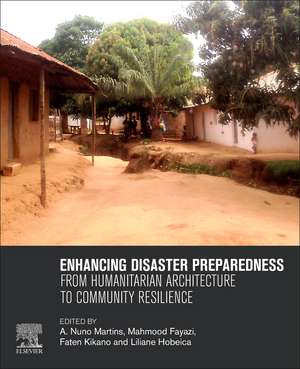
Enhancing Disaster Preparedness: From Humanitarian Architecture to Community Resilience
Editat de A. Nuno Martins, Mahmood Fayazi, Faten Kikano, Liliane Hobeicaen Limba Engleză Paperback – 7 oct 2020
- Explores Sendai’s fourth priority through a spatial lens
- Examines the role of humanitarian design in building resilience
- Critically revisits concepts such as incremental housing and building back better
- Provides examples of methodological tools for community engagement in resilience-building processes
Preț: 620.00 lei
Preț vechi: 896.28 lei
-31%
Puncte Express: 930
Carte tipărită la comandă
Livrare economică 23 noiembrie-07 decembrie
Livrare prin curier în România Termenul estimat este afișat lângă disponibilitate.
Transport gratuit pentru acest produs Plată online sau ramburs, în funcție de opțiunile comenzii.
Retur gratuit în 14 zile Comandă securizată și suport în română.
Specificații
ISBN-13: 9780128190784
ISBN-10: 0128190787
Pagini: 298
Ilustrații: 150 illustrations (75 in full color)
Dimensiuni: 191 x 235 x 19 mm
Greutate: 0.51 kg
Editura: ELSEVIER SCIENCE
ISBN-10: 0128190787
Pagini: 298
Ilustrații: 150 illustrations (75 in full color)
Dimensiuni: 191 x 235 x 19 mm
Greutate: 0.51 kg
Editura: ELSEVIER SCIENCE
V-ar putea interesa
-
 -26%Preț: 608.24 lei820.71 lei
 -
 Climate Change: A Very Short IntroductionMark Maslin-19%Preț: 58.13 lei71.69 lei
 -
 Turned Out NiceMarek KohnPreț: 147.12 lei
 -
 Recipe for SurvivalDana HunnesPreț: 153.35 lei
 -
 Drought, Flood, FireChris C. FunkPreț: 133.69 lei
 -
 Earth DetoxJulian CribbPreț: 129.40 lei
 -
 Climate Refugees: Beyond the Legal Impasse?Simon BehrmanPreț: 464.56 lei
 -
 State of the World 2009: Confronting Climate ChangeWorldwatch Institute-18%Preț: 713.80 lei870.48 lei
 -
 Preț: 146.50 lei
 -
 Emissions of Methane & Nitrous Oxide from Natural SourcesAnderson T Scott-27%Preț: 1598.82 lei2182.66 lei
 -
 -27%Preț: 999.83 lei1362.62 lei
 -
 -27%Preț: 1022.73 lei1395.26 lei
 -
 -27%Preț: 1023.18 lei1395.56 lei
 -
 Resetting Our Future: A Chicken Can't Lay a Duck EggBernice Maxton-LeePreț: 60.44 lei
 -
 Climate Adaptation: Accounts of Resilience, Self-Sufficiency and Systems ChangeArkbound Foundation-6%Preț: 75.64 lei80.77 lei
 -
 Great Adaptations: In the shadow of a climate crisisMorgan Phillips-10%Preț: 69.11 lei76.86 lei
 -
 -18%Preț: 908.24 lei1107.60 lei
 -
 Loss and Damage from Climate ChangeReinhard MechlerPreț: 477.72 lei
 -
 Climate ChangeAndré Berger-24%Preț: 886.98 lei1167.08 lei
 -
 Twenty Years of Ozone DeclineChristos Zerefos-18%Preț: 1231.19 lei1501.45 lei
Public țintă
Academics in disaster management, policy makers, industry sector, NGOs and risk practitioners in generalCuprins
PART I – Humanitarian architecture
1. A humanitarian shelter terminology framework
2. Techo’s emergency-housing response to hurricanes in Puerto Rico: Lessons from the field
3. The story of the disaster-relief houses in Iceland
4. The influence of technical assistance in the adoption of safer construction practices in Nepal
5. Participatory design for refugee shelters: An experiment in Syrian camps in Jordan
6. Lessons for Humanitarian Architecture from design contests: The case of the Building 4Humanity Design Competition
PART II – Architecture and urban design to enhance community preparedness
7. Architects’ multifaceted roles in enhancing resilience after disasters
8. Probing for resilience: Exploring design with empathy in Zanzibar, Tanzania
9. Consolidation design as an adaptation strategy in the Toi Market in Nairobi, Kenya
10. Risk and urban design in Brazilian favelas: Linking participation, collective spaces, and territorial management
PART III – Housing vulnerability, community resilience, and inclusive governance
11. Informality versus short-term regularization of the Syrian refugees’ situation in Lebanon
12. Incremental housing in Villa Verde, Chile: A view through the Sendai Framework lens
13. Climate Action Zones: A clustering methodology for resilient spatial planning in climate uncertainty
14. The links between vulnerability, poverty, and natural hazards: A focus on the impacts of globalization trends
1. A humanitarian shelter terminology framework
2. Techo’s emergency-housing response to hurricanes in Puerto Rico: Lessons from the field
3. The story of the disaster-relief houses in Iceland
4. The influence of technical assistance in the adoption of safer construction practices in Nepal
5. Participatory design for refugee shelters: An experiment in Syrian camps in Jordan
6. Lessons for Humanitarian Architecture from design contests: The case of the Building 4Humanity Design Competition
PART II – Architecture and urban design to enhance community preparedness
7. Architects’ multifaceted roles in enhancing resilience after disasters
8. Probing for resilience: Exploring design with empathy in Zanzibar, Tanzania
9. Consolidation design as an adaptation strategy in the Toi Market in Nairobi, Kenya
10. Risk and urban design in Brazilian favelas: Linking participation, collective spaces, and territorial management
PART III – Housing vulnerability, community resilience, and inclusive governance
11. Informality versus short-term regularization of the Syrian refugees’ situation in Lebanon
12. Incremental housing in Villa Verde, Chile: A view through the Sendai Framework lens
13. Climate Action Zones: A clustering methodology for resilient spatial planning in climate uncertainty
14. The links between vulnerability, poverty, and natural hazards: A focus on the impacts of globalization trends