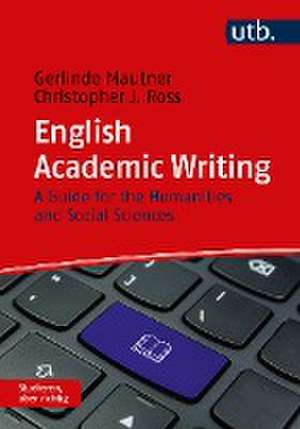
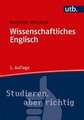
English Academic Writing: Studieren, aber richtig
Autor Gerlinde Mautner, Christopher J. Rossen Limba Engleză Paperback – 19 iun 2023



Preț: 236.07 lei
Puncte Express: 354
Carte indisponibilă temporar
Doresc să fiu notificat când acest titlu va fi disponibil:
Se trimite...
Specificații
ISBN-13: 9783825260286
ISBN-10: 3825260283
Pagini: 238
Dimensiuni: 152 x 216 x 17 mm
Greutate: 0.37 kg
Editura: UTB GmbH
Seria Studieren, aber richtig
ISBN-10: 3825260283
Pagini: 238
Dimensiuni: 152 x 216 x 17 mm
Greutate: 0.37 kg
Editura: UTB GmbH
Seria Studieren, aber richtig
Notă biografică
Dr. Gerlinde Mautner lehrt am Insitut für Englische Wirtschaftskommunikation der Wirtschaftsuniversität Wien.
Cuprins
Acknowledgments Explanatory notes for readers Introduction: Seven pillars of academic writing 1 Creativity and constraints: Planning research texts 1.1 Research genres 1.1.1 Genres, structures and hierarchies 1.1.2 Hierarchical organisation in research texts 1.2 The research story and its parts 1.2.1 The abstract 1.2.2 The beginning: Setting the scene 1.2.3 The middle: Developing the plot 1.2.4 The ending: Rounding it all off 1.3 Text appeal 2 One step at a time: Designing paragraphs 2.1 The essence of English paragraphs 2.2 The components of a paragraph 2.2.1 The topic sentence 2.2.2 The `meaty¿ middle 2.2.3 The final sentence 2.3 Paragraph appeal 3 Focus and flow: Constructing sentences 3.1 Sentence types 3.1.1 The simple sentence 3.1.2 The complex sentence 3.1.3 Subordinate clauses 3.2 Principles of sentence construction 3.2.1 The `given-new¿ principle 3.2.2 End focus 3.3 Passive sentences 3.4 Sentence appeal 3.4.1 Getting the verb-noun balance right 3.4.2 Varying sentence structure 4 Breath marks: Punctuation 4.1 Why punctuation matters 4.2 What punctuation marks signal 4.2.1 Suggesting `stops¿ 4.2.2 Suggesting `detours¿ 4.2.3 Suggesting `pauses¿ 4.3 Commas: sometimes a question of style 4.3.1 Where style plays little part 4.3.2 Where style comes in 5 Only connect: Cohesion 5.1 General principles of cohesion and coherence 5.2 Cohesion within paragraphs 5.2.1 Semantic chains 5.2.2 Pronouns 5.2.3 Linkers 5.2.4 Structural devices 5.3 Cohesion beyond the paragraph 6 Your words, not mine: Citations 6.1 What to cite and how much 6.2 Types of citations 6.2.1 Direct versus indirect citations 6.2.2 Integral versus non-integral citations 6.3 Weaving citations into the text 6.4 Inadvertent plagiarism and how to avoid it 7 Follow me: Guiding and persuading the reader 7.1 Showing the reader the way: Metacomments 7.2 Getting the reader on your side 7.2.1 Reasoning 7.2.2 Emphasising 7.2.3 Evaluating 7.2.4 Rapport-building Appendix 1 Conference presentations A1.1 The audience, or `pity the listener¿ A1.2 The purposes A1.3 Language considerations A1.4 Text slides Appendix 2 Grant proposals Appendix 3 Phrasebank for academic writing List of references Index