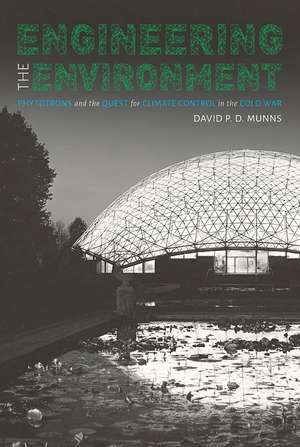
Engineering the Environment: Phytotrons and the Quest for Climate Control in the Cold War
Autor David P. D. Munnsen Limba Engleză Hardback – 10 mai 2017
Descoperim în Engineering the Environment o analiză riguroasă a unui capitol aproape uitat din istoria științei: fitotroanele. Structura volumului este organizată în jurul ascensiunii și declinului acestor laboratoare gigantice, David P. D. Munns utilizând o metodologie care împletește istoria tehnologiei cu fiziologia plantelor. Autorul explică modul în care controlul umidității și al temperaturii, susținut de primele sisteme de calcul, a transformat biologia într-o disciplină de tip „Big Science” în timpul Războiului Rece.
Notăm cu interes modul în care Munns poziționează aceste facilități nu doar ca instrumente de cercetare, ci ca promisiuni politice pentru eradicarea foametei globale. Comparabil cu A Lab for All Seasons de Sharon E. Kingsland în ceea ce privește rigoarea documentării inovațiilor din laboratoarele botanice, volumul de față se distinge prin focalizarea pe contextul geopolitic și pe moștenirea acestor structuri în cercetarea contemporană a schimbărilor climatice. Dacă în lucrările sale anterioare, precum Far Beyond the Moon, autorul explora sistemele de susținere a vieții în spațiu, aici el analizează încercarea de a replica și controla „bucăți de natură” pe Pământ.
Stilul este unul academic, dar narativul rămâne alert, punctat de cele 38 de ilustrații care oferă o perspectivă vizuală asupra acestor „mașini de creștere”. Din punct de vedere metodologic, lucrarea recuperează relevanța fitotroanelor pentru Antropocen, argumentând că înțelegerea complexității ecosistemelor moderne depinde de lecțiile învățate în aceste laboratoare controlate. Este o contribuție esențială pentru istoria științei generale, oferind o punte între tehnologia militară a epocii și ecologia modernă.
Preț: 448.63 lei
Carte disponibilă
Livrare economică 12-26 noiembrie
Specificații
ISBN-10: 082294474X
Pagini: 384
Ilustrații: 38 b&w Illustrations
Dimensiuni: 152 x 229 x 33 mm
Greutate: 0.68 kg
Ediția:1
Editura: University of Pittsburgh Press
Colecția University of Pittsburgh Press
V-ar putea interesa
-
 The Invention of AirStephen T. JohnsonPreț: 115.01 lei
 -
 The Oxford Companion to the YearBonnie Blackburn-31%Preț: 665.45 lei970.27 lei
 -
 Blessed Days of Anaesthesia: How anaesthetics changed the worldStephanie J. Snow-17%Preț: 171.74 lei207.41 lei
 -
 Molecules: A Very Short IntroductionPhilip Ball-19%Preț: 57.65 lei71.42 lei
 -
 Linnaeus' Philosophia BotanicaStephen Freer-24%Preț: 544.32 lei714.37 lei
 -
 Science in the Looking Glass: What Do Scientists Really Know?E. Brian Davies-14%Preț: 300.57 lei348.48 lei
 -
 A Short History of Scientific ThoughtJohn Henry-23%Preț: 245.60 lei318.85 lei
 -
 Preț: 191.06 lei
 -
 Mysteries and Discoveries of ArchaeoastronomyGiulio MagliPreț: 301.80 lei
 -
 Of Moths and MenJudith HooperPreț: 163.45 lei
 -
 Science and Empire in the Atlantic WorldJames DelbourgoPreț: 426.77 lei
 -
 Before the FalloutDiana PrestonPreț: 141.41 lei
 -
 Communicating ScienceNicholas RussellPreț: 394.66 lei
 -
 Mr. Wilson's Cabinet Of WonderLawrence WeschlerPreț: 90.75 lei
 -
 BloodDouglas StarrPreț: 146.90 lei
De ce să citești această carte
Această carte este recomandată cercetătorilor din domeniul istoriei științei și profesioniștilor interesați de evoluția ecologiei. Cititorul câștigă o înțelegere profundă a modului în care tehnologia Războiului Rece a modelat cercetarea biologică actuală. Este un titlu esențial pentru a înțelege cum eforturile trecute de a controla clima prin „fitotroane” informează astăzi strategiile noastre de adaptare la schimbările climatice globale.
Despre autor
David P. D. Munns este profesor asistent de istorie la John Jay College of Criminal Justice din cadrul City University of New York. Specializat în istoria științei și a tehnologiei, Munns și-a concentrat cercetările pe intersecția dintre inginerie și sistemele biologice. Opera sa examinează frecvent teme precum controlul mediului și supraviețuirea umană în condiții extreme, aspecte vizibile atât în studiile sale despre fitotroane, cât și în cercetările privind tehnologiile spațiale din lucrarea Far Beyond the Moon.
Recenzii
—Choice
—Helen Anne Curry, University of Cambridge
—Joseph A. November, University of South Carolina
—Journal of the History of Biology
—Alex Wellerstein, Stevens Institute of Technology
Notă biografică
Descriere
Engineering the Environment tells the forgotten story of a research program that revealed the shape of the environment, the limits of growth and development, and the limits of human control over complex technological systems. As support and funding for basic science dwindled in the mid-1960s, phytotrons declined and ultimately disappeared—until, nearly thirty years later, the British built the Ecotron to study the impact of climate change on biological communities. By revisiting this history of phytotrons, David Munns reminds us of the vital role they can play in helping researchers unravel the complexities of natural ecosystems in the Anthropocene.