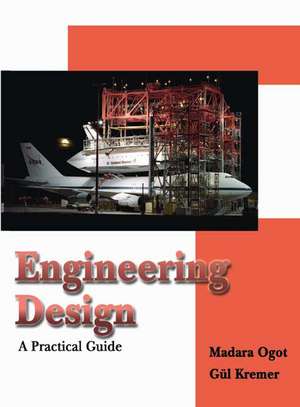
Engineering Design: A Practical Guide
Autor Madara Ogot, Gul Okudan-Kremeren Limba Engleză Paperback – 31 oct 2004
In addition, an overview of materials and manufacturing methods is presented. The use of Excel has been incorporated throughout the text for performing routine calculations, leaving more time for the creative aspects of the design process. Finally, the text contains an extensive discussion of systematic concept generation using the theory of inventive problem solving, TRIZ.
Below is a listing of the book's table of contents:
1. Engineering Design
1.1 Design
1.2 Engineering Design
1.3 Process Design
1.4 Overview of the Engineering Design Process
1.5 Design Reviews
PART I ENGINEERING DESIGN AIDS
2. Management of the Design Process
2.1 Introduction to Project Management
2.2 Planning and Scheduling (includes discussion of work breakdown structures, design structure matrix, activity networks and Gantt charts). Provides an automated MS Excel-based project management workbook that incorporates all these tools).
2.2 Directing
3. Collaborative Design
3.1 Introduction
3.2 Conceptual Understanding of Teams and Team Development
3.3 Challenges: Conflict Management, Performance and Motivation
3.4 Communication
3.5 Potential Factors Impacting Team Performance
4. Engineering Communication: Reports and Oral Presentations
4.1 Introduction
4.2 The Formal EngineeringReport
4.3 Plagiarism
4.4 Report Formats
4.5 Oral Presentations
4.6 Poster Presentations
5. Engineering Communication: Illustration and Solid Modeling
5.1 Introduction
5.2 Introduction to Digital Media
5.3 Technical Sketching and Solid Modeling
5.4 Working Drawings
5.5 Computer Generated Sketches for Documentation
6. Decision Making
6.1 Introduction
6.2 Rank Order: Pairwise Comparison Charts
6.3 Relative Order: Analytic Hierarchy Process (AHP)
6.4 Relative Order: Decision Matrices
PART II THE ENGINEERING DESIGN PROCESS
7. Problem Definition and Determination of Need
7.1 Introduction
7.2 Problem Definition
7.3 Determination of Customer/Client Needs
7.4 Revised Problem Statement
8. Conceptualization I: External Search
8.1 Introduction
8.2 Patents and Patent Searches
8.3 Benchmarking
8.4 Product Dissection
8.5 Biomimicry
9. Conceptualization II: Internal Search and Concept Selection
9.1 Introduction
9.2 Internal Search (Includes discussion on concept generation methods such as brain storming and its variations, Delphi method, synetics, checklists, scamper and morphological charts).
9.3 Concept Selection (Use of Pugh charts and decision matrices)
10. Systematic Innovation with TRIZ
10.1 Introduction
10.2 Simplified Steps for Application of TRIZ tools
10.3 Analyzing the System and its Resources
10.4 The Ideal Final Result
10.5 The 40 Design Principles
10.6 Technical Contradictions and the Contradiction Matrix
10.7 Physical Contradictions
PART III Overview of Materials and Manufacturing
11. Materials and Material Selection
11.1Introduction
11.2 Materials and Material Selection
11.3 Mechanical Properties of Materials: Stress-Strain
11.4 Typical Mechanical Properties for Material Selection
11.5 Typical Thermal Properties for Material Selection
11.6 Typical Electrical Properties for Material Selection
11.7 Typical Manufacturing Properties for Material Selection
11.8 General Material Categories
11.9 Properties of Common Metals
11.10 Overview of Polymers
11.11 Properties of Common Polymers
11.12 Steps in Material Selection
12. Physical Models and Prototypes
12.1 Introduction
12.2 Rapid Prototyping - An Overview
12.3 Machining
12.4 An Overview of Fastening Methods
13. Commercial Manufacturing Processes
13.1 Manufacturing Processes for Metals - An Overview
13.2 Manufacturing Process for Plastics - An Overview
PART IV GENERAL DESIGN CONSIDERATIONS
14. Green Design
14.1 Introduction: What is Green Design
14.2 Ecological Principles
14.3 Sustainability Metric - Ecological Footprint
14.4 Life Cycle Assessment
15. Engineering Ethics
15.1 What is Engineering Ethics?
15.2 Professional Societies and Codes of Ethics
15.3 Stimulating Moral Imagination
15.4 Recognizing Ethical Issues
15.5 Developing Analytical Skills
15.6 Eliciting a Sense of Responsibility
15.7 Tolerating Disagreement and Ambiguity
PART V APPENDICES
ACreation of Project Management Workbooks in Excel
BAdobe Illustrator 10 Tutorial
CTRIZ: Contradiction Matrices
DNSPE: Codes of Ethics for Engineers
EComponent Tables
FCommon Unit Conversions
Glossary
Faculty interested in receiving an evaluation copy of thebook for course adoption should contact the first author using the address below
Dr. Madara Ogot
Engineering Design Program
213 Hammond Building
The Pennsylvania State University
University Park, PA 16802
madaraogot@psu.edu
Preț: 302.08 lei
Carte disponibilă
Livrare economică 12-26 noiembrie
Specificații
ISBN-10: 1412038502
Pagini: 454
Dimensiuni: 177 x 241 x 27 mm
Greutate: 0.63 kg
Editura: Troubador Publishing