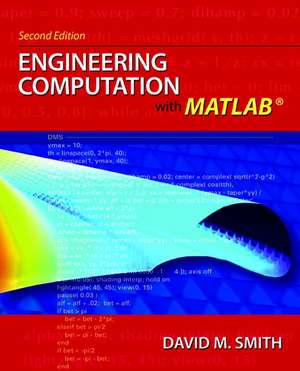
Engineering Computation with MATLAB: United States Edition
Autor David M. Smithen Limba Engleză Mixed media product – 7 ian 2009
Preț: 588.06 lei
Preț vechi: 726.00 lei
-19%
Puncte Express: 882
Disponibilitate incertă
Doresc să fiu notificat când acest titlu va fi disponibil:
Se trimite...
Specificații
ISBN-13: 9780136080633
ISBN-10: 0136080634
Pagini: 480
Dimensiuni: 187 x 232 mm
Greutate: 0.71 kg
Ediția:2Nouă
Editura: Pearson Education
Colecția Addison Wesley
Locul publicării:Boston, United States
ISBN-10: 0136080634
Pagini: 480
Dimensiuni: 187 x 232 mm
Greutate: 0.71 kg
Ediția:2Nouă
Editura: Pearson Education
Colecția Addison Wesley
Locul publicării:Boston, United States
Cuprins
Chapter 1: Introduction to Computers and Programming
1.1 Background
1.2 History of Computer Architectures
1.3 Computing Systems Today
1.4 Executing a MATLAB Program
1.5 Problem Solving
Chapter 2: Getting Started with MATLAB
2.1 Programming Language Background
2.2 Basic Data Manipulation
2.3 The MATLAB User Interface
2.4 Scripts
2.5 Engineering Example–Spacecraft Launch
Chapter 3: Vectors and Arrays
3.1 Concept: Using Built-in Functions
3.2 Concept: Data Collections
3.3 MATLAB Vectors
3.4 Engineering Example–Forces and Moments
3.5 MATLAB Arrays
3.6 Engineering Example–Computing Soil Volume
Chapter 4: Execution Control
4.1 Concept: Code Blocks
4.2 Conditional Execution in General
4.3 if Statements
4.4 switch Statements
4.5 Iteration in General
4.6 for Loops
4.7 while Loops
4.8 Engineering Example–Computing Liquid Levels
Chapter 5: Functions
5.1 Concepts: Abstraction and Encapsulation
5.2 Black Box View of a Function
5.3 MATLAB Implementation
5.4 Engineering Example–Measuring a Solid Object
Chapter 6: Character Strings
6.1 Character String Concepts: Mapping Casting, Tokens and Delimiting
6.2 MATLAB Implementation
6.3 Format Conversion Functions
6.4 Character String Operations
6.5 Arrays of Strings
6.6 Engineering Example–Encryption
Chapter 7: Cell Arrays and Structures
7.1 Concept: Collecting Dissimilar Objects
7.2 Cell Arrays
7.3 MATLAB Structures
7.4 Structure Arrays
7.5 Engineering Example–Assembling a Structure
Chapter 8: File Input and Output
8.1 Concept: Serial Input and Output (I/O)
8.2 MATLAB Workspace I/O
8.3 High-Level I/O Functions
8.4 Lower-Level File I/O
8.5 Engineering Example–Spreadsheet Data
Chapter 9: Recursion
9.1 Concept: The Activation Stack
9.2 Recursion Defined
9.3 Implementing a Recursive Function in MATLAB
9.4 Exceptions
9.5 Wrapper Functions
9.6 Tail Recursion
9.7 Mutual Recursion
9.8 Generative Recursion
9.9 Examples of Recursion
9.10 Engineering Example–Robot Arm Motion
Chapter 10: Principles of Problem Solving
10.1 Solving Simple Problems
10.2 Assembling Solution Steps
10.3 Summary of Operations
10.4 Solving Larger Problems
10.5 Engineering Example–Processing Geopolitical Data
Chapter 11: Plotting
11.1 Plotting in General
11.2 2-D Plotting
11.3 3-D Plotting
11.4 Surface Plots
11.5 Interacting with Plotted Data
11.6 Engineering Example–Visualizing Geographic Data
Chapter 12: Matrices
12.1 Concept: Behavioral Abstraction
12.2 Matrix Operations
12.3 MATLAB Implementation
12.4 Rotating Coordinates
12.5 Solving Simultaneous Linear Equations
12.6 Engineering Examples
Chapter 13: Images
13.1 Nature of an Image
13.2 Image Types
13.3 Reading, Displaying, and Writing Images
13.4 Operating on Images
13.5 Engineering Example–Detecting Edges
Chapter 14: Processing Sound
14.1 The Physics of Sound
14.2 Recording and Playback
14.3 MATLAB Implementation
14.4 Time Domain Operations
14.5 The Fast Fourier Transform
14.6 Frequency Domain Operations
14.7 Engineering Example–Oil Rig Structural Integrity
Chapter 15: Numerical Methods
15.1 Interpolation
15.2 Curve Fitting
15.3 Numerical Integration
15.4 Numerical Differentiation
15.5 Engineering Example–Analyzing Rocket Data
15.6 Engineering Example-Cleaning Up Images
Chapter 16: Sorting
16.1 Measuring Algorithm Cost
16.2 Algorithms for Sorting Data
16.3 Performance Analysis
16.4 Applications of Sorting Algorithms
16.5 Engineering Example–A Selection of Countries
Online Chapters
Chapter 17: Searching Graphs
Chapter 18: Object-Oriented Programming
Chapter 19: Linked Lists
Chapter 20: Binary Trees
Chapter 21: N-ary Trees and Graphs
Chapter 22: The Cost of Computing
Appendixes
A MATLAB Special Characters, Reserved Words, and Symbols
B The ASCII Character Set
C Internal Number Representation
D Web Reference Materials (online)
E Answers to True or False and Fill in the Blanks (online)
Index
Notă biografică
David Smith has been teaching introductory computer science classes for engineers at the Georgia Institute of Technology since 1997 when he retired from industry. Previously, he worked 31 years for Lockheed-Martin at their Marietta, Georgia, facility as a systems and software specialist with a focus on intelligent systems. He was active in designing and developing software for the C-130J, C-27J, F-22 and C-5 aircraft, and was the technical leader of the Pilot’s Associate program, a $42 million research project sponsored by the Defense Advanced Research Projects Agency.
He has a bachelor’s degree in aeronautical engineering from Southampton University, and a master’s degree in control systems from Imperial College, London.
He has a bachelor’s degree in aeronautical engineering from Southampton University, and a master’s degree in control systems from Imperial College, London.
Caracteristici
- Engineering Examples are interspersed in the chapters, providing robust examples that extend chapter concepts into practice, such as the fundamental principles used to implement vehicle navigation systems.
- Do It Yourself Exercise boxes allow readers to master concepts by trying what they just learned. Exercises follow each new topic for immediate reinforcement.
- Style Points clearly advise readers about writing quality code that is easy to understand, debug, and reuse.
- Hints enrich understanding of a topic by providing a little extra “aside” in places where readers may benefit from it.
- Common Pitfall boxes alert readers to common mistakes that programmers make, and clearly explain how to avoid them.
- End-of-chapter material—including a chapter summary, true-or-false question and answers, fill-in-the-blanks and answers, and a variety of large-scale programming projects—helps readers assess their understanding.
- Each new copy of Engineering Computation with MATLAB® comes with an access card to the password-protected Companion Website, featuring:
- Six bonus chapters including material on searching graphs, object-oriented dynamic data structures (linked lists, binary trees, N-ary trees, and graphs), and the cost of computing
- Two additional appendices: Web reference materials and solutions to selected programming projects;
- Source code;
- And more.
Caracteristici noi
- Many new and significantly improved end-of-chapter programming projects
- Updated engineering examples
- MATLAB 2008® changes integrated where appropriate
- Class tested to insure unprecedented accuracy
- Each new copy of Engineering Computation with MATLAB, Second Edition, comes with an access card to the Companion Website, which features six bonus chapters, an additional appendix, answers to the Self Test questions, source code, and solutions to some of the programming projects.