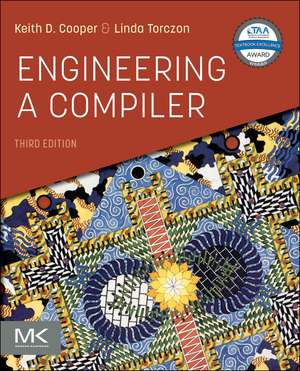
Engineering a Compiler
Autor Keith D. Cooper, Linda Torczonen Limba Engleză Paperback – 21 noi 2022
Engineering a Compiler, Third Edition covers the latest developments in compiler technology, with new chapters focusing on semantic elaboration (the problems that arise in generating code from the ad-hoc syntax-directed translation schemes in a generated parser), on runtime support for naming and addressability, and on code shape for expressions, assignments and control-structures. Leading educators and researchers, Keith Cooper and Linda Torczon, have revised this popular text with a fresh approach to learning important techniques for constructing a modern compiler, combining basic principles with pragmatic insights from their own experience building state-of-the-art compilers.
- Presents in-depth treatments of algorithms and techniques used in the front end of a modern compiler
- Pays particular attention to code optimization and code generation, both primary areas of recent research and development
- Focuses on how compilers (and interpreters) implement abstraction, tying the underlying knowledge to students’ own experience and to the languages in which they have been taught to program
- Covers bottom-up methods of register allocation at the local scope
Preț: 506.14 lei
Preț vechi: 835.43 lei
-39%
Puncte Express: 759
Carte tipărită la comandă
Livrare economică 30 noiembrie-14 decembrie
Livrare express 31 octombrie-06 noiembrie pentru 230.54 lei
Livrare prin curier în România Termenul estimat este afișat lângă disponibilitate.
Transport gratuit pentru acest produs Plată online sau ramburs, în funcție de opțiunile comenzii.
Retur gratuit în 14 zile Comandă securizată și suport în română.
Specificații
ISBN-13: 9780128154120
ISBN-10: 0128154128
Pagini: 848
Dimensiuni: 191 x 235 x 34 mm
Greutate: 1.27 kg
Ediția:3
Editura: ELSEVIER SCIENCE
ISBN-10: 0128154128
Pagini: 848
Dimensiuni: 191 x 235 x 34 mm
Greutate: 1.27 kg
Ediția:3
Editura: ELSEVIER SCIENCE
V-ar putea interesa
-
 -40%Preț: 496.15 lei825.63 lei
 -
 -20%Preț: 209.98 lei262.47 lei
 -
 Modern Software EngineeringDavid Farley-20%Preț: 224.19 lei280.23 lei
 -
 Essentials of CompilationJeremy G. Siek-21%Preț: 339.77 lei432.05 lei
 -
 -22%Preț: 339.50 lei432.64 lei
 -
 Structure and Interpretation of Computer Programs, second editionGerald Jay Sussman-20%Preț: 552.67 lei690.84 lei
 -
 Programming Language PragmaticsMichael Scott-40%Preț: 488.30 lei808.04 lei
 -
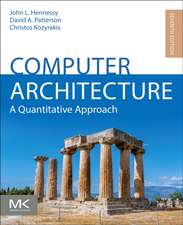 Computer Architecture: A Quantitative ApproachJohn L. Hennessy-39%Preț: 539.69 lei882.55 lei
 -
 Code Complete: A practical handbook of software constructionSteve McConnell-20%Preț: 287.39 lei359.24 lei
 -
 Sipser, M: Introduction to the Theory of ComputationMichael (Massachusetts Institute of Technology) Sipser-23%Preț: 645.30 lei834.40 lei
 -
 CompilersAlfred V. Aho-20%Preț: 637.81 lei797.26 lei
 -
 Computer Systems: A Programmer's Perspective, Global EditionRandal E. Bryant-20%Preț: 652.59 lei815.74 lei
 -
 Coding For Dummies, All New EditionPaul McFedries-20%Preț: 116.94 lei146.18 lei
 -
 Write Great Code, Volume 2, 2nd EditionRandall Hyde-27%Preț: 267.82 lei367.09 lei
 -
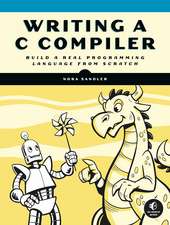 -34%Preț: 362.53 lei551.12 lei
 -
 Introduction to Computer Organization: ARM EditionRobert G. Plantz-35%Preț: 303.72 lei468.10 lei
 -
 -36%Preț: 236.32 lei367.47 lei
 -
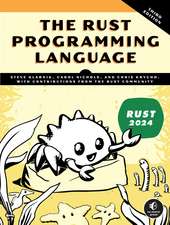 The Rust Programming Language, 3rd EditionCarol Nichols-34%Preț: 292.45 lei444.81 lei
 -
 -20%Preț: 321.81 lei402.26 lei
 -
 .NET 10 RevealedKajetan Duszy¿ski-20%Preț: 240.60 lei300.75 lei
Public țintă
Primarily graduate, some undergraduate students in computer science; professional compiler writers, system software developers, architects and computer system designersCuprins
1. Overview of Compilation
2. Scanners
3. Parsers
4. Intermediate Representations
5. Syntax-Driven Translation
6. Implementing Procedures
7. Code Shape
8. Introduction to Optimization
9. Data-Flow Analysis
10. Scalar Optimization
11. Instruction Selection
12. Instruction Scheduling
13. Register Allocation
14. Runtime Optimization
2. Scanners
3. Parsers
4. Intermediate Representations
5. Syntax-Driven Translation
6. Implementing Procedures
7. Code Shape
8. Introduction to Optimization
9. Data-Flow Analysis
10. Scalar Optimization
11. Instruction Selection
12. Instruction Scheduling
13. Register Allocation
14. Runtime Optimization