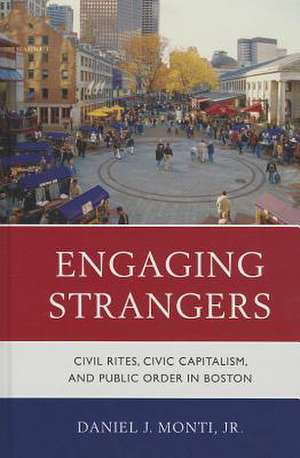
Engaging Strangers: Civil Rites, Civic Capitalism, and Public Order in Boston
Autor Daniel J. Monti Jr.en Limba Engleză Hardback – 19 dec 2012
There's some unexpected good news, however, and it's coming from one of the last places in America you'd expect different people to be getting along: Boston. Bostonians - well known for their unwelcoming and sometimes violent treatment of newcomers and unwillingness to find common ground with people deemed outsiders - aren't acting broken or taking their resentments out on each other these days. They've turned instead to calmer ways of talking about each other and treating each other in public. Far from being disconnected and afraid, people in Boston are better connected and more respectful of each other, and their city is better organized and more orderly than at any time in its long and storied history. Bostonians have learned to get along with the strangers among them in ways their ancestors never knew or expected the rest of us would be willing to entertain much less master. They have their civic act together.
Engaging Strangers explores how the people of Boston have learned to practice a more congenial and respectful set of civic virtues. In this book, the author provides a model for civic conduct for the rest of America to study and follow.
Preț: 633.75 lei
Preț vechi: 958.73 lei
-34%
Puncte Express: 951
Carte tipărită la comandă
Livrare economică 07-21 decembrie
Livrare prin curier în România Termenul estimat este afișat lângă disponibilitate.
Transport gratuit pentru acest produs Plată online sau ramburs, în funcție de opțiunile comenzii.
Retur gratuit în 14 zile Comandă securizată și suport în română.
Specificații
ISBN-13: 9781611475913
ISBN-10: 1611475910
Pagini: 281
Dimensiuni: 153 x 235 x 26 mm
Greutate: 0.52 kg
Editura: Bloomsbury Publishing
Colecția Fairleigh Dickinson University Press
Locul publicării:New York, United States
ISBN-10: 1611475910
Pagini: 281
Dimensiuni: 153 x 235 x 26 mm
Greutate: 0.52 kg
Editura: Bloomsbury Publishing
Colecția Fairleigh Dickinson University Press
Locul publicării:New York, United States
Cuprins
Table of Contents
Foreword: "Engaging Strangers and the Banality of Civility" by Zane Miller
Preface
Chapter 1: "Lost in Boston"
Chapter 2: Boston by the Numbers
Chapter 3: Brahmins Don't Eat Here Anymore
Chapter 4: Ritualized Crises and Institutional Strangers
Chapter 5: Neighbors Make Good Fences
Chapter 6: The Enchanted Trolley Tour
Chapter 7: "At First We Were Just Civic Friends"
Chapter 8: A Crowded Mother's Day on the Leonard P. Zakim Bunker Hill Bridge
Chapter 9: Boston's Tribes
Chapter 10: The Leisure of the Theory Class
Foreword: "Engaging Strangers and the Banality of Civility" by Zane Miller
Preface
Chapter 1: "Lost in Boston"
Chapter 2: Boston by the Numbers
Chapter 3: Brahmins Don't Eat Here Anymore
Chapter 4: Ritualized Crises and Institutional Strangers
Chapter 5: Neighbors Make Good Fences
Chapter 6: The Enchanted Trolley Tour
Chapter 7: "At First We Were Just Civic Friends"
Chapter 8: A Crowded Mother's Day on the Leonard P. Zakim Bunker Hill Bridge
Chapter 9: Boston's Tribes
Chapter 10: The Leisure of the Theory Class
Recenzii
Observers of urban sociology and politics have long lamented the disorder and alienation that prevails in US cities. Monti challenges this view in his study of "civil rites" and "civic capitalism" in contemporary Boston. Traditionally, Boston's Brahmins, the wealthy and well-educated white upper class, took the lead in civic projects, and other residents simply followed the Brahmins, if they paid attention at all. While traditional conflicts continue to resound in the city's politics, other actors, notably the business community and institutions like the Catholic Church, have steadily cultivated a civic culture in which residents of varied income levels and ethnic identities focus on what they have in common more than on what divides them. Businesses, in particular, are more inclined to treat all citizens as actual or potential customers, and those citizens learn to conduct themselves in credible and credit-worthy ways. Monti thus holds that the civil culture has become more "bourgeois" in the full span of the interactions. Whether this is also occurring in other cities is outside his research, and this offers an agenda for other urbanists to explore and critique. Summing Up: Recommended. Upper-division undergraduate, graduate, research, and professional collections.