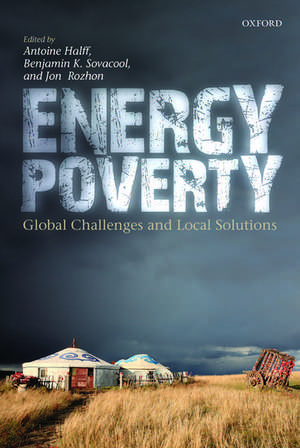
Energy Poverty: Global Challenges and Local Solutions
Editat de Antoine Halff, Benjamin K. Sovacool, Jon Rozhonen Limba Engleză Hardback – 27 noi 2014
Recomandăm Energy Poverty ca pe un instrument de lucru esențial pentru oricine activează în domeniul dezvoltării economice. Pe linia analitică a lucrării Energy, Poverty, and Development, dar cu un focus accentuat pe soluții locale aplicabile și studii de caz de la firul ierbii, acest volum editat de Antoine Halff, Benjamin K. Sovacool și Jon Rozhon depășește simpla constatare a unei crize globale. În timp ce alte titluri similare, precum International Energy and Poverty, se concentrează pe integrarea abordărilor fragmentate, lucrarea de față oferă un „tool kit” pragmatic, fiind parțial manual de teren și parțial analiză economică.
Considerăm că forța acestui volum rezidă în rigoarea datelor: cele 83 de figuri și 70 de tabele fundamentează o strategie clară pentru combaterea sărăciei energetice. Cititorul va învăța cum să măsoare progresul politicilor de acces la energie și, mai important, va înțelege ce a funcționat și ce a eșuat în experiențele naționale ale Chinei sau ale statelor africane, relatate direct de oficiali și reglementatori locali. Structura este una orientată spre rezultate, împărțită între benchmark-uri necesare, analize istorice și opțiuni de implementare rapidă.
Într-un context marcat de schimbări climatice și resurse finite, Energy Poverty demonstrează că extinderea rețelelor moderne de energie nu este doar un imperativ moral, ci o necesitate economică globală. Tonul este unul autoritar și documentat, transformând o problemă umanitară complexă într-o serie de pași acționabili pentru economiști și antreprenori.
Preț: 852.18 lei
Preț vechi: 990.91 lei
-14%
Carte tipărită la comandă
Livrare economică 28 mai-03 iunie
Specificații
ISBN-10: 0199682364
Pagini: 476
Ilustrații: 83 Figures, 70 Tables, 6 Boxes
Dimensiuni: 162 x 240 x 30 mm
Greutate: 0.86 kg
Editura: OUP OXFORD
Colecția OUP Oxford
Locul publicării:Oxford, United Kingdom
V-ar putea interesa
-
 Common WealthJeffrey SachsPreț: 89.83 lei
 -
 Preț: 174.18 lei
 -
 How Economics Can Save the WorldErik Angner-27%Preț: 59.98 lei81.87 lei
 -
 Measuring Poverty around the WorldAnthony B. AtkinsonPreț: 209.07 lei
 -
 The Poverty of GrowthOlivier De SchutterPreț: 97.38 lei
 -
 PovertyRuth ListerPreț: 152.92 lei
 -
 Energy SecurityRoland DannreutherPreț: 134.95 lei
 -
 Energy and DevelopmentFrauke UrbanPreț: 352.69 lei
 -
 Preț: 214.73 lei
 -
 The Energy FixKarina Antram-36%Preț: 56.85 lei88.40 lei
 -
 What Can We Do?: Climate ChangeKatie Dicker-38%Preț: 48.55 lei78.22 lei
 -
 Power Trip: The Story of EnergyMichael E. Webber-32%Preț: 124.22 lei181.43 lei
 -
 -26%Preț: 77.34 lei104.52 lei
 -
 Moral Case For Fossil FuelsAlex Epstein-26%Preț: 135.53 lei181.97 lei
 -
 Climate and EnergyE. Calvin BeisnerPreț: 169.87 lei
 -
 -20%Preț: 93.76 lei116.94 lei
 -
 Roelen, K: Empathy FixKeetie RoelenPreț: 124.25 lei
 -
 Global Energy Transition and Sustainable Development Challenges, Vol. 1Tessaleno Devezas-18%Preț: 750.78 lei915.58 lei
 -
 -18%Preț: 969.60 lei1182.43 lei
De ce să citești această carte
Credem că această carte este indispensabilă pentru experții în politici publice și economiștii care caută soluții tehnice la criza energetică globală. Veți câștiga o înțelegere profundă a mecanismelor de implementare din piețele emergente și un set de instrumente testate pentru proiecte de dezvoltare durabilă. Este o resursă rară care combină rigoarea academică a editurii OUP OXFORD cu experiența practică a reglementatorilor din teren.
Despre autor
Volumul este coordonat de o echipă de experți de renume mondial în politici energetice. Benjamin K. Sovacool este un cercetător prolific în domeniul tranziției energetice și al justiției climatice, având o experiență vastă în analiza barierelor instituționale în calea energiei regenerabile. Antoine Halff aduce o expertiză valoroasă din perspectiva piețelor globale de energie, fiind anterior analist principal la Agenția Internațională a Energiei (IEA). Jon Rozhon completează echipa cu o perspectivă practică asupra reglementării și consultanței internaționale, asigurând echilibrul dintre teorie și aplicabilitatea politică a acestui manual de referință.
Descriere
Recenzii
... an excellent reference tool
At long last, Energy is receiving the attention it deserves as a key factor in Poverty Alleviation. This means that key concerns in our quest for Sustainable Development, climate, population, environment and health have finally been brought together. Energy Poverty; Global issues, Local Solutions is an excellent resource for the thoughtful analyst and political leader when addressing these crucial challenges for a safe and prosperous future.