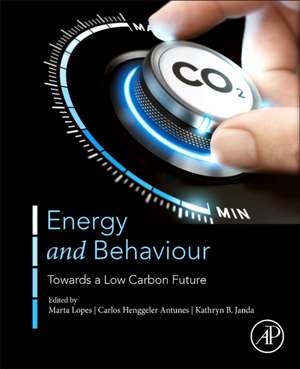
Energy and Behaviour: Towards a Low Carbon Future
Editat de Marta Lopes, Carlos Henggeler Antunes, Kathryn B. Jandaen Limba Engleză Paperback – 25 noi 2019
- Introduces the major disciplinary and interdisciplinary approaches to understanding energy and behaviour
- Delivers a cross-sectoral overview including energy behaviour in buildings, industry, transportation, smart grids, and smart cities
- Reviews a selection of innovative energy behaviour modelling approaches, including agent-based modelling, optimization, and decision support
- Critically addresses the importance of interventions, policies, and regulatory design
Preț: 628.93 lei
Preț vechi: 883.74 lei
-29%
Puncte Express: 943
Carte tipărită la comandă
Livrare economică 20 noiembrie-04 decembrie
Livrare prin curier în România Termenul estimat este afișat lângă disponibilitate.
Transport gratuit pentru acest produs Plată online sau ramburs, în funcție de opțiunile comenzii.
Retur gratuit în 14 zile Comandă securizată și suport în română.
Specificații
ISBN-13: 9780128185674
ISBN-10: 0128185678
Pagini: 558
Ilustrații: 34 illustrations
Dimensiuni: 191 x 235 x 28 mm
Greutate: 0.95 kg
Editura: ELSEVIER SCIENCE
ISBN-10: 0128185678
Pagini: 558
Ilustrații: 34 illustrations
Dimensiuni: 191 x 235 x 28 mm
Greutate: 0.95 kg
Editura: ELSEVIER SCIENCE
V-ar putea interesa
-
 Low-carbon Energy Security from a European PerspectivePatrizia Lombardi-23%Preț: 339.55 lei443.60 lei
 -
 -29%Preț: 527.26 lei741.92 lei
 -
 Energy Policy for PeaceDaniel Kammen-30%Preț: 633.92 lei911.58 lei
 -
 Integrated Microbial Fuel Cells for Wastewater TreatmentRouzbeh Abbassi-26%Preț: 1101.33 lei1486.96 lei
 -
 -9%Preț: 622.13 lei683.66 lei
 -
 -26%Preț: 618.30 lei836.26 lei
 -
 The Regulation and Policy of Latin American Energy TransitionsLucas Noura Guimarães-31%Preț: 623.42 lei899.27 lei
 -
 -24%Preț: 625.58 lei823.84 lei
 -
 The Power of the MineSudeshna Ghosh BanerjeePreț: 242.90 lei
 -
 Governance of Indian State Power UtilitiesSheoli PargalPreț: 239.95 lei
 -
 Preț: 329.60 lei
 -
 Private Participation in the Indian Power SectorMohua MukherjeePreț: 273.05 lei
 -
 Preț: 200.31 lei
 -
 Beyond CrisisMani KhuranaPreț: 234.11 lei
 -
 Le potentiel transformateur de l'industrie minière en AfriqueSudeshna Ghosh BanerjeePreț: 236.12 lei
 -
 Preț: 241.18 lei
 -
 Getting Energy Prices RightIan W. H. Parry-7%Preț: 230.60 lei246.92 lei
 -
 EXXONNeela BanerjeePreț: 40.07 lei
 -
 Evolutionary Multi-Criterion OptimizationAntónio Gaspar-CunhaPreț: 401.91 lei
 -
 Multiobjective Linear and Integer ProgrammingCarlos Henggeler Antunes-15%Preț: 723.99 lei851.75 lei
 -
 Power PricesLea Bloechlinger-8%Preț: 574.51 lei624.47 lei
 -
 Reconstruction of China's Low-Carbon City Evaluation Indicator System: A Methodological Guide for ApplicationsJiahua (Intergovernmental Panel on Climate Change) Pan-15%Preț: 692.31 lei814.47 lei
 -
 Singapore in a Post-Kyoto WorldTilak DoshiPreț: 252.70 lei
Cuprins
1. Energy and behaviour: Challenges of a low-carbon future
PART 1: Understanding energy behaviour: Disciplinary approaches and beyond
1.1 Psychology and energy conservation: Contributions from theory and practice
1.2 Behavioural economics for energy and climate change policies and the transition to a sustainable energy use - A Scandinavian perspective
1.3 Beyond energy behaviour: A broader way to see people for climate change technology planning
Part 2: Energy behaviour across sectors
2.1 Resource-efficient nondomestic buildings: Intertwining behaviours and technology
2.2 The challenge of improving energy efficiency in the building sector: Taking an in-depth look at decision-making on investments in energy-efficient refurbishments
2.3 Reframing energy efficiency in industry: A discussion of definitions, rationales and management practices
2.4 What do we know about the role the human dimension plays in shaping a sustainable low-carbon transport transition?
2.5 The impact of the institutional context on the potential contribution of new business models to democratizing the energy system
2.6 Energy, human activity, and knowledge: Addressing smart city challenges
PART 3 - Modelling energy behaviour
3.1 Energy and enjoyment: The value of household electricity consumption
3.2 Developing quantitative insights on building occupant behaviour: Supporting modelling tools and datasets
3.3 Agent-based modelling of the social dynamics of energy end use
3.4 Preference elicitation approaches for energy decisions
PART 4 - Promoting behaviour change
4.1 A critical review of energy behaviour change: The influence of context.
4.2 Urban low-carbon futures: Results from real-world lab experiment in Berlin
4.3 Overview of the European Union policies to promote more sustainable behaviours in energy end-users
4.4. A brief history of behaviour in US energy programs: Landscape, integration, and future opportunities
PART 1: Understanding energy behaviour: Disciplinary approaches and beyond
1.1 Psychology and energy conservation: Contributions from theory and practice
1.2 Behavioural economics for energy and climate change policies and the transition to a sustainable energy use - A Scandinavian perspective
1.3 Beyond energy behaviour: A broader way to see people for climate change technology planning
Part 2: Energy behaviour across sectors
2.1 Resource-efficient nondomestic buildings: Intertwining behaviours and technology
2.2 The challenge of improving energy efficiency in the building sector: Taking an in-depth look at decision-making on investments in energy-efficient refurbishments
2.3 Reframing energy efficiency in industry: A discussion of definitions, rationales and management practices
2.4 What do we know about the role the human dimension plays in shaping a sustainable low-carbon transport transition?
2.5 The impact of the institutional context on the potential contribution of new business models to democratizing the energy system
2.6 Energy, human activity, and knowledge: Addressing smart city challenges
PART 3 - Modelling energy behaviour
3.1 Energy and enjoyment: The value of household electricity consumption
3.2 Developing quantitative insights on building occupant behaviour: Supporting modelling tools and datasets
3.3 Agent-based modelling of the social dynamics of energy end use
3.4 Preference elicitation approaches for energy decisions
PART 4 - Promoting behaviour change
4.1 A critical review of energy behaviour change: The influence of context.
4.2 Urban low-carbon futures: Results from real-world lab experiment in Berlin
4.3 Overview of the European Union policies to promote more sustainable behaviours in energy end-users
4.4. A brief history of behaviour in US energy programs: Landscape, integration, and future opportunities