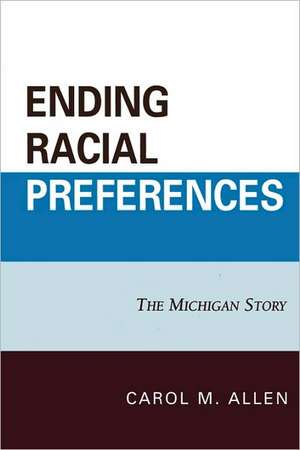
Ending Racial Preferences: The Michigan Story: Bloomsbury Studies in Political Communication
Editat de Carol M. Allen Contribuţii de William B. Allen, Barbara J. Grutteren Limba Engleză Paperback – 16 apr 2009
Ending Racial Preferences opens with a review of the campaigns for and against similar initiatives in California, Florida, Washington, and the city of Houston. The book then delivers an in-depth historical account of the MCRI-from its inception in 2003 through the first year following its passage in 2006. Readers are invited to decide for themselves whether affirmative action preferences are good for America. Carol M. Allen reproduces the remarks delivered at a TAFM debate, along with a compilation of pro and con responses by 14 experts to 50 questions about preferences. This book will be of interest to those working in the fields of public policy and state politics.
Din seria Bloomsbury Studies in Political Communication
- nou
 Preț: 550.97 lei
 - 29%
 Preț: 345.19 lei
 - 37%
 Preț: 658.57 lei
 - 24%
 Preț: 307.73 lei
 - 23%
 Preț: 334.48 lei
 - 35%
 Preț: 594.56 lei
 - 37%
 Preț: 659.73 lei
 - 23%
 Preț: 321.15 lei
 - 29%
 Preț: 344.27 lei
 - 23%
 Preț: 322.08 lei
 - 29%
 Preț: 345.39 lei
 - 29%
 Preț: 345.30 lei
 - 31%
 Preț: 404.27 lei
 - 33%
 Preț: 355.87 lei
 - 33%
 Preț: 640.50 lei
 - 29%
 Preț: 342.12 lei
 - 37%
 Preț: 659.45 lei
 - 24%
 Preț: 369.30 lei
 - 27%
 Preț: 353.58 lei
 - 29%
 Preț: 343.67 lei
 - 29%
 Preț: 343.67 lei
 - 28%
 Preț: 351.97 lei
 - 23%
 Preț: 329.78 lei
 - 36%
 Preț: 521.72 lei
 - 23%
 Preț: 336.84 lei
 - 23%
 Preț: 320.91 lei
 - 29%
 Preț: 344.70 lei
 - 35%
 Preț: 593.49 lei
 - 29%
 Preț: 344.06 lei
 - 23%
 Preț: 312.75 lei
 - 27%
 Preț: 354.59 lei
 - 25%
 Preț: 306.14 lei
 - 29%
 Preț: 343.37 lei
 - 22%
 Preț: 338.89 lei
 - 29%
 Preț: 342.63 lei
 - 29%
 Preț: 340.06 lei
Preț: 373.38 lei
Preț vechi: 543.49 lei
-31%
Puncte Express: 560
Carte tipărită la comandă
Livrare economică 07-21 decembrie
Livrare prin curier în România Termenul estimat este afișat lângă disponibilitate.
Transport gratuit de la 400.00 lei Plată online sau ramburs, în funcție de opțiunile comenzii.
Retur gratuit în 14 zile Comandă securizată și suport în română.
Specificații
ISBN-13: 9780739124345
ISBN-10: 073912434X
Pagini: 440
Dimensiuni: 154 x 232 x 32 mm
Greutate: 0.66 kg
Editura: Bloomsbury Publishing
Colecția Lexington Books
Seria Bloomsbury Studies in Political Communication
Locul publicării:New York, United States
ISBN-10: 073912434X
Pagini: 440
Dimensiuni: 154 x 232 x 32 mm
Greutate: 0.66 kg
Editura: Bloomsbury Publishing
Colecția Lexington Books
Seria Bloomsbury Studies in Political Communication
Locul publicării:New York, United States
V-ar putea interesa
-
 The Great DivideJoseph E. Stiglitz-28%Preț: 78.61 lei108.44 lei
 -
 What's Wrong with Fat?Abigail C. Saguy-15%Preț: 217.26 lei254.38 lei
 -
 Bottlenecks: A New Theory of Equal OpportunityJoseph Fishkin-31%Preț: 393.69 lei567.57 lei
 -
 Cut AdriftMarianne CooperPreț: 167.94 lei
 -
 Preț: 249.45 lei
 -
 Feeling the UnthinkableDonald GutierrezPreț: 116.77 lei
 -
 Preț: 183.28 lei
 -
 DispatcherMark GevisserPreț: 178.20 lei
 -
 Turning the TideAngela V. JohnPreț: 148.45 lei
Cuprins
Chapter 1 Contents
Chapter 2 Foreword
Chapter 3 Preface
Chapter 4 Acknowledgments
Chapter 5 1 What Came Before
Chapter 6 2 Creating a Fair Michigan, Part I: The Ballot Petition Process
Chapter 7 3 Creating a Fair Michigan, Part II: The Election Campaigns
Chapter 8 4 The Debates: A Simple Dialogue
Chapter 9 5 "Ask the Experts": Questions from the Debates
Chapter 10 6 What Followed?
Chapter 11 7 Moving from Diversity to Inclusion: The Way Forward
Chapter 12 Appendix I: Debates Sponsored by Toward A Fair Michigan
Chapter 13 Appendix II: Audience Feedback from the TAFM Debates
Chapter 14 Appendix III: Brief of Amicus Curiae
Chapter 15 Bibliography
Chapter 16 About the Author and Contributor
Chapter 2 Foreword
Chapter 3 Preface
Chapter 4 Acknowledgments
Chapter 5 1 What Came Before
Chapter 6 2 Creating a Fair Michigan, Part I: The Ballot Petition Process
Chapter 7 3 Creating a Fair Michigan, Part II: The Election Campaigns
Chapter 8 4 The Debates: A Simple Dialogue
Chapter 9 5 "Ask the Experts": Questions from the Debates
Chapter 10 6 What Followed?
Chapter 11 7 Moving from Diversity to Inclusion: The Way Forward
Chapter 12 Appendix I: Debates Sponsored by Toward A Fair Michigan
Chapter 13 Appendix II: Audience Feedback from the TAFM Debates
Chapter 14 Appendix III: Brief of Amicus Curiae
Chapter 15 Bibliography
Chapter 16 About the Author and Contributor
Recenzii
Ending Racial Preferences: The Michigan Story tells how determined citizens mobilized to end racial preferences despite the opposition of every civic and political institution in the state. The success of the Michigan Civil Rights Initiative vindicates Allen's belief in the ability of democratic institutions to withstand the pressures of modern interest group politics.
This book tells one of the great 'David vs. Goliath' stories in modern Michigan politics. The odds that Towards a Fair Michigan had to overcome were truly overwhelming; no matter where you stand on Affirmative Action, you will get a real education from reading how this small, tightly-organized group managed to win.
Two virtues give this book extraordinary value. It provides a wealth of accurate and little-known detail about the origin and passage of the Michigan Civil Rights Initiative-an authoritative account that will never be matched. It also provides an inspiring model for the working of democracy. Ordinary citizens may collectively, as Aristotle wrote and Carol Allen shows, achieve surpassing wisdom "when they meet together."
Carol Allen has written a scholarly yet absorbing account of the scorching battle to end Michigan's use of race-based preferences in university admissions, hiring and contracting, including her own efforts to inject a degree of civility and rationality into the campaign. But she sees clearly that the success of the ballot measure in Michigan is only a beginning: she argues persuasively for substituting a vision of "inclusiveness" for policies based on increasingly narrow-minded notions of multiculturalism and diversity.
This book tells one of the great 'David vs. Goliath' stories in modern Michigan politics. The odds that Towards a Fair Michigan had to overcome were truly overwhelming; no matter where you stand on Affirmative Action, you will get a real education from reading how this small, tightly-organized group managed to win.
Two virtues give this book extraordinary value. It provides a wealth of accurate and little-known detail about the origin and passage of the Michigan Civil Rights Initiative-an authoritative account that will never be matched. It also provides an inspiring model for the working of democracy. Ordinary citizens may collectively, as Aristotle wrote and Carol Allen shows, achieve surpassing wisdom "when they meet together."
Carol Allen has written a scholarly yet absorbing account of the scorching battle to end Michigan's use of race-based preferences in university admissions, hiring and contracting, including her own efforts to inject a degree of civility and rationality into the campaign. But she sees clearly that the success of the ballot measure in Michigan is only a beginning: she argues persuasively for substituting a vision of "inclusiveness" for policies based on increasingly narrow-minded notions of multiculturalism and diversity.