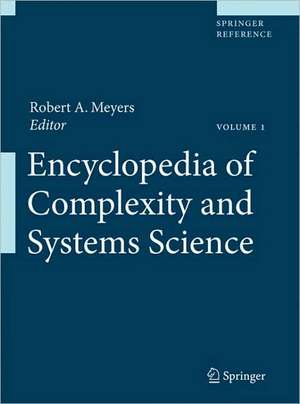
Encyclopedia of Complexity and Systems Science
en Limba Engleză Hardback – apr 2009
Recomandăm Encyclopedia of Complexity and Systems Science cercetătorilor, studenților avansați și practicienilor din inginerie sau științe fundamentale care au nevoie de o resursă de referință exhaustivă pentru modelarea sistemelor non-liniare. Publicată de Springer, această lucrare în format Hardback reușește să sintetizeze instrumente și măsuri esențiale — de la dinamica turbulentă și procese stocastice până la rețele neurale și automate celulare — într-un singur corpus de cunoștințe. Descoperim aici o abordare care transcende barierele disciplinare clasice, oferind un cadru teoretic solid pentru fenomene diverse, precum sustenabilitatea ecosistemelor, managementul traficului sau dinamica piețelor financiare. Structura acestei ediții din 2009 este concepută pentru a evidenția modul în care structurile subiacente comune pot fi utilizate pentru a transfera metode de analiză dintr-un domeniu în altul. Reținem integrarea riguroasă a conceptelor de sinergetică și auto-organizare, aplicate unor probleme contemporane presante, cum ar fi limitele longevității umane sau predictibilitatea dezastrelor naturale. Această enciclopedie completează perspectiva oferită de Unifying Themes in Complex Systems de Ali A. Minai, adăugând o rigoare metodologică de tip referențial și o acoperire mult mai vastă a fundamentelor matematice față de abordările centrate pe conferințe. În timp ce Thinking in Complexity de Klaus Mainzer propune o analiză mai degrabă conceptuală și filosofică, enciclopedia de față se concentrează pe instrumentele de lucru și aplicabilitatea lor tehnică în cercetarea de vârf, fiind o investiție durabilă pentru orice bibliotecă universitară sau departament de cercetare.
Preț: 4193.47 lei
Preț vechi: 5113.99 lei
-18%
Carte disponibilă
Livrare economică 18 noiembrie-02 decembrie
Specificații
ISBN-10: 0387758887
Pagini: 398
Ilustrații: MCXX, 10398 p. In 14 volumes, not available separately.
Dimensiuni: 400 x 450 x 285 mm
Greutate: 30 kg
Ediția:2009 edition
Editura: Springer
Locul publicării:New York, NY, United States
V-ar putea interesa
-
 Snow Avalanches: Beliefs, Facts, and ScienceFrancois Louchet-21%Preț: 402.54 lei506.54 lei
 -
 Renormalization Methods: A Guide For BeginnersWilliam David McComb-12%Preț: 277.69 lei316.68 lei
 -
 Statistical PhysicsClaudine HermannPreț: 409.18 lei
 -
 Semiclassical Dynamics and RelaxationD S F Crothers-18%Preț: 945.58 lei1153.15 lei
 -
 Introduction to Nonextensive Statistical Mechanics: Approaching a Complex WorldConstantino Tsallis-15%Preț: 599.41 lei705.19 lei
 -
 -15%Preț: 555.93 lei654.03 lei
 -
 The Structure and Dynamics of CitiesMarc Barthélemy-11%Preț: 610.83 lei686.34 lei
 -
 Fractional Diffusion Equations and Anomalous DiffusionLuiz Roberto Evangelista-11%Preț: 682.25 lei766.58 lei
 -
 Perspectives on Statistical ThermodynamicsYoshitsugu Oono-11%Preț: 559.55 lei628.70 lei
 -
 Extreme Environmental EventsRobert A. Meyers-18%Preț: 1987.26 lei2423.49 lei
 -
 Complex Systems in Finance and EconometricsRobert A. Meyers-23%Preț: 3000.91 lei3897.29 lei
 -
 -15%Preț: 607.14 lei714.27 lei
 -
 Modeling Complex PhenomenaLui Lam-15%Preț: 645.56 lei759.48 lei
 -
 Computational ComplexityRobert A. Meyers-20%Preț: 9052.85 lei11316.06 lei
 -
 Mathematics of Complexity and Dynamical SystemsRobert A. Meyers-24%Preț: 2054.50 lei2703.28 lei
 -
 Predicting the FutureHenry Abarbanel-15%Preț: 667.41 lei785.19 lei
 -
 Microstates, Entropy and QuantaDon Koks-15%Preț: 625.95 lei736.42 lei
 -
 Theoretical Physics 8Wolfgang Nolting-15%Preț: 630.56 lei741.84 lei
 -
 Lattice Models for Fluctuating Hydrodynamics in Granular and Active MatterAlessandro Manacorda-15%Preț: 665.43 lei782.86 lei
 -
 -18%Preț: 986.57 lei1203.13 lei
 -
 The Application of EconophysicsHideki Takayasu-18%Preț: 951.64 lei1160.53 lei
 -
 THERMAL FLUCTUATIONS AND RELAXATION PROCESSES IN NANOMAGNETSYuri P Kalmykov & Serg William T Coffey-18%Preț: 1069.91 lei1304.76 lei
Public țintă
ResearchDe ce să citești această carte
Această lucrare se adresează cercetătorilor care caută un fundament teoretic și tehnic unitar pentru studiul sistemelor complexe. Cititorul câștigă acces la o sinteză a metodelor analitice aplicabile în fizică, biologie, economie și informatică. Este un instrument esențial pentru a înțelege mecanismele auto-organizării și pentru a aborda riguros fenomenele non-liniare, oferind claritate într-un domeniu vast și interdisciplinar.
Despre autor
Lucrarea este publicată de Springer, o editură de renume mondial specializată în literatură academică și științifică. Enciclopedia reunește contribuții de la experți de top în teoria sistemelor, cibernetică și științe complexe. Colectivul editorial a selectat tematici care acoperă întreg spectrul cercetării moderne, de la algoritmi genetici la neuroștiințe cognitive, asigurând o rigoare academică specifică publicațiilor de referință din domeniul științelor exacte și al ingineriei de sistem.
Descriere scurtă
Recenzii
Notă biografică
Dr Meyers conceived and has served as Editor-in-Chief of the Academic Press (now Elsevier) Encyclopedia of Physical Science and Technology. This is an 18-volume publication of 780 twenty-page articles written to an audience of university students and practicing professionals. This encyclopedia, first published in 1987, was very successful, and because of this, was revised and reissued in 1992 as a second edition. The Third Edition was published in 2001 and is now on-line. Dr Meyers has completed two editions of the Encyclopedia of Molecular Cell Biology and Molecular Medicine for Wiley VCH publishers (1995 and 2004). These cover molecular and cellular level genetics, biochemistry, pharmacology, diseases and structure determination as well as cell biology. His eight-volume Encyclopedia of Environmental Analysis and Remediation was published in 1998 by John Wiley & Sons and his 15- volume Encyclopedia of Analytical Chemistry was published in 2000, also by John Wiley & Sons.
Dr. Meyers has worked with more than 20 Nobel laureates during his career.