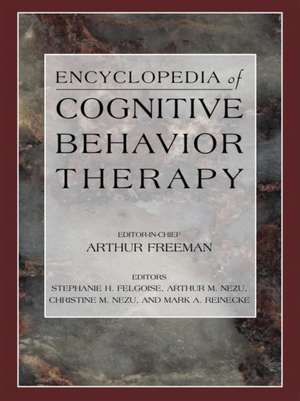
Encyclopedia of Cognitive Behavior Therapy
Editat de Stephanie Felgoise, Arthur M Nezu, Christine M Nezu, Mark A Reineckeen Limba Engleză Hardback – 19 aug 2005
Descoperim în Encyclopedia of Cognitive Behavior Therapy un instrument de lucru robust, prezentat într-un format Hardback generos, organizat alfabetic pentru a facilita accesul rapid la informații clinice esențiale. Lucrarea, coordonată de Stephanie Felgoise și Arthur M Nezu, funcționează ca un compendiu de înțelepciune clinică, oferind nu doar descrieri teoretice, ci și o rețea densă de indexare încrucișată care permite navigarea între diagnostice, metode de tratament și populații specifice. Notăm cu interes prefața semnată de Aaron T. Beck, care validează această sinteză a diversității terapiei cognitiv-comportamentale. Pe linia clinică a volumului Handbook of Cognitive Behavioral Therapy de Amy Wenzel, dar cu un accent pronunțat pe formatul de enciclopedie care permite consultarea punctuală, această ediție Springer US integrează contribuții de la nume sonore precum Marsha Linehan (pentru terapia dialectic-comportamentală) și Edna Foa (pentru intervenții în traume). Structura este echilibrată între fundamentele tratamentului — precum formularea de caz și relația terapeutică — și aplicații complexe pentru grupuri diverse, de la copii și adolescenți până la veterani și refugiați. Putem afirma că progresia conținutului, de la tulburările de anxietate și depresie la probleme emergente precum dependența de internet, oferă o imagine de ansamblu exhaustivă asupra evoluției domeniului. Fiecare secțiune este susținută de date empirice actualizate la nivelul anului 2005, fiind o resursă stabilă pentru practicienii care caută protocoale de intervenție verificate și o bibliografie de referință pentru aprofundare.
Preț: 2056.64 lei
Preț vechi: 2164.89 lei
-5%
Carte tipărită la comandă
Livrare economică 16-30 iunie
Specificații
ISBN-10: 030648580X
Pagini: 452
Ilustrații: VIII, 452 p.
Dimensiuni: 219 x 283 x 33 mm
Greutate: 1.12 kg
Ediția:2005 edition
Editura: Springer Us
Locul publicării:New York, NY, United States
V-ar putea interesa
-
 Cognitive Therapy and the Emotional DisordersAaron T Beck-35%Preț: 57.62 lei88.84 lei
 -
 Oxford Guide to Behavioural Experiments in Cognitive TherapyJames Bennett-Levy-22%Preț: 388.34 lei495.53 lei
 -
 Handbooks of Cognitive Behavioral TherapyColin R. Martin-26%Preț: 1888.98 lei2569.43 lei
 -
 -5%Preț: 574.48 lei604.72 lei
 -
 Cognitive Behavioral Group TherapyIngrid Sochting-23%Preț: 595.45 lei773.31 lei
 -
 The Wiley Handbook of Cognitive Behavioral Therapy, 3 Volume SetStefan G. Hofmann-26%Preț: 2473.58 lei3347.26 lei
 -
 -5%Preț: 386.19 lei406.52 lei
 -
 -5%Preț: 288.18 lei303.34 lei
 -
 -5%Preț: 245.94 lei258.89 lei
 -
 Treating OCD in Children and Adolescents: A Cognitive-Behavioral ApproachMartin E. Franklin-5%Preț: 329.40 lei346.74 lei
 -
 Cognitive Behavior Therapy, Third Edition: Basics and BeyondJudith S. Beck-5%Preț: 463.75 lei488.16 lei
 -
 -5%Preț: 794.15 lei835.95 lei
 -
 Handbook of Cognitive-Behavioral Therapies, Fourth EditionKeith S. Dobson-5%Preț: 401.21 lei422.32 lei
 -
 Cognitive-Behavioral Therapy of Addictive DisordersBruce S. LiesePreț: 342.31 lei
 -
 An Introduction to Cognitive Behaviour TherapyHelen Kennerley-5%Preț: 350.42 lei368.86 lei
 -
 -5%Preț: 583.39 lei614.10 lei
 -
 -5%Preț: 614.06 lei646.39 lei
 -
 Cognitive Therapy of Anxiety Disorders: Science and PracticeDavid A. Clark-5%Preț: 505.64 lei532.25 lei
 -
 Cognitive Behavioural Therapy (Cbt)Elaine Iljon ForemanPreț: 68.54 lei
Public țintă
Professional/practitionerDe ce să citești această carte
Această enciclopedie este esențială pentru psihologii clinicieni și educatorii care au nevoie de o resursă de referință rapidă și autoritară. Cititorul câștigă acces la expertiza colectivă a fondatorilor CBT, primind ghidaj concret pentru o gamă vastă de patologii. Este un volum ideal pentru biblioteca oricărui cabinet de psihoterapie, oferind rigoare academică și soluții practice imediate într-un singur loc.
Despre autor
Editorii acestui volum, Stephanie Felgoise, Arthur M Nezu, Christine M Nezu și Mark A Reinecke, sunt figuri proeminente în psihologia clinică americană. Arthur M Nezu și Christine M Nezu sunt recunoscuți internațional pentru dezvoltarea terapiei prin rezolvarea de probleme (Problem-Solving Therapy) și pentru contribuțiile lor vaste în medicina comportamentală. Stephanie Felgoise și Mark A Reinecke aduc o expertiză valoroasă în psihopatologia copilului și adolescentului, precum și în formarea clinică. Împreună, acești editori au reușit să coordoneze o echipă de experți de talie mondială pentru a crea un standard în literatura de specialitate dedicată terapiilor cognitiv-comportamentale.
Descriere scurtă
With a preface by Aaron T. Beck, founder of the cognitive approach, the Encyclopedia features entries by noted experts including Arthur Freeman, Windy Dryden, Marsha Linehan, Edna Foa, and Thomas Ollendick to name but a few, and reviews the latest empirical data on first-line therapies and combination approaches, to give readers both insights into clients’ problems and the most effective treatments available.
• Common disorders and conditions: anxiety, depression,
OCD, phobias, sleep disturbance, eating disorders, grief, anger
• Essential components of treatment: the therapeutic relationship,
case formulation, homework, relapse prevention
• Treatment methods: dialectical behavior therapy, REBT,
paradoxical interventions, social skills training, stress inoculation,
play therapy, CBT/medicine combinations
• Applications of CBT with specific populations: children,
adolescents, couples, dually diagnosed clients, the elderly,
veterans, refugees
• Emerging problems: Internet addiction, chronic pain, narcolepsy
pathological gambling, jet lag
All entries feature reference lists and are cross-indexed.
The Encyclopedia of Cognitive Behavior Therapy capably fills practitioners’ and educators’ needs for an idea book, teaching text, or quick access to practical, workable interventions.
Cuprins
Recenzii
"Readers interested in gaining information on ‘mainstream’ cognitive behavior theory (CBT) topics … will not be disappointed. However, the diversity of topics covered is broad enough that those interested in topics outside the mainstream are not likely to be disappointed either. Even seasoned CBT clinicians and researchers are likely to find applications of CBT in this volume that are new to them. … it provides information of interest to a wide range of readers – from novices to experts." (Christina S. McCrea, PsycCRITIQUES, Vol. 51 (8), 2006)
"Cognitive Behavior therapy (CBT) has been reported to be among the most widely practiced therapy techniques in the United States. … At approximately 450 pages, the encyclopedia is concise in size, yet comprehensive in scope. … A list of references for further research is provided at the end of every article. … it provides an excellent and broad overview and would fit the needs of students, therapists, or patients who wish to learn more about the applications of cognitive behavior therapy." (Lorraine Evans, ARBA online, March, 2007)
Notă biografică
work at Teachers College-Columbia University. He studied at the Alfred Adler Institute in New York under Drs. Kurt and Alexandra Adler, the Institute for Rational Living under Dr. Albert Ellis, and completed a Postdoctoral Fellowship at the Center for
Cognitive Therapy at the University of Pennsylvania under Dr. Aaron T. Beck.
In addition to 50+ book chapters, reviews and journal articles, he has published twenty three professional books on the topic of CBT including: Cognitive Therapy of Personality Disorders (with Aaron T. Beck), Clinical Applications of Cognitive Therapy, The Comprehensive Casebook of Cognitive Therapy (with Frank Dattilio). Dr. Arthur Freeman has published two popular books, Woulda, Coulda, Shoulda: Overcoming Mistakes and Missed Opportunities (with Rose DeWolf) and The Ten Dumbest Mistakes Smart People Make, and How to Overcome Them (with Rose DeWolf). His work has been translated into Bulgarian, Chinese, Dutch, German, Italian, Japanese, Portuguese, Spanish, and Swedish. Dr. Freeman serves on the editorial boards of several U.S. and international journals.
He is board certified in Clinical Psychology, Family Therapy and Behavioral Psychology by the American Board of Professional Psychology. Art Freeman is a Fellow of the American Psychological Association (divisions of Clinical Psychology, Psychotherapy, and Family Psychology), of the American Psychological Society, of the Academy of Clinical Psychology, and of the Pennsylvania Psychological Association. Dr. Freeman is a past president of the Association for Advancement of Behavior Therapy and is the Vice President (2000-2002) of the North American Society of Adlerian Psychology.
In 2000, the Pennsylvania Psychological Association named him recipient of its award for "Outstanding Contribution to the Science and Practice of Psychology." Dr. Arthur Freeman has been a Visiting Professor of Psychiatry and Psychology at the Universities of Umea and Gothenburg (Sweden); at the University of Catania (Italy), at the Shanghai Second Medical University (China). He has lectured in twenty five countries over the past 20 years.