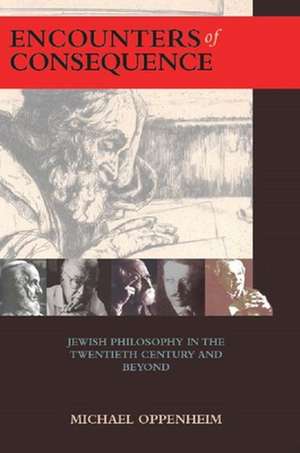
Encounters of Consequence: Jewish Philosophy in the Twentieth Century and Beyond
Autor Michael Oppenheimen Limba Engleză Hardback – oct 2009
Preț: 864.68 lei
Preț vechi: 1122.95 lei
-23%
Puncte Express: 1297
Carte tipărită la comandă
Livrare economică 20 noiembrie-04 decembrie
Livrare prin curier în România Termenul estimat este afișat lângă disponibilitate.
Transport gratuit pentru acest produs Plată online sau ramburs, în funcție de opțiunile comenzii.
Retur gratuit în 14 zile Comandă securizată și suport în română.
Specificații
ISBN-13: 9781934843673
ISBN-10: 1934843679
Pagini: 432
Dimensiuni: 156 x 234 x 28 mm
Greutate: 0.77 kg
Ediția:New.
Editura: Academic Studies Press
Colecția Academic Studies Press
Locul publicării:Boston, MA, United States
ISBN-10: 1934843679
Pagini: 432
Dimensiuni: 156 x 234 x 28 mm
Greutate: 0.77 kg
Ediția:New.
Editura: Academic Studies Press
Colecția Academic Studies Press
Locul publicării:Boston, MA, United States
V-ar putea interesa
-
 -27%Preț: 80.24 lei109.89 lei
 -
 The Definition of Anti-SemitismKenneth L. Marcus-11%Preț: 340.85 lei382.27 lei
 -
 -24%Preț: 192.53 lei253.67 lei
 -
 Goodbye East EndDavid MerronPreț: 114.49 lei
 -
 Jewish Philosophy and Psychoanalysis: Narrating the InterhumanMichael Oppenheim-33%Preț: 608.93 lei911.64 lei
 -
 Preț: 429.60 lei
 -
 -19%Preț: 454.27 lei560.83 lei
 -
 New DiasporaVictoria AaronsPreț: 315.32 lei
 -
 Will to FreedomEgon BalasPreț: 155.02 lei
 -
 Jews and Genes: The Genetic Future in Contemporary Jewish ThoughtRabbi Elliot N. DorffPreț: 333.42 lei
 -
 The Rag RaceAdam D MendelsohnPreț: 246.55 lei
 -
 -34%Preț: 383.45 lei579.32 lei
 -
 Questions Jews AskMordecai M. Kaplan-38%Preț: 418.45 lei674.13 lei
 -
 The Greater Judaism in Making: A Study of Modern Evolution of JudaismMordecai M. Kaplan-24%Preț: 511.47 lei677.29 lei
 -
 -23%Preț: 784.54 lei1018.88 lei
 -
 -15%Preț: 644.10 lei757.76 lei
 -
 -26%Preț: 549.82 lei740.50 lei
 -
 -26%Preț: 594.50 lei800.90 lei
 -
 -26%Preț: 547.92 lei739.26 lei
 -
 -25%Preț: 508.34 lei678.57 lei
Cuprins
Preface. I. Challenges and Responses. 1. Some Underlying Issues of Modern Jewish Philosophy. 2. Does Judaism Have Universal Significance? II. Philosophers of Encounter. Franz Rosenzweig. 3. Death and the Fear of Death in Franz Rosenzweig’s The Star of Redemption. 4. The Halevi Book. 5. Into Life: Rosenzweig’s Essays on God, Man and the World. Martin Buber 6. The Meaning of Hasidism: Martin Buber and Gershom Scholem. 7. Autobiography and the Becoming of the Self: Martin Buber and Joseph Campbell. Emmanuel Levinas. 8. Franz Rosenzweig and Emmanuel Levinas: A Midrash or Thought-Experiment. 9. Welcoming the Other: The Philosophical Foundation for Pluralism in the Works of Charles Davis and Emmanuel Levinas. III. Jewish Philosophers in the Late Twentieth Century. 10. Joseph B. Soloveitchik and Soren Kierkegaard: Reflections on “The Lonely Man of Faith”. 11. Eliezer Schweid: The First Israeli Philosopher. 12. Can We Still Stay With Him?: Two Jewish Theologians Confront the Holocaust (Emil Fackenheim and Arthur Cohen). 13. Theology and Community: The Work of Emil Fackenheim. 14. Irving Greenberg: A Jewish Dialectic of Hope. 15. Feminist Jewish Philosophy: A Response. Bibliography.
Recenzii
“This book of essays is in Michael Oppenheim’s distinctive voice—intelligent, insightful, and sensitive to all the important issues. Always informed and thoughtful, Oppenheim brings out the best in his subjects. In his criticism, he always seeks to illuminate rather than score points, and in dealing with some of the significant thinkers of our time he makes a valuable and important contribution to all who are interested in modern Jewish thought."
“Interweaving earlier articles into a new whole, Michael Oppenheim’s book advances and enhances each of his areas of focus: modern Jewish thought, philosophy, and feminism. A study of fascinating originality, Oppenheim explores conceptions of self and the self’s relations to others from the vantage point of the formative twentieth-century Jewish philosophers. Ultimately, it is Oppenheim’s measured sensibilities of comparison and rapprochement that make this volume valuable and unique.”
“Michael Oppenheim’s Encounters of Consequence is a wonderful collection of essays showcasing the principal Jewish philosophers of the modern period. He brings these thinkers into dialogue with others, highlighting some of the critical issues of our time. In translating their insights for our mutual understanding, discussion, and critique, Oppenheim opens a parallel door to the transformative critique of feminist theory and philosophy.”
"The 'encounters' to which Oppenheim (religion, Concordia U., Montreal) refers are ones between Jewish tradition and modernity, history, and other philosophies. In this collection of 15 articles — most previously published — major modern Jewish philosophers address issues with universal implications. Among those discussing questions of Jewish identity, faith, and the challenges of secularism, the Holocaust, and religious pluralism are Martin Buber, Gerhom Scholem, and Irving Greenberg. Differing views are presented, e.g., between Buber and Scholem on Hasidism. Prominent Jewish and non-Jewish thinkers are partnered in dialogs: e.g., Joseph Soloveitchik and Kierkegaard on "the lonely man of faith." The final chapter is devoted to Jewish feminist perspectives on justice, relationships, and gendered 'God talk.'"
"This collection of 15 reprinted articles by Oppenheim (Concordia Univ., Montreal) provides a scholarly introduction to major philosophers and events in Jewish philosophy from the 20th century to the present. The chapters define objectives, currents, and limits of modern Jewish thought on such relevant issues as Jewish fate and faith; the relationship between Jewish identity and Jewish law; Holocaust destruction and Zionist rebirth; and the challenges of feminism, secularism, and religious pluralism. Featured are several chapters dealing with views on God, man, self, and other as expressed in the writings of Franz Rosenzweig, Martin Buber, and Emmanuel Levinas; and reflections on Joseph Soloveitchik's lonely man of faith, Arthur Cohen and Emil Fackenheim's responses to the Shoah, Eliezer Schweid's Zionist philosophy, Irving Greenberg's dialectic of hope, and issues of Jewish feminism. Unfortunately, chapters are reprinted, not re-edited, and redundant thoughts and different spellings for the same word are detectable. Also, the various chapters differ in depth, quality, and relevance, no doubt a reflection of the time, audience, and genre of the original publication. However, in one way or another, the volume reflects adequately and effectively a plurality of approaches in uncovering a Jewish philosophy of encounter. Summing Up: Recommended. Upper-level undergraduates through researchers/faculty."
“Interweaving earlier articles into a new whole, Michael Oppenheim’s book advances and enhances each of his areas of focus: modern Jewish thought, philosophy, and feminism. A study of fascinating originality, Oppenheim explores conceptions of self and the self’s relations to others from the vantage point of the formative twentieth-century Jewish philosophers. Ultimately, it is Oppenheim’s measured sensibilities of comparison and rapprochement that make this volume valuable and unique.”
“Michael Oppenheim’s Encounters of Consequence is a wonderful collection of essays showcasing the principal Jewish philosophers of the modern period. He brings these thinkers into dialogue with others, highlighting some of the critical issues of our time. In translating their insights for our mutual understanding, discussion, and critique, Oppenheim opens a parallel door to the transformative critique of feminist theory and philosophy.”
"The 'encounters' to which Oppenheim (religion, Concordia U., Montreal) refers are ones between Jewish tradition and modernity, history, and other philosophies. In this collection of 15 articles — most previously published — major modern Jewish philosophers address issues with universal implications. Among those discussing questions of Jewish identity, faith, and the challenges of secularism, the Holocaust, and religious pluralism are Martin Buber, Gerhom Scholem, and Irving Greenberg. Differing views are presented, e.g., between Buber and Scholem on Hasidism. Prominent Jewish and non-Jewish thinkers are partnered in dialogs: e.g., Joseph Soloveitchik and Kierkegaard on "the lonely man of faith." The final chapter is devoted to Jewish feminist perspectives on justice, relationships, and gendered 'God talk.'"
"This collection of 15 reprinted articles by Oppenheim (Concordia Univ., Montreal) provides a scholarly introduction to major philosophers and events in Jewish philosophy from the 20th century to the present. The chapters define objectives, currents, and limits of modern Jewish thought on such relevant issues as Jewish fate and faith; the relationship between Jewish identity and Jewish law; Holocaust destruction and Zionist rebirth; and the challenges of feminism, secularism, and religious pluralism. Featured are several chapters dealing with views on God, man, self, and other as expressed in the writings of Franz Rosenzweig, Martin Buber, and Emmanuel Levinas; and reflections on Joseph Soloveitchik's lonely man of faith, Arthur Cohen and Emil Fackenheim's responses to the Shoah, Eliezer Schweid's Zionist philosophy, Irving Greenberg's dialectic of hope, and issues of Jewish feminism. Unfortunately, chapters are reprinted, not re-edited, and redundant thoughts and different spellings for the same word are detectable. Also, the various chapters differ in depth, quality, and relevance, no doubt a reflection of the time, audience, and genre of the original publication. However, in one way or another, the volume reflects adequately and effectively a plurality of approaches in uncovering a Jewish philosophy of encounter. Summing Up: Recommended. Upper-level undergraduates through researchers/faculty."