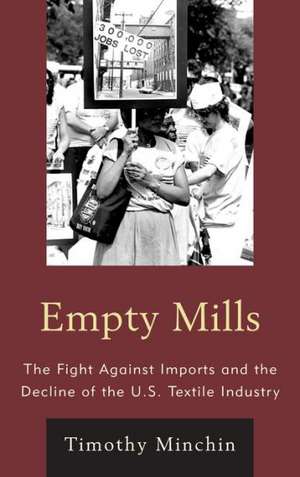
Empty Mills: The Fight Against Imports and the Decline of the U.S. Textile Industry
Autor Timothy J. Minchinen Limba Engleză Hardback – 19 dec 2012
Preț: 679.72 lei
Preț vechi: 1054.48 lei
-36%
Puncte Express: 1020
Carte tipărită la comandă
Livrare economică 26 noiembrie-10 decembrie
Livrare prin curier în România Termenul estimat este afișat lângă disponibilitate.
Transport gratuit pentru acest produs Plată online sau ramburs, în funcție de opțiunile comenzii.
Retur gratuit în 14 zile Comandă securizată și suport în română.
Specificații
ISBN-13: 9781442220829
ISBN-10: 1442220821
Pagini: 333
Ilustrații: 11 BW Photos
Dimensiuni: 161 x 237 x 29 mm
Greutate: 0.61 kg
Editura: Bloomsbury Publishing
Colecția Rowman & Littlefield
Locul publicării:New York, United States
ISBN-10: 1442220821
Pagini: 333
Ilustrații: 11 BW Photos
Dimensiuni: 161 x 237 x 29 mm
Greutate: 0.61 kg
Editura: Bloomsbury Publishing
Colecția Rowman & Littlefield
Locul publicării:New York, United States
Cuprins
Introduction
Chapter 1: A Troubled Industry in an Era of Prosperity
Chapter 2: Mobilizing Against the Import Threat
Chapter 3: Import Escalation and the Build-Up to H.R. 1562
Chapter 4: The Most Important Battle: The Fight to Pass the 1985 Textile Bill
Chapter 5: A Resounding Blow: The 1987 and 1990 Textile Bills
Chapter 6: "Us is Spelled U.S.": The Crafted with Pride in the USA Campaign
Chapter 7: Looking Beyond Our Borders: The Industry in the Era of NAFTA and GATT
Chapter 8: A Tidal Wave: The Collapse of the Industry in the New Millennium
Chapter 9: Fighting Back: Lowell, Massachusetts and the Long Battle against Deindustrialization in the North
Chapter 10: "It Knocked This City to Its Knees": A Case Study of Deindustrialization in Kannapolis, North Carolina
Epilogue
Bibliography
Chapter 1: A Troubled Industry in an Era of Prosperity
Chapter 2: Mobilizing Against the Import Threat
Chapter 3: Import Escalation and the Build-Up to H.R. 1562
Chapter 4: The Most Important Battle: The Fight to Pass the 1985 Textile Bill
Chapter 5: A Resounding Blow: The 1987 and 1990 Textile Bills
Chapter 6: "Us is Spelled U.S.": The Crafted with Pride in the USA Campaign
Chapter 7: Looking Beyond Our Borders: The Industry in the Era of NAFTA and GATT
Chapter 8: A Tidal Wave: The Collapse of the Industry in the New Millennium
Chapter 9: Fighting Back: Lowell, Massachusetts and the Long Battle against Deindustrialization in the North
Chapter 10: "It Knocked This City to Its Knees": A Case Study of Deindustrialization in Kannapolis, North Carolina
Epilogue
Bibliography
Recenzii
Historian Minchin (La Trobe Univ., Australia) provides a thoroughly documented study about one of the lesser-known and most disastrous stories of America's deindustrialization--the decline and fall of the textile industry. Textile manufacturing was the nation's first industry, early in New England and later in the South, employing many thousands of people, mostly in small cities. Because of this, small cities were devastated when a mill closed. Little attention was given in the media to the mill closings in small cities, as opposed to the wide media coverage of layoffs in large cities like Detroit and Pittsburgh. In addition to these mills' being the major employer in a small city, a great proportion of the workers were women and blacks. Minchin also reports on the unsuccessful efforts to save the industry through union compromises and employer organization, to no avail. The effects of imports, trade deals such as NAFTA, and automation are discussed in detail. The book concludes with two microeconomic studies, one in the North and one in the South, of cities that were devastated and their efforts to recover. Abundant footnotes; exhaustive bibliography. Summing Up: Recommended.
Minchin makes a convincing case. His research is thorough, combining oral history interviews with research in the papers of textile-state politicians, newspaper accounts, and a substantial peek into the secondary literature of the field. The book provides well-footnoted support for the conventional wisdom, familiar to most residents of the textile South, of the negative impact of deindustrialization on communal and personal levels. Minchin tells his story with clarity and a certain verve. ... Minchin writes with clarity, and his research is solid. It provides a valuable addition and source of information about Washington, D.C.'s wrangling with the imports and a working depiction of the functions of deindustrialization. The book is useful for scholars of American deindustrialization in the post- World War II South. For graduate seminars it should provide a very good tool for discussions about methodology and the mentality of historians' tasks.
Competition from low-priced imports has been a major cause of job losses and plant closures in American manufacturing since the 1960s. Alfred E. Eckes, Jr., Judith Stein, Dana Frank, and other authors have profitably explored the impact of imports. Still, the subject has not received the attention it deserves within the expanding historical literature on deindustrialization. Timothy J. Minchin's highly worthwhile Empty Mills helps fill the gap. ... Empty Mills is lucidly written. . . . The volume is based on comprehensive research, including multiple interviews conducted by the author. Numerous passages about and in the words of the industries' employees and backers poignantly capture the plight of displaced operatives and shuttered mill towns. Sections of the book would work well with undergraduates. 'Protectionism' is practically a dirty word in educated society today across the spectrum from left to right. Empty Mills presents a convincing argument that the nation's commitment to free trade should be comprehensively rethought.
Empty Mills demonstrates the devastating impact of the demise of the U.S. textile and garment industries on workers and communities and tells the story of the curious cross-class campaigns that tried-and ultimately failed-to preserve U.S. jobs using import controls. This is a tragic cautionary tale for working people and unions in the neoliberal era.
Minchin makes a convincing case. His research is thorough, combining oral history interviews with research in the papers of textile-state politicians, newspaper accounts, and a substantial peek into the secondary literature of the field. The book provides well-footnoted support for the conventional wisdom, familiar to most residents of the textile South, of the negative impact of deindustrialization on communal and personal levels. Minchin tells his story with clarity and a certain verve. ... Minchin writes with clarity, and his research is solid. It provides a valuable addition and source of information about Washington, D.C.'s wrangling with the imports and a working depiction of the functions of deindustrialization. The book is useful for scholars of American deindustrialization in the post- World War II South. For graduate seminars it should provide a very good tool for discussions about methodology and the mentality of historians' tasks.
Competition from low-priced imports has been a major cause of job losses and plant closures in American manufacturing since the 1960s. Alfred E. Eckes, Jr., Judith Stein, Dana Frank, and other authors have profitably explored the impact of imports. Still, the subject has not received the attention it deserves within the expanding historical literature on deindustrialization. Timothy J. Minchin's highly worthwhile Empty Mills helps fill the gap. ... Empty Mills is lucidly written. . . . The volume is based on comprehensive research, including multiple interviews conducted by the author. Numerous passages about and in the words of the industries' employees and backers poignantly capture the plight of displaced operatives and shuttered mill towns. Sections of the book would work well with undergraduates. 'Protectionism' is practically a dirty word in educated society today across the spectrum from left to right. Empty Mills presents a convincing argument that the nation's commitment to free trade should be comprehensively rethought.
Empty Mills demonstrates the devastating impact of the demise of the U.S. textile and garment industries on workers and communities and tells the story of the curious cross-class campaigns that tried-and ultimately failed-to preserve U.S. jobs using import controls. This is a tragic cautionary tale for working people and unions in the neoliberal era.