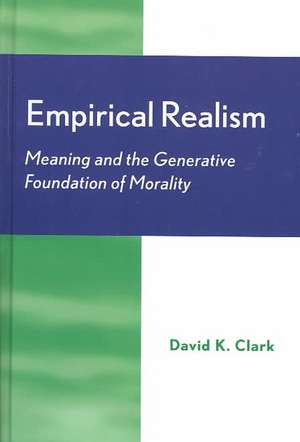
Empirical Realism: Meaning and the Generative Foundation of Morality
Autor David Clarken Limba Engleză Hardback – 25 noi 2003
Preț: 711.55 lei
Preț vechi: 1116.02 lei
-36%
Puncte Express: 1067
Carte tipărită la comandă
Livrare economică 20 noiembrie-04 decembrie
Livrare prin curier în România Termenul estimat este afișat lângă disponibilitate.
Transport gratuit pentru acest produs Plată online sau ramburs, în funcție de opțiunile comenzii.
Retur gratuit în 14 zile Comandă securizată și suport în română.
Specificații
ISBN-13: 9780739107669
ISBN-10: 0739107666
Pagini: 417
Dimensiuni: 158 x 236 x 36 mm
Greutate: 0.81 kg
Editura: Bloomsbury Publishing
Colecția Lexington Books
Locul publicării:New York, United States
ISBN-10: 0739107666
Pagini: 417
Dimensiuni: 158 x 236 x 36 mm
Greutate: 0.81 kg
Editura: Bloomsbury Publishing
Colecția Lexington Books
Locul publicării:New York, United States
V-ar putea interesa
-
 -33%Preț: 1218.71 lei1813.45 lei
 -
 -27%Preț: 807.96 lei1107.44 lei
 -
 Cicely Saunders: Selected writings 1958-2004Cicely Saunders-26%Preț: 873.50 lei1181.23 lei
 -
 Urban World/Global CityDavid Clark-15%Preț: 423.54 lei498.29 lei
 -
 Gender, Space, and Time: Women and Higher EducationDorothy Moss-34%Preț: 585.82 lei883.54 lei
 -
 Ethics Within Reason: A Neo-Gewirthian ApproachEdward Spence-33%Preț: 836.58 lei1247.11 lei
 -
 -18%Preț: 352.54 lei431.19 lei
 -
 Decent PeopleNorman S. CarePreț: 269.64 lei
 -
 From Africa to Zen: An Invitation to World PhilosophyRobert Solomon-24%Preț: 352.54 lei461.94 lei
 -
 -23%Preț: 263.04 lei343.47 lei
 -
 Finding and Confirming TruthJohn S. Pletz-28%Preț: 272.83 lei378.17 lei
 -
 False Truths: The Error of Relying on AuthorityEdward C. Mendler-27%Preț: 269.33 lei368.65 lei
Cuprins
Chapter 1 Introduction and Overview
Chapter 2 In Search of the World Well Lost: Realism vs Antirealism
Chapter 3 The Midas Touch: The Enigma of Empiricism and the Dogma of Pragmatism
Chapter 4 Harnessing the Midas Touch: The World Recovered
Chapter 5 Psychological Meaning: Intrinsic to Internal Processes?
Chapter 6 Enjoying Your Experience and Having It Too
Chapter 7 The Transition to Morality
Chapter 8 The Face of Moral Realism
Chapter 9 Moral Realism Under Fire
Chapter 10 No Exit: The Exclusive Disjunction
Chapter 11 The Marriage of Heaven and Hell: Monism vs Pluralism
Chapter 12 Beyond Focal Things and Practices
Chapter 13 Dignity of Meaning and Being
Chapter 14 Adjudication: Convergence and Vision
Chapter 2 In Search of the World Well Lost: Realism vs Antirealism
Chapter 3 The Midas Touch: The Enigma of Empiricism and the Dogma of Pragmatism
Chapter 4 Harnessing the Midas Touch: The World Recovered
Chapter 5 Psychological Meaning: Intrinsic to Internal Processes?
Chapter 6 Enjoying Your Experience and Having It Too
Chapter 7 The Transition to Morality
Chapter 8 The Face of Moral Realism
Chapter 9 Moral Realism Under Fire
Chapter 10 No Exit: The Exclusive Disjunction
Chapter 11 The Marriage of Heaven and Hell: Monism vs Pluralism
Chapter 12 Beyond Focal Things and Practices
Chapter 13 Dignity of Meaning and Being
Chapter 14 Adjudication: Convergence and Vision
Recenzii
Very few philosophers would take on the scope and reach of this volume. Fewer would manage the task with as much eloquence and elegance as David Clark. Spanning a range of integrated topics in metaphysics, philosophy of mind, and ethics, Clark offers a highly novel and spirited defense of realism which includes substantive discussion of core issues in philosophy of technology and environmental ethics-two topics not usually covered in such conversations. This book will surely thrill some and outrage others. Whatever one's response, the ride Clark takes us on with this ambitious volume is well worth the trip.
David Clark takes up Richard Sylvan's famous challenge to create a new environmental ethic....Additionally, his identification of prohibitions against the destruction of a rich life and the infliction of horrifying experience upon another being seem promising normative principles for the treatment of human and non-human others and go some way towards solving the anthropocentrism problem. As well, those interested in the possibilities for a Heideggerian ethics will find valuable material for reflection here.
David Clark's book is an ambitious and far-reaching defense of a robust form of moral realism. Overall Clark's book engages the contemporary analytic literature in a wide range of key areas, including the latest work on moral realism. His position is novel and challenging, rooted in an abiding respect for our everyday moral experience, yet at the same time sensitive to the ways in which that experience can be corrupted or distorted by culture and moral tradition. His sensibilities are poetic, and his account of the dignity we can discover in the objects of everyday experience is courageous and powerful.
David Clark takes up Richard Sylvan's famous challenge to create a new environmental ethic....Additionally, his identification of prohibitions against the destruction of a rich life and the infliction of horrifying experience upon another being seem promising normative principles for the treatment of human and non-human others and go some way towards solving the anthropocentrism problem. As well, those interested in the possibilities for a Heideggerian ethics will find valuable material for reflection here.
David Clark's book is an ambitious and far-reaching defense of a robust form of moral realism. Overall Clark's book engages the contemporary analytic literature in a wide range of key areas, including the latest work on moral realism. His position is novel and challenging, rooted in an abiding respect for our everyday moral experience, yet at the same time sensitive to the ways in which that experience can be corrupted or distorted by culture and moral tradition. His sensibilities are poetic, and his account of the dignity we can discover in the objects of everyday experience is courageous and powerful.