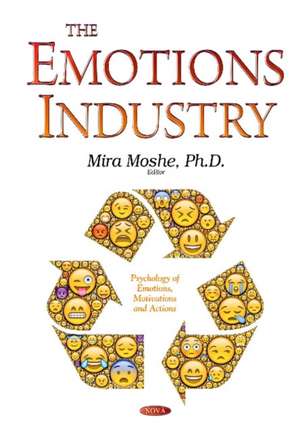
Emotions Industry
Editat de Mira Mosheen Limba Engleză Hardback – sep 2014
Preț: 1197.04 lei
Preț vechi: 1628.51 lei
-26%
Puncte Express: 1796
Carte disponibilă
Livrare economică 31 octombrie-14 noiembrie
Livrare prin curier în România Termenul estimat este afișat lângă disponibilitate.
Transport gratuit pentru acest produs Plată online sau ramburs, în funcție de opțiunile comenzii.
Retur gratuit în 14 zile Comandă securizată și suport în română.
Specificații
ISBN-13: 9781633215665
ISBN-10: 1633215660
Pagini: 325
Dimensiuni: 178 x 254 x 20 mm
Greutate: 0.68 kg
Editura: Nova Science Publishers Inc
Colecția Nova Science Publishers, Inc (US)
Locul publicării:United States
ISBN-10: 1633215660
Pagini: 325
Dimensiuni: 178 x 254 x 20 mm
Greutate: 0.68 kg
Editura: Nova Science Publishers Inc
Colecția Nova Science Publishers, Inc (US)
Locul publicării:United States
V-ar putea interesa
-
 STRESSILIENT PBSam AkbarPreț: 56.95 lei
 -
 Preț: 255.66 lei
 -
 Prospection, well-being, and mental healthAndrew MacLeod-30%Preț: 353.98 lei503.39 lei
 -
 The Oxford Handbook of Emotional DevelopmentDaniel Dukes-32%Preț: 818.09 lei1208.33 lei
 -
 Handbook of Music and Emotion: Theory, Research, ApplicationsPatrik N. Juslin-20%Preț: 533.93 lei668.85 lei
 -
 -31%Preț: 748.17 lei1082.02 lei
 -
 Emotional FreedomJudith OrloffPreț: 95.27 lei
 -
 The Psychology of HappinessMichael Argyle-11%Preț: 364.36 lei409.39 lei
 -
 Loving Nature: Towards an Ecology of EmotionKay MiltonPreț: 449.38 lei
 -
 The EQ Edge - Emotional Intelligence and Your Success 3eHoward E. BookPreț: 143.22 lei
 -
 Preț: 482.05 lei
 -
 The Laws of EmotionNico H. Frijda-5%Preț: 1305.72 lei1374.44 lei
 -
 Living with IntensitySusan DanielsPreț: 162.74 lei
 -
 EmotionsKeith OatleyPreț: 342.27 lei
 -
 Understanding Emotions 2eK Oatley-18%Preț: 913.72 lei1114.30 lei
 -
 Heimweh Bei Kindern Vorbeugen Und VerringernDr Marion SonnenmoserPreț: 62.04 lei
 -
 Walk of ShameMira Moshe-26%Preț: 835.89 lei1136.18 lei
 -
 The Anxiety Check-InBree CartwrightPreț: 79.62 lei
 -
 A Little Book of Self-Care for Those Who GrievePaula BeckerPreț: 96.85 lei
 -
 Depression - Looking Up from the Stubborn DarknessEdward T. WelchPreț: 121.93 lei
 -
 -18%Preț: 750.75 lei915.55 lei
 -
 Affect DynamicsChristian E. Waugh-24%Preț: 1029.61 lei1354.76 lei
 -
 The Handbook of Disgust ResearchPhilip A. Powell-18%Preț: 954.94 lei1164.57 lei
 -
 Preț: 154.73 lei
Descriere
This book deals with the multi-cultural phenomenon of the emotions industry, as well as the cynical manner in which that industry exploits its consumers in various cultures. The book was written in order to illuminate the fact that the culture industry has developed a "new" configuration dominated by the production and distribution of emotions the emotions industry. The emotions industry is an industry that provides an incentive to exaggerate emotions in order to accumulate social, cultural or economic wealth. It endeavors to create emotional needs by connecting between the realization of these needs and consumer culture; by blurring the boundaries between authentic and simulated emotions, between real and imagined authenticity; by encouraging the externalization of inner worlds for financial gain, generating income or any other result; by revealing emotional worlds that gradually become merchandise, an effective and productive means of promoting economic, political, social or cultural processes. Obviously this is only possible on the condition that we are capable of controlling emotional processes, responding or delaying reactions, opening up and including or closing up and excluding our surroundings. This ability to regulate emotions lies at the foundation of the emotions industry, which shapes the interaction between emotion, cognition and behavior, commercial-economic and private interests, social-cultural and spiritual needs. Thus emotional regulation is transformed into a production line of emotional expectations and reactions, which specializes in creating emotional products and marketing them to the public in the framework of mass consumer culture.
Cuprins
Table of Contents:
Introduction: A Profile of the Emotions Industry pp.vii-xv
SECTION I: THE EMOTIONS INDUSTRY - THE CONSTRUCTION OF A ROMANTIC PRODUCTION LINE pp.1-2
Chapter 1: Cellular Branding: The Search for Love via the Emotions Industry
(Mira Moshe, Ariel University, Israel)pp.3-24
Chapter 2: Romance Tourism: The Ultimate Emotions Industry
(Julia Meszaros, Florida International University, FL, US)pp.25-42
Chapter 3: What's The Fighting All About? A Comparison of Reasons for Romantic Conflicts on Television Programs and in the Real World
(Amir Hetsroni and Abira Reizer, Ariel University, Israel)pp.43-58
SECTION II: THE EMOTIONS INDUSTRY – FROM PRODUCTION TO CONSUMPTION OF EMOTIONAL CONTENT pp.59-60
Chapter 4: “The Journalism of Astonishment”: Engaging the Audience Emotionally through Amateur Visuals
(Mervi Pantti, Department of Social Research, Media and Communication Studies, University of Helsinki, Finland)pp.61-78
Chapter 5: The Emotions Industry in Italy: You’ve Got Mail
(Mariolina Graziosi, University of Milan, Italy)pp.79-94
Chapter 6: Eliciting “Kosher Emotions” in Ultra-Orthodox Jewish Women's Film
(Matan Aharoni, Department of Communications, University of Haifa, Israel)pp.95-116
SECTION III: THE EMOTIONS INDUSTRY – MEDIA CONSUMERS’ CONFRONTATION WITH FEAR AND DEATH pp.117-118
Chapter 7: Flirting With Death: Writing As a Mode of Being-In-The-World on an On-Line Suicide Support Forum
(Shirly Bar-Lev, School of Engineering, Ruppin Academic Center, Israel)pp.119-136
Chapter 8: “I Was Really Scared”: A Cross-Cultural Comparison of Reconstructing Childhood’s Fearful Viewing Experiences
(Dafna Lemish and Michal Alon-Tirosh, College of Mass Communication and Media Arts, Southern Illinois University, IL, US and others)pp.137-158
SECTION IV: THE EMOTIONS INDUSTRY - THE POLITICS OF EMOTIONS pp.159-160
Chapter 9: Spectacles for Everyone: Emotions and Politics in Argentina, 2010-2013
(Adrián Scribano and Mira Moshe, National Council of Scientific and
Technological Research (CONICET), Argentina and Ariel University, Israel)pp.161-180
Chapter 10: The Emotions Industry in Online Romanian Politics: Selling Leadership and Trust during the 2012 Parliamentary Campaign
(Florenta Toader, National University of Political Studies and Public Administration, Bucharest, Romania)pp.181-198
SECTION V: THE EMOTIONS INDUSTRY - FASHION AND FASHIONABLE SELF-EXPOSURE pp.199-200
Chapter 11: The Emotions Industry: Celebrities and Self-Confession As a Marketing Strategy
(Mira Moshe, Ariel University, Israel)pp.201-220
Chapter 12: The Emotions Industry: Emotions in Fame
(Samita Nandy, Centre for Media and Celebrity Studies (CMCS), Canada)pp.221-234
Chapter 13: Simmel’s Theory of Fashion As a Hypothesis of Affective Capitalism
(Juhana Venäläinen, University of Eastern Finland, School of Humanities, Finland)pp.235-250