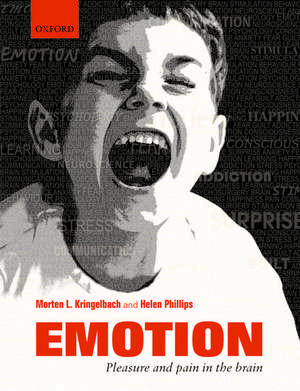
Emotion: Pleasure and Pain in the Brain
Autor Morten Kringelbach, Helen Phillipsen Limba Engleză Paperback – 16 ian 2014
Preț: 347.43 lei
Preț vechi: 445.08 lei
-22%
Puncte Express: 521
Carte disponibilă
Livrare economică 09-15 iulie
Livrare prin curier în România Termenul estimat este afișat lângă disponibilitate.
Transport gratuit de la 400.00 lei Plată online sau ramburs, în funcție de opțiunile comenzii.
Retur gratuit în 14 zile Comandă securizată și suport în română.
Specificații
ISBN-13: 9780199593491
ISBN-10: 0199593493
Pagini: 304
Ilustrații: 120 line art
Dimensiuni: 190 x 247 x 13 mm
Greutate: 0.58 kg
Ediția:01
Editura: OUP OXFORD
Colecția OUP Oxford
Locul publicării:Oxford, United Kingdom
ISBN-10: 0199593493
Pagini: 304
Ilustrații: 120 line art
Dimensiuni: 190 x 247 x 13 mm
Greutate: 0.58 kg
Ediția:01
Editura: OUP OXFORD
Colecția OUP Oxford
Locul publicării:Oxford, United Kingdom
V-ar putea interesa
-
 The Inner Eye: Social Intelligence in EvolutionNicholas Humphrey-19%Preț: 190.72 lei234.02 lei
 -
 -27%Preț: 301.09 lei411.99 lei
 -
 Preț: 218.73 lei
 -
 The End of AdolescencePhilip Graham-19%Preț: 359.23 lei443.35 lei
 -
 -31%Preț: 452.29 lei657.46 lei
 -
 Psychology of the Digital AgeJohn R. SulerPreț: 342.30 lei
 -
 The Beautiful BureaucratHelen PhillipsPreț: 101.60 lei
 -
 Modern Vintage GiftsHelen Philipps-18%Preț: 89.49 lei109.19 lei
 -
 The Psychology of ConflictPaul Randolph-45%Preț: 156.05 lei281.64 lei
Recenzii
An informative text which provides enough information for students to get to grips with the biological aspects of emotion, arranged in a logical and accessible format. It is user friendly and appealing.
A really well written and comprehensive introduction to emotion, covering all the main issues and theories... academically sound, up to date and readable.
A very useful link between neuroscience and the physiology underpinning behaviour and psychology.
A really well written and comprehensive introduction to emotion, covering all the main issues and theories... academically sound, up to date and readable.
A very useful link between neuroscience and the physiology underpinning behaviour and psychology.
Notă biografică
Morten L. Kringelbach, D.Phil., is the director of the Hedonia: TrygFonden Research Group - a transnational research group based in both Oxford, UK and Aarhus, Denmark. He is a Senior Research Fellow in the Department of Psychiatry, University of Oxford and a Professor at Aarhus University, Denmark, as well as Senior Research Fellow and College Lecturer in Neuroscience at The Queen's College, University of Oxford.Dr Helen Phillips is a journalist, writer and consultant, specialising in neuroscience and life sciences, for print, online and broadcast media. Dr Phillips obtained her first degree in Natural Sciences from the University of Cambridge and was awarded a DPhil in Neuroscience from the University of Sussex.