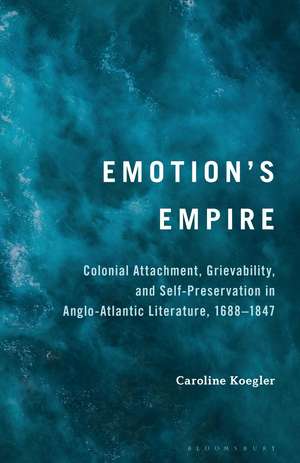
Emotion's Empire: Colonial Attachment, Grievability and Self-Preservation in Anglo-Atlantic Literature, 1688–1847
Autor Caroline Koegleren Limba Engleză Hardback – 4 ian 2027
Re-situating the "grateful slave" trope as part of a larger "colonial attachment narrative," Caroline Koegler broadens understanding of the trope's place within an overarching affective system shaped by imperial patriarchy. Similarly, the concept "affective coverture" is introduced to explore how women's normalized legal inferiority - encapsulated in Blackstone's concept of legal "coverture"-translated into the comparative importance or unimportance of some characters' feelings and well-being.
While Emotion's Empire traces normative ways in which these types of affective allocation and integration unfold, it remains attentive to those moments in a narrative that diverge from or question imperial affective conventions, or carry them into new contexts thereby adding to their proliferation or shifting their dynamics and effects. Indeed, this book teases out how intricately and at times how unevenly or seemingly paradoxically literary texts negotiate imperial affect, reflecting empire's adaptability to different contexts and different agendas during this crucial time in literary history.
The ebook editions of this book are available open access under a CC BY-NC-ND 4.0 licence on bloomsburycollections.com. Open access was funded by Freie Universität Berlin.
Preț: 595.88 lei
Preț vechi: 878.52 lei
-32% Precomandă
Puncte Express: 894
Carte nepublicată încă
Livrare prin curier în România Precomanda se expediază când titlul devine disponibil.
Transport gratuit pentru acest produs Plată online sau ramburs, în funcție de opțiunile comenzii.
Retur gratuit în 14 zile Comandă securizată și suport în română.
Doresc să fiu notificat când acest titlu va fi disponibil:
Se trimite...
Specificații
ISBN-13: 9798216485278
Pagini: 224
Dimensiuni: 152 x 229 mm
Editura: Bloomsbury Publishing
Colecția Bloomsbury Academic
Locul publicării:New York, United States
Pagini: 224
Dimensiuni: 152 x 229 mm
Editura: Bloomsbury Publishing
Colecția Bloomsbury Academic
Locul publicării:New York, United States
Cuprins
Acknowledgements
Theoretical Introduction: Emotion's Empire, 1688-1847
PART ONE: Colonial Attachment Re-Written
1. Archipelagic Feeling in The Woman of Colour (1808): Writing Away From/Towards the Colonial Attachment Narrative
2. A Sea of Troubles: Reading Emily Brontë's Wuthering Heights (1847) as a Hostile Attachment-Takeover
PART TWO: Grievability in Layers
3. Affective Coverture in Sarah Scott's The History of Sir George Ellison (1766), Henry Mackenzie's Julia de Roubigné (1777) and Charlotte Smith's The Story of Henrietta (1800)
4. Affective Anarchitectures in Mary Shelley's Frankenstein (1818) and The Last Man (1826): Ruination and Pandemic Feeling
PART THREE: Self-Preservation in the Transatlantic
5. Un-writing Health: Failed Self-Preservation as Resistance in Olaudah Equiano's Interesting Narrative (1789)
6. Transatlantic Fancies: The Economy of Self-Preservation in Jane Austen's Sanditon (1817)
Conclusion: Reading Multiplicity and Empire-as-Emotion
Theoretical Introduction: Emotion's Empire, 1688-1847
PART ONE: Colonial Attachment Re-Written
1. Archipelagic Feeling in The Woman of Colour (1808): Writing Away From/Towards the Colonial Attachment Narrative
2. A Sea of Troubles: Reading Emily Brontë's Wuthering Heights (1847) as a Hostile Attachment-Takeover
PART TWO: Grievability in Layers
3. Affective Coverture in Sarah Scott's The History of Sir George Ellison (1766), Henry Mackenzie's Julia de Roubigné (1777) and Charlotte Smith's The Story of Henrietta (1800)
4. Affective Anarchitectures in Mary Shelley's Frankenstein (1818) and The Last Man (1826): Ruination and Pandemic Feeling
PART THREE: Self-Preservation in the Transatlantic
5. Un-writing Health: Failed Self-Preservation as Resistance in Olaudah Equiano's Interesting Narrative (1789)
6. Transatlantic Fancies: The Economy of Self-Preservation in Jane Austen's Sanditon (1817)
Conclusion: Reading Multiplicity and Empire-as-Emotion