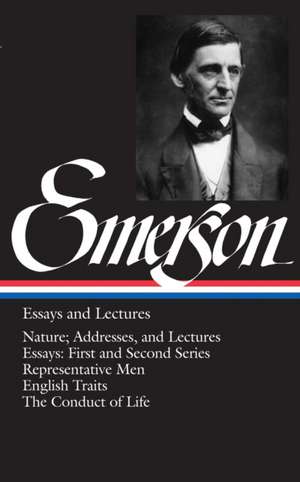
Emerson Essays and Lectures
Autor Ralph Waldo Emersonen Limba Engleză Hardback – 15 noi 1983
Preț: 235.06 lei
Puncte Express: 353
Preț estimativ în valută:
41.54€ • 48.88$ • 36.27£
41.54€ • 48.88$ • 36.27£
Carte disponibilă
Livrare economică 16-30 martie
Specificații
ISBN-13: 9780940450158
ISBN-10: 0940450151
Pagini: 1150
Dimensiuni: 134 x 207 x 37 mm
Greutate: 0.75 kg
Editura: Library of America
Locul publicării:New York, NY, United States
ISBN-10: 0940450151
Pagini: 1150
Dimensiuni: 134 x 207 x 37 mm
Greutate: 0.75 kg
Editura: Library of America
Locul publicării:New York, NY, United States
V-ar putea interesa
-
 The British EmpiricistsStephen PriestPreț: 390.33 lei
 -
 Contemporary Perspectives on Natural Law: Natural Law as a Limiting ConceptAna Marta González-18%Preț: 1203.23 lei1467.35 lei
 -
 -18%Preț: 1193.67 lei1455.70 lei
 -
 The Young Carnap's Unknown Master: Husserl’s Influence on Der Raum and Der logische Aufbau der WeltGuillermo E. Rosado Haddock-18%Preț: 1194.74 lei1457.00 lei
 -
 -28%Preț: 262.59 lei366.17 lei
 -
 The Space of Love and GarbageS Phineas UphamPreț: 244.56 lei
 -
 Preț: 238.87 lei
 -
 Preț: 93.02 lei
 -
 Philosophy of Culture, Schopenhauer and TraditionWolfgang SchirmacherPreț: 245.52 lei
 -
 The Spirit of the AgePaul AshtonPreț: 140.66 lei
 -
 Complete Works of Ralph Waldo Emerson Volume 8Ralph Waldo EmersonPreț: 176.46 lei
 -
 Human QuintessenceSigurd IbsenPreț: 186.36 lei
 -
 Bergson and His PhilosophyJ Alexander GunnPreț: 131.14 lei
 -
 -17%Preț: 194.62 lei233.68 lei
 -
 Die frühen EssaysGeorg Edward Moore-23%Preț: 1110.91 lei1442.73 lei
 -
 Preț: 298.81 lei
 -
 Preț: 77.26 lei
Descriere
The library of America is dedicated to publishing America's best and most significant writing in handsome, enduring volumes, featuring authoritative texts. Hailed as the "finest-looking, longest-lasting editions ever made" (The New Republic), Library of America volumes make a fine gift for any occasion. Now, with exactly one hundred volumes to choose from, there is a perfect gift for everyone.
Notă biografică
Ralph Waldo Emerson, the son of a Unitarian minister and a chaplain during the American Revolution, was born in 1803 in Boston. He attended the Boston Latin School, and in 1817 entered Harvard, graduating in 1820. Emerson supported himself as a schoolteacher from 1821-26. In 1826 he was "approbated to preach," and in 1829 became pastor of the Scond Church (Unitarian) in Boston. That same year he married Ellen Louise Tucker, who was to die of tuberculosis only seventeen months later. In 1832 Emerson resigned his pastorate and traveled to Eurpe, where he met Coleridge, Wordsworth, and Carlyle. He settled in Concord, Massachusetts, in 1834, where he began a new career as a public lecturer, and married Lydia Jackson a year later. A group that gathered around Emerson in Concord came to be known as "the Concord school," and included Bronson Alcott, Henry David Thoreau, Nathaniel Hawthorne, and Margaret Fuller. Every year Emerson made a lecture tour; and these lectures were the source of most of his essays. Nature (1836), his first published work, contained the essence of his transcendental philosophy, which views the world of phenomena as a sort of symbol of the inner life and emphasizes individual freedom and self-reliance. Emerson's address to the Phi Beta Kappa society of Harvard (1837) and another address to the graduating class of the Harvard Divinity School (1838) applied his doctrine to the scholar and the clergyman, provoking sharp controversy. An ardent abolitionist, Emerson lectured and wrote widely against slavery from the 1840's through the Civil War. His principal publications include two volumes of Essays (1841, 1844), Poems (1847), Representative Men (1850), The Conduct of Life (1860), and Society and Solitude (1870). He died of pneumonia in 1882 and was buried in Concord.