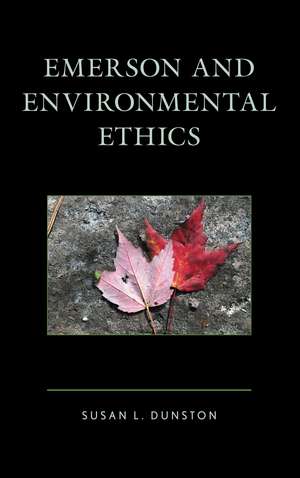
Emerson and Environmental Ethics
Autor Susan Dunstonen Limba Engleză Hardback – 15 sep 2018
| Toate formatele și edițiile | Preț | Express |
|---|---|---|
| Paperback (1) | 241.43 lei 6-8 săpt. | |
| Bloomsbury Publishing – 11 mai 2021 | 241.43 lei 6-8 săpt. | |
| Hardback (1) | 621.00 lei 6-8 săpt. | |
| Bloomsbury Publishing – 15 sep 2018 | 621.00 lei 6-8 săpt. |
Preț: 621.00 lei
Preț vechi: 730.59 lei
-15%
Puncte Express: 932
Preț estimativ în valută:
109.90€ • 128.44$ • 95.42£
109.90€ • 128.44$ • 95.42£
Carte tipărită la comandă
Livrare economică 20 februarie-06 martie
Preluare comenzi: 021 569.72.76
Specificații
ISBN-13: 9781498552967
ISBN-10: 149855296X
Pagini: 152
Dimensiuni: 161 x 230 x 19 mm
Greutate: 0.41 kg
Editura: Bloomsbury Publishing
Colecția Lexington Books
Locul publicării:New York, United States
ISBN-10: 149855296X
Pagini: 152
Dimensiuni: 161 x 230 x 19 mm
Greutate: 0.41 kg
Editura: Bloomsbury Publishing
Colecția Lexington Books
Locul publicării:New York, United States
Cuprins
Chapter 1, Emerson and Environmental Literacy
Original Relation
Environmental Literacy
Chapter 2, Emerson Valuing Nature: Aesthetics and Ethics
Being "A lover of nature"
Being a Writer of Nature
Value Creating: Reading and Writing Nature Fairly
Chapter 3, Emerson and Contemporary Environmentalism
Ecofeminism
Systems Thinking
Indigenous Environmental Philosophy
Philosophy as Activism
Chapter 4, The Garden and the Wilderness
The Politics of Garden and Wilderness in America
Emerson's Garden
Creating with an "Ecological Conscience"
Chapter 5, Emerson and Ahimsa
Ontological Monism
Human Places, Human Perspective
Liberating Words
Mountains
Coda
Original Relation
Environmental Literacy
Chapter 2, Emerson Valuing Nature: Aesthetics and Ethics
Being "A lover of nature"
Being a Writer of Nature
Value Creating: Reading and Writing Nature Fairly
Chapter 3, Emerson and Contemporary Environmentalism
Ecofeminism
Systems Thinking
Indigenous Environmental Philosophy
Philosophy as Activism
Chapter 4, The Garden and the Wilderness
The Politics of Garden and Wilderness in America
Emerson's Garden
Creating with an "Ecological Conscience"
Chapter 5, Emerson and Ahimsa
Ontological Monism
Human Places, Human Perspective
Liberating Words
Mountains
Coda
Recenzii
Emerson and Environmental Ethics is a timely study that lays important groundwork on Emerson and environmentalism. It is responsive to the critical canon and theoretical turns in Emerson studies, but not explicitly so. Beautifully and carefully written, the work itself feels Emersonian with startling turns of phrase and insight.This volume affirms that there is still much to learn from Emerson in our own time of environmental crisis.
Emerson is still vastly under-appreciated as a philosopher and, as Dunston thoroughly shows, must be appreciated as a fundamentally-and foundationally important-environmental thinker.
Ralph Waldo Emerson is often considered essentially a poet, in verse and prose. But Susan Dunston takes him seriously as a philosopher whose environmental ethics influenced such diverse figures as Henry Thoreau, William James, D. T. Suzuki, Aldo Leopold, Loren Eiseley, Annie Dillard, Alan Watts, and E. O. Wilson, and whose ecological concerns are paralleled in contemporary eco-feminism, Indigenous culture, and other forms. Implicit in Emerson's stirring charge to "Build . . . your own world," Dunston shows, is not egoism but rather an ethic of accountability, "that we not harm." Her widely informed, close analyses of Emerson's writings open exciting new contexts for understanding his Transcendentalist manifesto Nature (1836) as well as several of his essential essays. At the same time, her book is a quietly impassioned call for an empathetic sense of "interconnected diversity" and genuine "nature literacy," which are desperately needed for our planet's ecological health.
Susan L. Dunston's Emerson and Environmental Ethics reacquaints readers with Emerson as a brilliant mind in his time and ours. Every chapter is full of surprising insights into his work and its relevance to the most compelling concerns of today.
In this lucid, accessible, and beautifully written account of Emerson's philosophy, Susan Dunston charts a compelling path from Emerson's unifying vision to much later environmental philosophies. Her magnificent close readings reveal a writer equally committed to a philosophical thinking that is "sensuous, experiential, and reformist" and a practice that is "attentive, relational, empathetic, and aesthetically sensitive." Readers of this book will discover a progressive, practical, and influential Emerson who remains the deeply reflective writer we have long known.
Emerson is still vastly under-appreciated as a philosopher and, as Dunston thoroughly shows, must be appreciated as a fundamentally-and foundationally important-environmental thinker.
Ralph Waldo Emerson is often considered essentially a poet, in verse and prose. But Susan Dunston takes him seriously as a philosopher whose environmental ethics influenced such diverse figures as Henry Thoreau, William James, D. T. Suzuki, Aldo Leopold, Loren Eiseley, Annie Dillard, Alan Watts, and E. O. Wilson, and whose ecological concerns are paralleled in contemporary eco-feminism, Indigenous culture, and other forms. Implicit in Emerson's stirring charge to "Build . . . your own world," Dunston shows, is not egoism but rather an ethic of accountability, "that we not harm." Her widely informed, close analyses of Emerson's writings open exciting new contexts for understanding his Transcendentalist manifesto Nature (1836) as well as several of his essential essays. At the same time, her book is a quietly impassioned call for an empathetic sense of "interconnected diversity" and genuine "nature literacy," which are desperately needed for our planet's ecological health.
Susan L. Dunston's Emerson and Environmental Ethics reacquaints readers with Emerson as a brilliant mind in his time and ours. Every chapter is full of surprising insights into his work and its relevance to the most compelling concerns of today.
In this lucid, accessible, and beautifully written account of Emerson's philosophy, Susan Dunston charts a compelling path from Emerson's unifying vision to much later environmental philosophies. Her magnificent close readings reveal a writer equally committed to a philosophical thinking that is "sensuous, experiential, and reformist" and a practice that is "attentive, relational, empathetic, and aesthetically sensitive." Readers of this book will discover a progressive, practical, and influential Emerson who remains the deeply reflective writer we have long known.