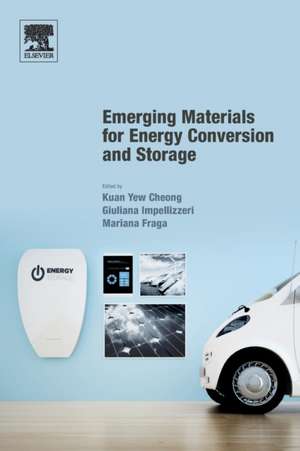
Emerging Materials for Energy Conversion and Storage
Editat de Kuan Yew Cheong, Giuliana Impellizzeri, Mariana Amorim Fragaen Limba Engleză Paperback – 17 aug 2018
The book is an important reference for students and researchers (from academics, but also industry) interested in understanding the properties of emerging materials.
- Explores the fundamentals, challenges and prospects for the application of emerging materials in the development of energy conversion and storage devices
- Presents a discussion of solar cell and photovoltaic, fuel cell, battery electrode, supercapacitor and hydrogen storage applications
- Includes notable examples of energy devices based on emerging materials to illustrate recent advances in this field
Preț: 1221.14 lei
Preț vechi: 1772.94 lei
-31%
Puncte Express: 1832
Carte tipărită la comandă
Livrare economică 24 noiembrie-08 decembrie
Livrare prin curier în România Termenul estimat este afișat lângă disponibilitate.
Transport gratuit pentru acest produs Plată online sau ramburs, în funcție de opțiunile comenzii.
Retur gratuit în 14 zile Comandă securizată și suport în română.
Specificații
ISBN-13: 9780128137949
ISBN-10: 0128137940
Pagini: 488
Dimensiuni: 152 x 229 mm
Greutate: 0.65 kg
Editura: ELSEVIER SCIENCE
ISBN-10: 0128137940
Pagini: 488
Dimensiuni: 152 x 229 mm
Greutate: 0.65 kg
Editura: ELSEVIER SCIENCE
Public țintă
Researchers, engineers, academics, physicists, chemists, and lecturers working in the fields of materials science and energyCuprins
Part 1: Emerging materials for dye-sensitized solar cells and thermoelectrics
1. SnTe: Structure, Synthesis and Thermoelectric properties
2. Metal Oxide Nanoparticles as Electron Transport Layer in Third Generation Solar Cells
Part 2: Emerging materials for electrochemical applications
3. Exploring the properties and fuel cell applications of atomic layer deposited metal oxide ultrathin films
4. Development, Challenges and Prospects of Carbon-Based Electrode for Lithium Air Batteries
Part 3: Emerging materials for supercapacitors
5. Emerging 2D nanomaterials for supercapacitor applications
6. Prospective Synthesis Approaches to Emerging Materials for Supercapacitors
7. Advances in Flexible supercapacitors for portable and wearable smart gadgets
8. Simple Parallel-Plate Capacitors to High–Energy Density Future Supercapacitors: A Materials Review
Part 4: Emerging materials for multifunctional applications in energy conversion and storage
9. Advanced nanocarbon materials for future energy application
Part 5: Emerging materials for hydrogen storage
10. All-metal and Non-metal Aromatic Clusters as Hydrogen and Carbon Monoxide Storage Materials
11. Liquid Phase Chemical Hydrogen Storage: From Recent Developments to Future Objectives
12. Recent progresses on the Mg-Co-H and Mg-Fe-H systems for hydrogen storage applications
13. A systematic approach to the synthesis, thermal stability and hydrogen storage properties of rare earth borohydrides
1. SnTe: Structure, Synthesis and Thermoelectric properties
2. Metal Oxide Nanoparticles as Electron Transport Layer in Third Generation Solar Cells
Part 2: Emerging materials for electrochemical applications
3. Exploring the properties and fuel cell applications of atomic layer deposited metal oxide ultrathin films
4. Development, Challenges and Prospects of Carbon-Based Electrode for Lithium Air Batteries
Part 3: Emerging materials for supercapacitors
5. Emerging 2D nanomaterials for supercapacitor applications
6. Prospective Synthesis Approaches to Emerging Materials for Supercapacitors
7. Advances in Flexible supercapacitors for portable and wearable smart gadgets
8. Simple Parallel-Plate Capacitors to High–Energy Density Future Supercapacitors: A Materials Review
Part 4: Emerging materials for multifunctional applications in energy conversion and storage
9. Advanced nanocarbon materials for future energy application
Part 5: Emerging materials for hydrogen storage
10. All-metal and Non-metal Aromatic Clusters as Hydrogen and Carbon Monoxide Storage Materials
11. Liquid Phase Chemical Hydrogen Storage: From Recent Developments to Future Objectives
12. Recent progresses on the Mg-Co-H and Mg-Fe-H systems for hydrogen storage applications
13. A systematic approach to the synthesis, thermal stability and hydrogen storage properties of rare earth borohydrides
Notă biografică
Kuan Yew Cheong received the B. Eng (1st Hons.) in Materials Engineering from Universiti Sains Malaysia (USM), Malaysia in 1997. After graduation, he worked in a project management company and a semiconductor-device manufacturing factory in Malaysia as a project engineer and quality assurance engineer, respectively, before deciding to pursue his postgraduate study. As the Fellow under the Academic Staff Training Scheme of USM, in 2001, he completed his M.Sc. in Materials Engineering (Thin Film Technology) at USM and, in 2004, he graduated with a Ph.D from the School of Microelectronic Engineering, Griffith University, Australia that was fully sponsored by Australian Research Council, USM, and Griffith University Postgraduate Research Scholarship. He worked as a lecturer, Senior Lecturer, and Assoc. Professor at the School of Materials and Mineral Resources Engineering, USM, since November 2004, and was promoted to full Professor in June 2014.
Prof. Cheong's main research area is on semiconductor material and device fabrication for energy related application, electronic packaging, and characterization. Outcomes of his research published in more than 170 high impact-factor journals and 5 book chapters. Currently, he serves as an Editor of Materials Science in Semiconductor Processing and Associate Editor of Physics Express. He also recently edited a book entitled "Two-dimensional Nanostructures for Energy Related Applications". Honoring his excellent contribution in research, the Academy of Sciences Malaysia has accoladed Prof. Cheong with 'Top Research Scientists Malaysia (TRSM) 2013" in 2014. He is a member of Materials Research Society (USA), a Senior Member of the Institute of Electrical, Electronic Engineers (IEEE), and a Fellow of The Institution of Engineers, Malaysia.
Prof. Cheong's main research area is on semiconductor material and device fabrication for energy related application, electronic packaging, and characterization. Outcomes of his research published in more than 170 high impact-factor journals and 5 book chapters. Currently, he serves as an Editor of Materials Science in Semiconductor Processing and Associate Editor of Physics Express. He also recently edited a book entitled "Two-dimensional Nanostructures for Energy Related Applications". Honoring his excellent contribution in research, the Academy of Sciences Malaysia has accoladed Prof. Cheong with 'Top Research Scientists Malaysia (TRSM) 2013" in 2014. He is a member of Materials Research Society (USA), a Senior Member of the Institute of Electrical, Electronic Engineers (IEEE), and a Fellow of The Institution of Engineers, Malaysia.