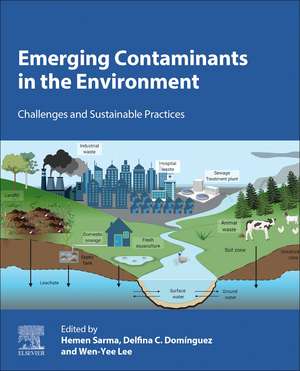
Emerging Contaminants in the Environment: Challenges and Sustainable Practices
Editat de Hemen Sarma, Delfina C. Dominguez, Wen-Yee Leeen Limba Engleză Paperback – 24 ian 2022
Bazându-ne pe bazele de date academice și cercetările recente din domeniul ecologiei industriale, Emerging Contaminants in the Environment reprezintă o sinteză tehnică riguroasă publicată de ELSEVIER SCIENCE. Ne-a atras atenția modul în care editorii Hemen Sarma, Delfina C. Dominguez și Wen-Yee Lee au reușit să ancoreze problematica poluanților emergenți în cadrul celor 17 obiective de dezvoltare durabilă ale ONU. Spre deosebire de alte lucrări teoretice, acest volum de 712 pagini prioritizează datele din studii de caz, oferind o perspectivă aplicată asupra eliminării contaminanților prin practici sustenabile.
Structura editorială este organizată progresiv, începând cu perspectivele actuale asupra solului și apei, continuând cu analiza specifică a medicamentelor anticancer în mediul înconjurător și impactul produselor de îngrijire personală asupra ecosistemelor. Apreciem în mod deosebit capitolul dedicat rezistenței antimicrobiene în apele de coastă, o problemă de sănătate publică majoră tratată aici cu rigoare științifică. Cititorii familiarizați cu New Trends in Emerging Environmental Contaminants de Swatantra P. Singh vor aprecia faptul că acest volum extinde discuția de la metodele de detecție spre soluții concrete de bioremediere și transportul poluanților în sedimente.
Remarcăm evoluția editorială a lui Hemen Sarma; dacă în lucrări precum One- and Two- Dimensional Nanomaterials se concentra pe proprietățile structurale la scară nanometrică, în acest volum utilizează acea expertiză pentru a evalua amenințările reprezentate de nanomaterialele inginerizate în natură. Cele 60 de ilustrații facilitează înțelegerea proceselor complexe de transport și bioacumulare, făcând din acest tratat un instrument de lucru esențial pentru cercetătorii din biotehnologie și științele mediului.
Preț: 797.62 lei
Preț vechi: 1088.99 lei
-27%
Carte tipărită la comandă
Livrare economică 01-15 iunie
Specificații
ISBN-10: 0323851606
Pagini: 712
Ilustrații: 60 illustrations (30 in full color)
Dimensiuni: 191 x 235 mm
Greutate: 1.2 kg
Editura: ELSEVIER SCIENCE
V-ar putea interesa
-
 Sustainable NanotechnologyGovindan ParayilPreț: 503.25 lei
 -
 SnoSverker SorlinPreț: 118.83 lei
 -
 -25%Preț: 1251.57 lei1679.54 lei
 -
 Advances in Environmental Research: Volume 18Justin A Daniels-30%Preț: 670.90 lei958.49 lei
 -
 SunbirthAn YuPreț: 103.11 lei
 -
 Sustainable Agriculture Reviews 50: Emerging Contaminants in AgricultureVipin Kumar Singh-5%Preț: 1067.21 lei1123.38 lei
 -
 Emerging Contaminants Vol. 1: Occurrence and ImpactNadia Morin-Crini-5%Preț: 880.13 lei926.45 lei
 -
 Emerging Contaminants Vol. 2: RemediationNadia Morin-Crini-24%Preț: 812.59 lei1069.20 lei
 -
 -19%Preț: 444.89 lei549.24 lei
 -
 Management and Mitigation of Emerging PollutantsNancy George-18%Preț: 1338.98 lei1632.91 lei
 -
 Advanced Studies on Environmental SustainabilityAhmed J. Obaid-18%Preț: 1349.68 lei1645.95 lei
 -
 -18%Preț: 940.13 lei1146.50 lei
 -
 Pollutants and Recent Trends in Wastewater TreatmentAli Müfit Bahadir-18%Preț: 867.82 lei1058.32 lei
 -
 Sustainable Advanced Technologies for Environmental ManagementDebabrata Mazumder-18%Preț: 1352.99 lei1649.99 lei
 -
 Contaminated Land and WaterHassan Alshemmari-18%Preț: 756.61 lei922.70 lei
 -
 -14%Preț: 829.86 lei964.95 lei
 -
 Bio-Nanomaterials in Environmental RemediationNarendra K. Sharma-23%Preț: 806.55 lei1047.46 lei
 -
 Sustainable NanomaterialsImran Uddin-18%Preț: 1502.53 lei1832.35 lei
Public țintă
Primary: Researchers and academics in environmental science or any researchers needing information on pollutants and remediation practicesSecondary: Researchers, academics, undergraduate and graduate students in Microbiology, Environmental biotechnology, bio-engineering and biomedical sciences, Health, Clinical and Pharmaceutical sciences
De ce să citești această carte
Această lucrare este esențială pentru cercetători și studenți la nivel avansat care caută soluții practice pentru bioremediere. Cititorul câștigă o înțelegere profundă a modului în care produsele farmaceutice și nanomaterialele afectează sănătatea globală, beneficiind de date concrete ancorate în Agenda 2030 a ONU. Este un ghid tehnic ce transformă teoria în strategii de eliminare a poluanților din sol, apă și aer.
Descriere scurtă
This book provides academics, researchers, students, and practitioners interested in the detection and elimination of emerging contaminants from the environment, with the latest advances by leading experts in emerging contaminants the field of environmental sciences.
- Covers most aspects of the most predominant emerging contaminants in the environment, including in soil, air, and water
- Describes the occurrence of these contaminants, the problems they cause, and the sustainable practices to deal with the contaminants
- Includes data from case studies to provide real-world examples of sustainable practices and emerging contaminant remediation
Cuprins
2. Emerging environmental contaminants—current status,challenges, and technological solutions
3. Anticancer drugs in the environment: environmental levels and technological challenges
4. Exposure to 1,4-dioxane and disinfection by-products due to the reuse of wastewater
5. Transport, fate, and bioavailability of emerging pollutants in soil, sediment, and wastewater treatment plants: potential environmental impacts
6. Pharmaceutical and personal care products in the environment: occurrence and impact on the functioning of the ecosystem
7. Excessive pharmaceutical and personal care products in the environment cause life-threatening diseases
8. A broad perspective on antimicrobial resistance in coastal waters
9. Environmental fate and transportation of perfluorinated compounds
10. Engineered nanomaterials: threats, releases, and concentrations in the environment
11. Plastic pollution in marine and freshwater environments: abundance, sources, and mitigation
12. Electronic waste: an emerging contaminant in the geo- environment
13. Effects of pesticides on human physiology, genetics,and evolution
14. Integrative behavioral and ecotoxicological effects of nanoparticles
15. Determination of multiclass emerging contaminants using QuEChERS method
16. Removal of quinolone antibiotics from wastewaters and sewage sludge
17. Chemosensing technology for rapid detection of emerging contaminants
18. Methods of bisphenol A detection by gas chromatography and mass spectrometry (GC-Ms) in human breast milk and foodstuff
19. Microalgae as whole-cell biosensors in the prospective assessment of toxic effects of emerging contaminants
20. The mixture of agricultural pesticides and their impact on populations: bioremediation strategies
21. Assisted and amended technology for the sustainableremediation of emerging contaminants
22. Bioremediation of cytostatic pharmaceutical and personal care products and emerging technologies
23. Removal of antimicrobial resistance determinants from wastewater: a risk perspective on conventional and emerging technologies
24. Novel nanomaterials for nanobioremediation of polyaromatic hydrocarbons