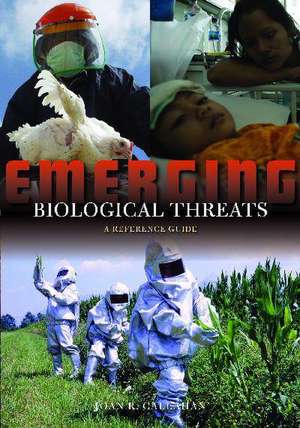
Emerging Biological Threats: A Reference Guide
Autor Joan R. Callahanen Limba Engleză Hardback – 23 dec 2009
What biological agents should we truly be afraid of? Which have garnered more attention than they warrant? Emerging Biological Threats: A Reference Guide is the antidote for the confusion surrounding the potentially devastating impact of pathogens on the human community. Written by a frontline professional in epidemiology, it is the most authoritative yet engagingly written resource available on the real risks we face, and the countermeasures used to confront them.
Emerging Biological Threats provides the information needed to understand significant direct threats to human health, as well as those that impact us indirectly by destroying livestock and crops. Focused primarily on the United States, it offers science-based yet accessible explorations of HIV, influenza, drug-resistant pathogens, tuberculosis, meningitis, and more. In addition, the book assesses current predictions about the future spread of various diseases as a result of climate change and overpopulation. The book concludes with chapters on relevant environmental and sociological trends and a discussion of current public health strategy.
Preț: 386.93 lei
Preț vechi: 407.30 lei
-5%
Puncte Express: 580
Carte tipărită la comandă
Livrare economică 20 noiembrie-04 decembrie
Livrare prin curier în România Termenul estimat este afișat lângă disponibilitate.
Transport gratuit de la 400.00 lei Plată online sau ramburs, în funcție de opțiunile comenzii.
Retur gratuit în 14 zile Comandă securizată și suport în română.
Specificații
ISBN-13: 9780313372094
ISBN-10: 0313372098
Pagini: 344
Dimensiuni: 178 x 254 x 25 mm
Greutate: 0.86 kg
Editura: Bloomsbury Publishing
Colecția Greenwood
Locul publicării:New York, United States
ISBN-10: 0313372098
Pagini: 344
Dimensiuni: 178 x 254 x 25 mm
Greutate: 0.86 kg
Editura: Bloomsbury Publishing
Colecția Greenwood
Locul publicării:New York, United States
V-ar putea interesa
-
 The Nature of Suffering and the Goals of MedicineEric J. Cassell-5%Preț: 356.59 lei375.36 lei
 -
 On BereavementTony Walter-27%Preț: 200.85 lei273.77 lei
 -
 Funding Health CareElias Mossialos-22%Preț: 216.16 lei278.38 lei
 -
 -27%Preț: 192.87 lei264.29 lei
 -
 -5%Preț: 607.25 lei639.20 lei
 -
 Key Concepts in Public HealthFrances Wilson-5%Preț: 361.64 lei380.67 lei
 -
 Exposing the Hidden Dangers of IronE. D. Weinberg-5%Preț: 115.85 lei121.94 lei
 -
 Understanding Health and Social CareJulia Johnson-5%Preț: 386.91 lei407.28 lei
Cuprins
Preface
1. Introduction
Public Health: A Short History
Koch and His Postulates
Hazard, Threat, and Risk
Outbreaks, Epidemics, and Pandemics
What Is Popular Culture?
More Definitions
So How Bad Is It?
2. Five Big Ones
HIV Disease and AIDS
Malaria
Tuberculosis
Influenza
Hepatitis B and C
3. Five More (and Complications)
Measles
Dysenteries and Enteric Fevers
Dengue and Dengue Hemorrhagic Fever
Bad Bugs and Miracle Drugs
Emerging Diseases
What about Pneumonia?
What about Meningitis and Encephalitis?
Conclusion
4. Food Insecurity
What about Bees?
Mad Cow Disease
Foot-and-Mouth Disease
Anthrax
Rinderpest
Heartwater
Classical Swine Fever
Blue-Ear Pig Disease
Newcastle Disease
Avian Influenza
Honeybee Colony Collapse Disorder
Conclusion
5. Food Insecurity, Continued
Citrus Tristeza Virus
Bacterial Wilt
Southern Corn Leaf Blight
Citrus Canker
Late Blight of Potato
Soybean Rust
Witches' Broom Disease
Phoma Stem Canker
Asian Soybean Aphid
Locusts
Conclusion: One to Grow On
6. Making Things Worse
Too Many Babies: Overpopulation
Too Much Carbon: Global Climate Change
Not Enough Food: Famine, Pestilence, Destruction, and Death
Too Much Food: Metabolic Syndrome and Type 2 Diabetes
Too Many Sick People: The Healthcare Crisis
Too Many Angry People: Bioterrorism
Too Many Experts: The Bogus Health Industry
Too Many Drugs: Substance Abuse
Too Much UV: Stratospheric Ozone Depletion Revisited
Too Many Cooks: Environmental Management Issues
Conclusion
7. Fighting Back
Part 1: Balking the Enemy's Plans
Health Education
Better Food
A Higher Power
Basic Research
Water, Toilets, and Garbage
Part 2: Preventing the Junction of the Enemy's Forces
Lookouts: Surveillance and Screening
Arming the People: Vaccination
Holding the Line: Convenient Barriers
The Fifth Column: Ringers and Decoys
A Clean Camp: Home, School, and Workplace
Part 3: Attacking the Enemy's Army in the Field
Killing the Enemy: Snipers and WMDs
Disabling the Enemy's Transportation: Inconvenient Barriers
Destroying the Enemy's Resources: Habitat Modification
Enlisting Allies: Biological Controls
Bugout: Postexposure Prophylaxis
Part 4: Besieging Walled Cities
Mopping Up: Disease Eradication and Elimination
Occupation: Public Health Enforcement
Recruitment: Help Wanted
Who's Going to Pay for This?
Tuberculosis: The Million-Year War
Postscript: Making Friends
Index
1. Introduction
Public Health: A Short History
Koch and His Postulates
Hazard, Threat, and Risk
Outbreaks, Epidemics, and Pandemics
What Is Popular Culture?
More Definitions
So How Bad Is It?
2. Five Big Ones
HIV Disease and AIDS
Malaria
Tuberculosis
Influenza
Hepatitis B and C
3. Five More (and Complications)
Measles
Dysenteries and Enteric Fevers
Dengue and Dengue Hemorrhagic Fever
Bad Bugs and Miracle Drugs
Emerging Diseases
What about Pneumonia?
What about Meningitis and Encephalitis?
Conclusion
4. Food Insecurity
What about Bees?
Mad Cow Disease
Foot-and-Mouth Disease
Anthrax
Rinderpest
Heartwater
Classical Swine Fever
Blue-Ear Pig Disease
Newcastle Disease
Avian Influenza
Honeybee Colony Collapse Disorder
Conclusion
5. Food Insecurity, Continued
Citrus Tristeza Virus
Bacterial Wilt
Southern Corn Leaf Blight
Citrus Canker
Late Blight of Potato
Soybean Rust
Witches' Broom Disease
Phoma Stem Canker
Asian Soybean Aphid
Locusts
Conclusion: One to Grow On
6. Making Things Worse
Too Many Babies: Overpopulation
Too Much Carbon: Global Climate Change
Not Enough Food: Famine, Pestilence, Destruction, and Death
Too Much Food: Metabolic Syndrome and Type 2 Diabetes
Too Many Sick People: The Healthcare Crisis
Too Many Angry People: Bioterrorism
Too Many Experts: The Bogus Health Industry
Too Many Drugs: Substance Abuse
Too Much UV: Stratospheric Ozone Depletion Revisited
Too Many Cooks: Environmental Management Issues
Conclusion
7. Fighting Back
Part 1: Balking the Enemy's Plans
Health Education
Better Food
A Higher Power
Basic Research
Water, Toilets, and Garbage
Part 2: Preventing the Junction of the Enemy's Forces
Lookouts: Surveillance and Screening
Arming the People: Vaccination
Holding the Line: Convenient Barriers
The Fifth Column: Ringers and Decoys
A Clean Camp: Home, School, and Workplace
Part 3: Attacking the Enemy's Army in the Field
Killing the Enemy: Snipers and WMDs
Disabling the Enemy's Transportation: Inconvenient Barriers
Destroying the Enemy's Resources: Habitat Modification
Enlisting Allies: Biological Controls
Bugout: Postexposure Prophylaxis
Part 4: Besieging Walled Cities
Mopping Up: Disease Eradication and Elimination
Occupation: Public Health Enforcement
Recruitment: Help Wanted
Who's Going to Pay for This?
Tuberculosis: The Million-Year War
Postscript: Making Friends
Index
Recenzii
Callahan, who has worked as a researcher and consultant and most recently as an epidemiologist for the Naval Health Research Center, provides a resource on significant biological threats to human health, as well as those having indirect impact by destroying livestock and crops. Focusing on the US, she explores HIV, influenza, drug-resistant pathogens, tuberculosis, meningitis, malaria, hepatitis B and C, measles, and other diseases; animal diseases like mad cow disease and avian flu; threats to crops like citrus tristeza virus, late blight of potato, and bacterial wilt; human activities that have increased the risk associated with certain diseases, including overpopulation, the healthcare crisis, and global climate change; and what can be done about them. In discussing these threats, she incorporates information on popular culture, the threat level, risk factors, statistics, history, and prevention and treatment.
This handbook is a good starting point for undergraduate students.
Callahan has written an engaging, readable introductory reference book on emerging infectious diseases. . . . This book will be a useful addition to reference collections on infectious diseases and public health. Summing Up: Recommended. Lower-level undergraduates, two-year technical program students, and general readers.
The book will be of use to educationalists at all levels, to find good, exciting and accurate information. . Science journalists will get leads and general news journalists now have a place to check before they publish. One could add politicians (or at least their advisors and script writers) to the potential audience for this book. Like the other works produced by Greenwood Press this book is easy to use. It is interesting enough to read from cover-to-cover, but it also works well as a reference book. It would be a good book for public libraries.
This handbook is a good starting point for undergraduate students.
Callahan has written an engaging, readable introductory reference book on emerging infectious diseases. . . . This book will be a useful addition to reference collections on infectious diseases and public health. Summing Up: Recommended. Lower-level undergraduates, two-year technical program students, and general readers.
The book will be of use to educationalists at all levels, to find good, exciting and accurate information. . Science journalists will get leads and general news journalists now have a place to check before they publish. One could add politicians (or at least their advisors and script writers) to the potential audience for this book. Like the other works produced by Greenwood Press this book is easy to use. It is interesting enough to read from cover-to-cover, but it also works well as a reference book. It would be a good book for public libraries.