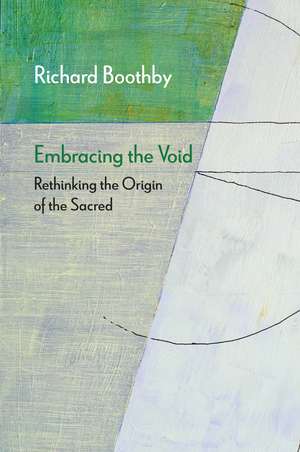
Embracing the Void: Rethinking the Origin of the Sacred: Diaeresis
Autor Richard Boothbyen Limba Engleză Paperback – 15 noi 2022
În lucrarea Embracing the Void, descoperim o perspectivă riguroasă asupra modului în care dimensiunea insesizabilă a necunoscutului fundamentează experiența sacrului. Punctul de plecare al lui Richard Boothby este conceptul lacanian „das Ding” (Lucrul), acea prezență excesivă și tulburătoare pe care subiectul o întâlnește inițial în figura maternă. Această ancoră teoretică îi permite autorului să depășească interpretarea clasică a lui Freud asupra religiei, văzută doar ca o proiecție a complexului Oedip, și să propună o dinamică a inconștientului mult mai nuanțată. Notăm cu interes modul în care Boothby extinde această analiză dincolo de spațiul european, examinând structurile de credință din hinduism, budism și islam, pentru a culmina cu o critică a culturii capitaliste contemporane, unde banii preiau rolul unei zeități seducătoare. Comparabil cu The Other Freud de James DiCenso în rigurozitatea analizei textelor freudiene, volumul de față este actualizat pentru dezbaterile contemporane din filozofia religiei prin integrarea deplină a turnurii lacaniene. Această lucrare reprezintă o evoluție firească în opera autorului; dacă în Freud as Philosopher acesta recalibra metapsihologia freudiană, iar în Death and Desire (RLE: Lacan) explora instinctul morții, în Embracing the Void el reușește să sintetizeze aceste interese într-o teorie unitară a impulsului religios. Structura narativă este una academică, dar accesibilă, oferind un ritm de lectură alert pentru un tratat de o asemenea profunzime teoretică.
Din seria Diaeresis
-
 Preț: 344.40 lei
 -
 Preț: 286.75 lei
 -
 Preț: 231.48 lei
 -
 Preț: 276.18 lei
 -
 Preț: 274.81 lei
 -
 Preț: 329.87 lei
 -
 Preț: 318.57 lei
 -
 Preț: 225.09 lei
 -
 Preț: 375.42 lei
 -
 Preț: 223.99 lei
 - 18%
 Preț: 753.76 lei
 -
Preț: 231.97 lei
Carte disponibilă
Livrare economică 30 octombrie-13 noiembrie
Livrare express 15-21 octombrie pentru 25.77 lei
Specificații
ISBN-10: 0810145383
Pagini: 240
Dimensiuni: 152 x 229 x 18 mm
Greutate: 0.37 kg
Editura: Northwestern University Press
Colecția Northwestern University Press
Seria Diaeresis
De ce să citești această carte
Această carte se adresează cercetătorilor și studenților din domeniile filozofiei, teologiei și psihanalizei care caută o explicație structurală a fenomenului religios. Cititorul câștigă un instrumentar teoretic nou pentru a înțelege de ce religia persistă în modernitate sub forme neașteptate. Este o recomandare esențială pentru cei care doresc să exploreze intersecția dintre inconștient și sacru dincolo de clișeele clasice ale psihologiei religiei.
Despre autor
Richard Boothby este profesor și șef al Departamentului de Filozofie de la Loyola College din Baltimore, Maryland. Cariera sa s-a concentrat constant pe intersecția dintre teoria psihanalitică și filozofia contemporană, fiind unul dintre cei mai importanți interpreți americani ai operei lui Jacques Lacan. Experiența sa academică este dublată de o înțelegere profundă a practicii clinice, teme explorate și în lucrări cu o notă personală precum Blown Away, unde analizează doliul prin prisma psihanalizei. Prin lucrări precum Sex on the Couch, Boothby a demonstrat o capacitate remarcabilă de a salva și actualiza concepte freudiene considerate adesea depășite.
Descriere scurtă
Renowned psychoanalytic philosopher Richard Boothby puts forward a novel theory of religion inspired by Jacques Lacan’s theory of das Ding, the disquieting, inaccessible dimension of fellow human beings. This notion of an unfathomable excess, originally encountered in the figure of the mother, led Lacan to break with Freud’s formulation of the Oedipus complex and underlies Lacan’s distinctive conception of unconscious dynamics. Leaning on this account, Boothby shows how our sense of the sacred arises from our relation to what we do not know.
Embracing the Void lays out the range of Freud’s attempts at a psychoanalytic theory of religion and then sketches the rough contours of Lacan’s contrasting approach. From there, Boothby offers the theoretical tools for interpreting the religious impulse and analyzes key religious traditions, from ancient Greek polytheism to Judaism and Christianity, and from Hinduism and Buddhism to Islam, finally turning to modern capitalist culture and the seductive deity that dominates it—money. Lucid, accessible, and compelling, the book provides a cogent intervention in one of the psychoanalytic tradition’s most contentious topics and offers a new approach to our understanding of religion.
Notă biografică
Recenzii
"By adroitly reading the sacred through the lens of Lacan’s notion of das Ding, Boothby situates the unknowable—and perhaps even a hint of the divine—at the very heart of human subjectivity at the same time as he gestures toward what cannot be contained by this subjectivity. This may be the quintessential act of raising 'a mundane object to the dignity of the Thing.' A landmark text in Lacanian theory." ––Mari Ruti, author of The Singularity of Being: Lacan and the Immortal Within
“A novel and unusually perceptive work. Richard Boothby charts a new path for our thinking about politics and what it means to be human—a path in which religion and notions of the sacred are not dismissible but inescapable. This book’s insights have genuine theoretical and political salience and are conveyed with distinctive clarity.” —Paul Eisenstein, coauthor of Rupture: On the Emergence of the Political
“At first sight, Lacan and Jesus might strike us as strange bedfellows. Echoing Tertullian’s famous question, ‘what has Athens to do with Jerusalem,’ it seems only reasonable to ask, ‘what has Psychoanalysis to do with Christianity?’ In this fantastic work, Boothby offers us a surprising answer. Not only is the reader rewarded with a clear and concise understanding of Lacan’s theory of desire, but this is expertly deployed to open up the depths of Jesus’ seemingly impossible injunction to love one’s enemy. In the hands of Boothby, we see this as a call to be radically receptive to the destabilizing and enigmatic abyss of the other’s desire. If the basic vocation of the religious is to tarry with, and be transformed by, the formidable mystery at the heart of reality, then Boothby argues that this vocation is achieved through nothing else than tarrying with, and being transformed by, the formidable dimension of mystery at the heart of one’s neighbour.” ––Peter Rollins, author of How (Not) to Speak of God and The Orthodox Heretic
"In this exceptional feat of scholarship, Boothby presents nothing less than a new psychoanalytic account of religion, which is likely to become a touchstone for all future considerations of the religious experience. Pitting Lacan against Freud, Boothby liberates religion from its unconscious place as a defensive illusion to which Freud had allocated it and reappraises its redemptive function for humanity’s relation with Otherness, as it is encountered in fellow human beings and in oneself. In the process, it is not only the function of religion and the sacred that is being formulated anew, but the foundation of psychoanalysis itself. Deeply learned yet consistently accessible, this book is a genuine triumph of innovative, creative thinking and will appeal to a very broad readership." —Dany Nobus, author of Critique of Psychoanalytic Reason: Studies in Lacanian Theory and Practice
Cuprins
- Preface: Is Nothing Sacred?
- Introduction: Reposing Freud’s Final Question
- PART ONE: REREADING LACAN (or, WHAT IS THE OTHER?)
- Chapter 1 Religion from Freud to Lacan
- Chapter 2 The Abyss of The Other
- Chapter 3 The Ex Nihilo of the Signifier
- PART TWO: REREADING RELIGION (or, WHAT IS THE SACRED?)
- Chapter 4 Greek Polytheism: The Worship of Force
- Chapter 5 Judaism: The Worship of Law
- Chapter 6 Christianity: The Worship of Love
- Chapter 7 Other Gods
- Chapter 8 Conclusions