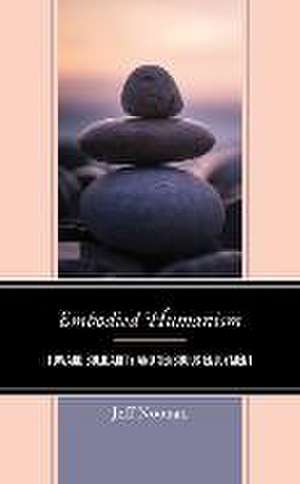
Embodied Humanism: Toward Solidarity and Sensuous Enjoyment
Autor Jeff Noonanen Limba Engleză Hardback – 22 aug 2022
Preț: 551.86 lei
Preț vechi: 818.25 lei
-33%
Puncte Express: 828
Carte tipărită la comandă
Livrare economică 20 noiembrie-04 decembrie
Livrare prin curier în România Termenul estimat este afișat lângă disponibilitate.
Transport gratuit pentru acest produs Plată online sau ramburs, în funcție de opțiunile comenzii.
Retur gratuit în 14 zile Comandă securizată și suport în română.
Specificații
ISBN-13: 9781793636942
ISBN-10: 179363694X
Pagini: 246
Dimensiuni: 159 x 239 x 24 mm
Greutate: 0.53 kg
Editura: Bloomsbury Publishing
Colecția Lexington Books
Locul publicării:New York, United States
ISBN-10: 179363694X
Pagini: 246
Dimensiuni: 159 x 239 x 24 mm
Greutate: 0.53 kg
Editura: Bloomsbury Publishing
Colecția Lexington Books
Locul publicării:New York, United States
Cuprins
Preface
Acknowledgements
Introduction: Humanity, Struggle, and the Sensuous Enjoyment of Life
Chapter 1: Why Posthumanism?
Chapter 2: Life Under the Sun: Ancient Poetic and Philosophical Insights
into the Goods of Earthly Life
Chapter 3: The Renaissance and Humanity's Place in the Order of Things
Chapter 4: The Enlightenment and the Deployment of Reason as a Critical Weapon
Chapter 5: The Social Conditions for the Universal Enjoyment of Life
Chapter 6: Responsibility and the Pleasures of Social Individuals
Bibliography
Index
About the Author
Acknowledgements
Introduction: Humanity, Struggle, and the Sensuous Enjoyment of Life
Chapter 1: Why Posthumanism?
Chapter 2: Life Under the Sun: Ancient Poetic and Philosophical Insights
into the Goods of Earthly Life
Chapter 3: The Renaissance and Humanity's Place in the Order of Things
Chapter 4: The Enlightenment and the Deployment of Reason as a Critical Weapon
Chapter 5: The Social Conditions for the Universal Enjoyment of Life
Chapter 6: Responsibility and the Pleasures of Social Individuals
Bibliography
Index
About the Author
Recenzii
In this masterful book, Jeff Noonan shows how an embodied humanism, founded on universal life-values emanating from human needs enables a solidarity for both the oppressed and the planet, capable of promoting the life range of humanity as a whole. Building on a vast range of scholarship, he argues meticulously and persuasively that the sensuous enjoyment of life avoids the pitfalls of egoistic hedonism because of the dynamic relationship between the self-determining, social individual and reality. Noonan demonstrates how a renewed humanism that recognizes the body as the source of all experience can provide answers to some of the central issues of our time. For the courage and intellectual mastery realized in its pages, this book deserves to be read and studied carefully by all those interested in a philosophical outlook that provides hope for our world.
In his characteristically clear, conversant and captivating style, Professor Noonan adds a deep- and far-reaching new chapter to his theoretically well-established and academically well-known materialist, democratic, life-asserting philosophical ethics. By so doing, Professor Noonan offers his readers yet another praiseworthy opportunity for engaging with, and reflecting upon, that ground-breaking life-value onto-axiology which he has been so instrumental in developing over the past twenty-five years, i.e., since its inception by the late Professor John McMurtry, to whom this book is dedicated. Intriguingly, while heaping epistemic, socio-historical and moral doubts on the otherworldly myths and aspirations of humankind, who suffered so much and so often because of totems and taboos, Noonan's main argument captures one of the essential elements of the Christian prayer par excellence, which recites: "Give us this day our daily bread and forgive us our trespasses as we forgive those who trespass against us; and lead us not into temptation, but deliver us from evil." Without meeting people's truly vital needs for meaningful survival, effective self-direction, collaborative sociality and peaceful growth, and chasing instead the fetishes of competitive self-affirmation and greed, no real lasting human good will ever be realised in a concrete and comprehensive way here on Earth.
In his characteristically clear, conversant and captivating style, Professor Noonan adds a deep- and far-reaching new chapter to his theoretically well-established and academically well-known materialist, democratic, life-asserting philosophical ethics. By so doing, Professor Noonan offers his readers yet another praiseworthy opportunity for engaging with, and reflecting upon, that ground-breaking life-value onto-axiology which he has been so instrumental in developing over the past twenty-five years, i.e., since its inception by the late Professor John McMurtry, to whom this book is dedicated. Intriguingly, while heaping epistemic, socio-historical and moral doubts on the otherworldly myths and aspirations of humankind, who suffered so much and so often because of totems and taboos, Noonan's main argument captures one of the essential elements of the Christian prayer par excellence, which recites: "Give us this day our daily bread and forgive us our trespasses as we forgive those who trespass against us; and lead us not into temptation, but deliver us from evil." Without meeting people's truly vital needs for meaningful survival, effective self-direction, collaborative sociality and peaceful growth, and chasing instead the fetishes of competitive self-affirmation and greed, no real lasting human good will ever be realised in a concrete and comprehensive way here on Earth.