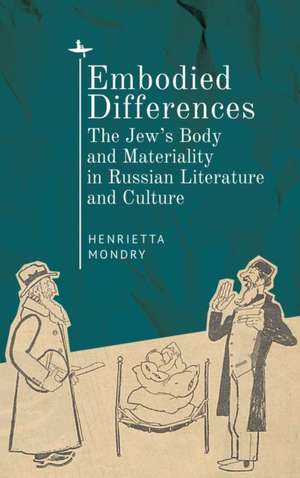
Embodied Differences: The Jew’s Body and Materiality in Russian Literature and Culture
Autor Henrietta Mondryen Limba Engleză Hardback – 12 ian 2021
Preț: 518.07 lei
Preț vechi: 681.36 lei
-24%
Puncte Express: 777
Carte disponibilă
Livrare economică 16-30 noiembrie
Livrare express 31 octombrie-06 noiembrie pentru 99.30 lei
Livrare prin curier în România Termenul estimat este afișat lângă disponibilitate.
Transport gratuit pentru acest produs Plată online sau ramburs, în funcție de opțiunile comenzii.
Retur gratuit în 14 zile Comandă securizată și suport în română.
Specificații
ISBN-13: 9781644694855
ISBN-10: 1644694859
Pagini: 268
Ilustrații: 14
Dimensiuni: 156 x 234 x 19 mm
Greutate: 0.55 kg
Editura: Academic Studies Press
Colecția Academic Studies Press
Locul publicării:Boston, MA, United States
ISBN-10: 1644694859
Pagini: 268
Ilustrații: 14
Dimensiuni: 156 x 234 x 19 mm
Greutate: 0.55 kg
Editura: Academic Studies Press
Colecția Academic Studies Press
Locul publicării:Boston, MA, United States
Cuprins
Table of Contents
A note on transliterationList of illustrations
Introduction
Part One: The Other Body and Spaces for Matter
Chapter One. Locating historically the Jew’s body between display and transformation
Chapter Two. The power of meat: defining ethnicity and masculinity in Gogol
Chapter Three. Valued bodies and spaces: cross-religious encounters in Dostoevsky
Chapter Four. Intimate spaces: the modern Jewess in the boudoir in Chekhov and Bely
Chapter Five. Animal advocacy and ritual murder trials
Chapter Six. Aphids and other undesirables: the predatory Jew versus Soviet art
Chapter Seven. Abject bodies: tactility, dissection, and body rites in postmodernist fiction
Part Two: Re/active Embodiments and a Sense of Things
Chapter Eight. Women writers inventing exotic origins
Chapter Nine. Strange ancestors in the house and in the basement
Chapter Ten. On feeding the family: constructing Jewishness through nurture
Chapter Eleven. Materiality of smell and constructs of embodied memory
Chapter Twelve. “An edible chronotope”: in search of Jewish heritage food
Conclusion: The Power of Bodies and Senses that Matter
Bibliography
Index
Recenzii
“Mondry’s book is exemplary in its linking between being human and/or being Jewish or non-Jewish, as the case may be. What is sad about her tale is that while we, as academics, know how poisonous are both the charges of difference as well the complex reactions to being so labeled, we seem to be caught in a loop that makes it ever more difficult to acknowledge the infiltration of a fragmented past into our pre- sent world. We often struggle to get our case across in spite of this. Mondry succeeds brilliantly.”
— Sander L. Gilman, Contemporary Jewry
“It is noteworthy and commendable that the book, which started with the outsiders’ often pernicious take on the Jew’s body and the “paradoxical space” (212) it occupies in Russian literature, ends with the celebration of Jewish agency. This is one of the many reasons why no student of Russian and Jewish literature and culture should bypass this innovative and provocative book.”
— Marat Grinberg, Antisemitism Studies
“This book rewards the reader as a result of the breadth of discussion of a specific domain, and the number of vectors that Mondry succeeds in applying in her research. This is complemented by the depth of discussion, represented by a layered approach that employs tools from literary theory, psychoanalysis, museum studies, pathology, and sociology, to name a few of the disciplines brought to bear on the topic at hand. It is an extremely erudite study that, nonetheless, engages the reader by its approach, making it an ideal acquisition for any academic library.”
— John Cook, University of Melbourne, Australian Slavonic and East European Studies
— Sander L. Gilman, Contemporary Jewry
“It is noteworthy and commendable that the book, which started with the outsiders’ often pernicious take on the Jew’s body and the “paradoxical space” (212) it occupies in Russian literature, ends with the celebration of Jewish agency. This is one of the many reasons why no student of Russian and Jewish literature and culture should bypass this innovative and provocative book.”
— Marat Grinberg, Antisemitism Studies
“This book rewards the reader as a result of the breadth of discussion of a specific domain, and the number of vectors that Mondry succeeds in applying in her research. This is complemented by the depth of discussion, represented by a layered approach that employs tools from literary theory, psychoanalysis, museum studies, pathology, and sociology, to name a few of the disciplines brought to bear on the topic at hand. It is an extremely erudite study that, nonetheless, engages the reader by its approach, making it an ideal acquisition for any academic library.”
— John Cook, University of Melbourne, Australian Slavonic and East European Studies