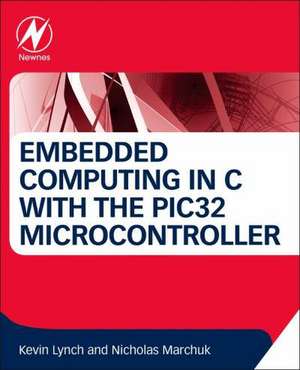
Embedded Computing and Mechatronics with the PIC32 Microcontroller
Autor Kevin Lynch, Nicholas Marchuk, Matthew Elwinen Limba Engleză Paperback – 2 dec 2015
Ecosistemul integrat în acest volum se bazează pe microcontrolerul PIC32MX795F512H, oferind o sinteză tehnică între hardware-ul MIPS32 și instrumentele de dezvoltare precum compilatorul XC32 și framework-ul Harmony. Suntem de părere că lucrarea reușește să elimine acei pași „magici” din programare, oferind o legătură logică între codul scris în C și registrele fizice ale procesorului. Complementar lui Introductory Programs with the 32-bit PIC Microcontroller, volumul acoperă zona avansată de mecatronică și control PID, pe care titlul semnat de Hubert Ward o tratează doar la nivel introductiv. Notăm cu interes rigoarea cu care sunt explicate comunicațiile industriale (SPI, I2C, CAN, USB) și procesarea semnalelor digitale, transformând teoria în aplicații practice pe sisteme electromecanice. Deși autorul Kevin Lynch are lucrări anterioare în domenii diverse, acest volum se distinge prin focalizarea strictă pe inginerie electronică și controlul mișcării. Structura cărții facilitează o progresie tehnică naturală: de la configurarea inițială și gestionarea întreruperilor, până la proiecte complexe de control al motoarelor DC și dimensionarea angrenajelor. Putem afirma că este un instrument de referință care transformă fișele de date abstracte în competențe de proiectare aplicată.
Preț: 384.23 lei
Preț vechi: 451.96 lei
-15%
Carte tipărită la comandă
Livrare economică 20 noiembrie-04 decembrie
Specificații
ISBN-10: 0124201652
Pagini: 650
Ilustrații: 100 illustrations
Dimensiuni: 191 x 235 x 38 mm
Greutate: 1.32 kg
Editura: ELSEVIER SCIENCE
V-ar putea interesa
-
 -22%Preț: 323.20 lei415.45 lei
 -
 Indoor Navigation Strategies for Aerial Autonomous SystemsPedro Castillo-Garcia-31%Preț: 599.26 lei867.74 lei
 -
 -27%Preț: 1704.74 lei2335.26 lei
 -
 System Identification, 2EPintelon-23%Preț: 996.78 lei1294.53 lei
 -
 Microprocessor TechnologyJ. S. Anderson-54%Preț: 221.47 lei478.04 lei
 -
 Embedded Systems and Computer ArchitectureGraham R WilsonPreț: 450.99 lei
 -
 Hall-Effect Sensors: Theory and ApplicationEdward Ramsden-19%Preț: 350.49 lei433.80 lei
 -
 -29%Preț: 242.37 lei342.22 lei
 -
 -20%Preț: 380.44 lei475.55 lei
 -
 Microprocessors and Microcomputer-Based System DesignMohamed Rafiquzzaman-18%Preț: 1536.65 lei1873.96 lei
 -
 Aircraft System IdentificationEugene Morelli-8%Preț: 644.57 lei700.62 lei
 -
 The Best of Closet Cooking 2017Kevin LynchPreț: 118.87 lei
 -
 The Best of Closet Cooking 2018Kevin LynchPreț: 119.07 lei
 -
 Cities and City PlanningLloyd RodwinPreț: 375.21 lei
 -
 Beginner's Guide to Programming the Pic32Thomas KibaloPreț: 267.91 lei
 -
 PIC Micro Principles V10Clive W. HumphrisPreț: 260.74 lei
 -
 ArduinoErik SavasgardPreț: 36.80 lei
 -
 Microcontroller Projects Using the Basic StampA. L. Williams-20%Preț: 539.49 lei674.37 lei
 -
 Wireless Sensor NetworksS. R. VijayalakshmiPreț: 390.82 lei
 -
 Mastering Embedded Linux Programming - Second EditionChris Simmonds-20%Preț: 418.10 lei522.63 lei
 -
 Mastering ROS for Robotics Programming - Second EditionLentin Joseph-19%Preț: 477.95 lei590.06 lei
 -
 Programmation ArduinoTorvalds, MarkPreț: 88.49 lei
 -
 Indoor Location-Based ServicesMartin Werner-20%Preț: 621.70 lei777.12 lei
Public țintă
Students, professionals and hobbyistsDe ce să citești această carte
Această carte se adresează studenților la inginerie și profesioniștilor care doresc să stăpânească arhitectura PIC32 fără a depinde exclusiv de biblioteci pre-scrise. Cititorul câștigă o înțelegere profundă a interfețării senzorilor și a controlului precis al actuatoarelor. Este recomandată pentru rigoarea tehnică și pentru setul complet de resurse (cod și video) care susțin învățarea practică.
Despre autor
Kevin Lynch a fost profesor emerit la MIT, având o carieră distinsă în cadrul School of Architecture and Urban Planning. Deși profilul său academic principal a vizat planificarea urbană, colaborarea sa la acest volum alături de Nicholas Marchuk și Matthew Elwin reflectă o abordare multidisciplinară a ingineriei și sistemelor de control. Experiența sa în structurarea informației complexe contribuie la claritatea didactică a manualului, făcându-l accesibil atât studenților, cât și pasionaților de robotică.
Cuprins
Part 1: Quickstart 1. Quickstart Part 2: Fundamentals 2. Hardware 3. Software 4. Using Libraries 5. Time and Space 6. Interrupts Part 3: Peripheral Reference 7. Digital Input and Output 8. Counter/Timers 9. Output Compare 10. Analog Input 11. UART 12. SPI Communication 13. I2C Communication 14. Parallel Master Port 15. Input Capture 16. Comparator 17. Sleep, Idle, and the Watchdog Timer 18. Flash Memory 19. Controller Area Network (CAN) 20. Harmony and its Application to USB Part 4: Mechatronics 21. Sensors 22. Digital Signal Processing 23. PID Feedback Control 24. Feedback Control of LED Brightness 25. Brushed Permanent Magnet DC Motors 26. Gearing and Motor Sizing 27. DC Motor Control 28. A Motor Control Project 29. Other Actuators Appendix A: A Crash Course in C Appendix B: Circuits Review Appendix C: Other PIC32 Models Index
Descriere
For the first time in a single reference, this book provides the beginner with a coherent and logical introduction to the hardware and software of the PIC32, bringing together key material from the PIC32 Reference Manual, Data Sheets, XC32 C Compiler User's Guide, Assembler and Linker Guide, MIPS32 CPU manuals, and Harmony documentation. This book also trains you to use the Microchip documentation, allowing better life-long learning of the PIC32. The philosophy is to get you started quickly, but to emphasize fundamentals and to eliminate "magic steps" that prevent a deep understanding of how the software you write connects to the hardware.
Applications focus on mechatronics: microcontroller-controlled electromechanical systems incorporating sensors and actuators. To support a learn-by-doing approach, you can follow the examples throughout the book using the sample code and your PIC32 development board. The exercises at the end of each chapter help you put your new skills to practice.
Coverage includes:
- A practical introduction to the C programming language
- Getting up and running quickly with the PIC32
- An exploration of the hardware architecture of the PIC32 and differences among PIC32 families
- Fundamentals of embedded computing with the PIC32, including the build process, time- and memory-efficient programming, and interrupts
- A peripheral reference, with extensive sample code covering digital input and output, counter/timers, PWM, analog input, input capture, watchdog timer, and communication by the parallel master port, SPI, I2C, CAN, USB, and UART
- An introduction to the Microchip Harmony programming framework
- Essential topics in mechatronics, including interfacing sensors to the PIC32, digital signal processing, theory of operation and control of brushed DC motors, motor sizing and gearing, and other actuators such as stepper motors, RC servos, and brushless DC motors
For more information on the book, and to download free sample code, please visit http://www.nu32.org
- Extensive, freely downloadable sample code for the NU32 development board incorporating the PIC32MX795F512H microcontroller
- Free online instructional videos to support many of the chapters