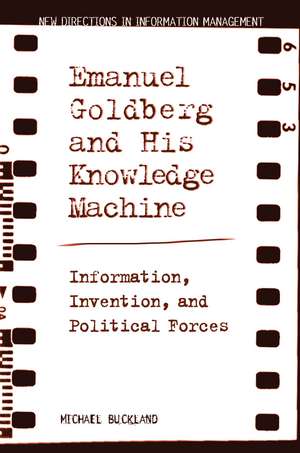
Emanuel Goldberg and His Knowledge Machine: Information, Invention, and Political Forces: New Directions in Information Management
Autor Michael Bucklanden Limba Engleză Paperback – 31 mar 2006
An incredible story emerges as Buckland unearths forgotten documents and rogue citations to make the case that it was Goldberg, not Vannevar Bush, who created the first desktop search engine. Goldberg, not Professor Zapp (a figment of J. Edgar Hoover's imagination), who developed microdot technology. Goldberg, not Heinz Kueppenbender, who designed the famous Contax 35 mm camera. Buckland firmly yet engagingly gives credit where credit is due, in the process shedding light on the circumstances that led to Goldberg's obscurity. The result is an illuminating tribute to a great mind, and a fascinating investigation of a crucial period in the history of information science and technology.
Preț: 284.06 lei
Preț vechi: 379.69 lei
-25%
Puncte Express: 426
Preț estimativ în valută:
50.27€ • 58.75$ • 43.65£
50.27€ • 58.75$ • 43.65£
Carte tipărită la comandă
Livrare economică 19 februarie-05 martie
Preluare comenzi: 021 569.72.76
Specificații
ISBN-13: 9780313313325
ISBN-10: 0313313326
Pagini: 400
Dimensiuni: 156 x 235 x 30 mm
Greutate: 0.62 kg
Editura: Bloomsbury Publishing
Colecția Libraries Unlimited
Seria New Directions in Information Management
Locul publicării:New York, United States
ISBN-10: 0313313326
Pagini: 400
Dimensiuni: 156 x 235 x 30 mm
Greutate: 0.62 kg
Editura: Bloomsbury Publishing
Colecția Libraries Unlimited
Seria New Directions in Information Management
Locul publicării:New York, United States
V-ar putea interesa
-
 -14%Preț: 1010.16 lei1174.60 lei
 -
 Preț: 233.95 lei
 -
 Inventing the InternetJanet AbbatePreț: 263.87 lei
 -
 ComputingPaul E. Ceruzzi-18%Preț: 85.26 lei104.11 lei
 -
 Information and SocietyMichael BucklandPreț: 81.60 lei
 -
 Information and Information SystemsMichael Buckland-23%Preț: 170.84 lei220.57 lei
 -
 -29%Preț: 845.94 lei1196.00 lei
 -
 The Origins of Agriculture in EuropeI. J. Thorpe-33%Preț: 253.83 lei377.63 lei
 -
 Preț: 235.06 lei
 -
 -11%Preț: 666.60 lei748.98 lei
 -
 Technology and Global ChangeArnulf Grübler-11%Preț: 512.04 lei575.32 lei
 -
 Preț: 379.72 lei
 -
 -18%Preț: 328.72 lei399.29 lei
 -
 The Sanitary CityMartin MelosiPreț: 409.63 lei
 -
 Renaissance Astrolabes and their MakersGerard L'E. Turner-39%Preț: 736.55 lei1208.08 lei
 -
 Medical Device and Equipment Design: Usability Engineering and ErgonomicsMichael E. Wiklund-47%Preț: 966.94 lei1810.42 lei
 -
 Essential RetroJames B GrahamePreț: 143.76 lei
 -
 The Theory of Optical InstrumentsE. T. WhittakerPreț: 193.16 lei
 -
 An Introduction to the Study of Integral EquationsMaxime BocherPreț: 193.16 lei
 -
 The Twenty-Seven Lines upon the Cubic SurfaceArchibald HendersonPreț: 221.79 lei
 -
 Preț: 193.38 lei
 -
 Usability Testing of Medical DevicesMichael E. Wiklund, P.E.-29%Preț: 938.25 lei1322.43 lei
 -
 Medical Device Use Error: Root Cause AnalysisMichael Wiklund-29%Preț: 872.64 lei1235.63 lei
 -
 Journey to the MoonEldon C HallPreț: 392.65 lei
 -
 Mosquito Photo-Reconnaissance Units of World War 2Martin Bowman-33%Preț: 84.00 lei124.82 lei
 -
 -29%Preț: 845.75 lei1195.89 lei
Cuprins
Preface
Origins
University Studies
Berlin
Sophie Posniak
Graphics
The Goldberg Wedge
The Great War
Ice and the Kinamo
The Goldberg Condition
Microdots
Zeiss Ikon and the Contax
Television
The 1931 Congress
The Statistical Machine
Ludwig, Killinger and Mutschmann
Paris
Palestine
Military Needs
The Microfilm Rapid Selector
Finale
After Goldberg
Goldberg in Retrospect
Appendix A: Texts in German
Appendix B: Biographical Sources
Appendix C: Goldberg Patents
Bibliography of Emanuel Goldberg's Writings
General Bibliography
Index
Origins
University Studies
Berlin
Sophie Posniak
Graphics
The Goldberg Wedge
The Great War
Ice and the Kinamo
The Goldberg Condition
Microdots
Zeiss Ikon and the Contax
Television
The 1931 Congress
The Statistical Machine
Ludwig, Killinger and Mutschmann
Paris
Palestine
Military Needs
The Microfilm Rapid Selector
Finale
After Goldberg
Goldberg in Retrospect
Appendix A: Texts in German
Appendix B: Biographical Sources
Appendix C: Goldberg Patents
Bibliography of Emanuel Goldberg's Writings
General Bibliography
Index
Recenzii
[P]rovides a detailed history of the development of the film industry in Germany and in Europe as it pertains to photography, cinema, and microfilm. In particular, it covers much of the history of Zeiss Ikon, which Goldberg helped to found and where he worked until forced to flee Nazi Germany. The book provides a detailed picture of the major figures in the industry and extensive discussion of how many film technologies were developed and how they function. With more than 100 pages of reference sources listed, it is an invaluable resource on the history of film technology. It is an easy read and is impressively researched.
More than a tribute or a history of a technology, this book is perhaps best read as a cultural history of sorts: the life story of a man and the technologies he helped to create and how both were profoundly shaped by the political and social forces of the time. The lesson implicit in Buckland's revealing narrative is that the man himself can be understood only in the context in which he was forgotten-and it is a story well worth remembering.
The story of Emanuel Goldberg offers insights into ways of handling documentary information, and still more insights into the tragic effects that social and political developments can have on our lives. We can now honour him as he deserves. And thank Michael Buckland for making this possible.
[P]rofessor Buckland's enormous achievement in bringing to light the career of a great scientist who, like many of his German and foreign colleagues, fell victim to the nationalistic madness that virtually destroyed German culture and science between 1933 and 1945. Emanuel Goldberg has at last received the understanding and recognition that his inventive genius deserved but were not possible in his lifetime. Recommended for the libraries of schools of library and information science, for schools with graduate programs in photographic technology, and for all scholars and students of the history of library technology.
More than a tribute or a history of a technology, this book is perhaps best read as a cultural history of sorts: the life story of a man and the technologies he helped to create and how both were profoundly shaped by the political and social forces of the time. The lesson implicit in Buckland's revealing narrative is that the man himself can be understood only in the context in which he was forgotten-and it is a story well worth remembering.
The story of Emanuel Goldberg offers insights into ways of handling documentary information, and still more insights into the tragic effects that social and political developments can have on our lives. We can now honour him as he deserves. And thank Michael Buckland for making this possible.
[P]rofessor Buckland's enormous achievement in bringing to light the career of a great scientist who, like many of his German and foreign colleagues, fell victim to the nationalistic madness that virtually destroyed German culture and science between 1933 and 1945. Emanuel Goldberg has at last received the understanding and recognition that his inventive genius deserved but were not possible in his lifetime. Recommended for the libraries of schools of library and information science, for schools with graduate programs in photographic technology, and for all scholars and students of the history of library technology.