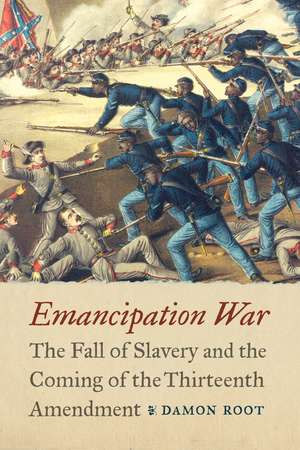
Emancipation War: The Fall of Slavery and the Coming of the Thirteenth Amendment
Autor Damon Rooten Limba Engleză Hardback – iun 2026
What happened in those intervening years that led Lincoln to switch from supporting a proslavery amendment to embracing the antislavery provision that ultimately became enshrined in the Constitution? Why did the Thirteenth Amendment of 1864–65 win out over that of 1861? Lincoln himself provided a key to understanding: “I claim not to have controlled events,” he said, “but confess plainly that events have controlled me.”
In Emancipation War award-winning journalist Damon Root chronicles the great legal, political, and military struggle to amend the U.S. Constitution to outlaw slavery once and for all. It is the story of canny political tacticians and unyielding radicals; of famous orators and unsung pamphleteers; of liberty-minded Union officers and enslaved persons who liberated themselves by following the North Star to freedom, and who then, in some cases, donned uniforms and took up arms against their former enslavers. It was this wide-ranging movement against slavery—operating both inside and outside the halls of government power, fighting both on and off the battlefield—that made an antislavery constitutional amendment possible.
Telling the story from both the top down and the bottom up, Emancipation War provides a gripping and revealing new history of the Thirteenth Amendment.
Preț: 166.40 lei
Puncte Express: 250
Carte disponibilă
Livrare economică 12-26 noiembrie
Livrare express 28 octombrie-03 noiembrie pentru 74.17 lei
Livrare prin curier în România Termenul estimat este afișat lângă disponibilitate.
Transport gratuit de la 400.00 lei Plată online sau ramburs, în funcție de opțiunile comenzii.
Retur gratuit în 14 zile Comandă securizată și suport în română.
Specificații
ISBN-13: 9781640126435
ISBN-10: 1640126430
Pagini: 168
Ilustrații: Index
Dimensiuni: 152 x 229 mm
Greutate: 0.4 kg
Editura: Potomac Books Inc
Colecția Potomac Books
Locul publicării:United States
ISBN-10: 1640126430
Pagini: 168
Ilustrații: Index
Dimensiuni: 152 x 229 mm
Greutate: 0.4 kg
Editura: Potomac Books Inc
Colecția Potomac Books
Locul publicării:United States
Notă biografică
Damon Root is an award-winning legal affairs journalist and the author of A Glorious Liberty: Frederick Douglass and the Fight for an Antislavery Constitution (Potomac Books, 2023) and Overruled: The Long War for Control of the U.S. Supreme Court. His writing has also appeared in the Los Angeles Daily News, Chicago Sun-Times, Newsweek, New York Post, New York Daily News, New York Press, Washington Times, Wall Street Journal, Globe and Mail, and other publications.
Extras
Chapter 1
“No More Slave States”
It was a Tuesday, January 29, 1850, and Senator Henry Clay of Kentucky
had set himself the none-too-modest goal of solving the seemingly
intractable problem of American slavery once and for all. By Clay’s
own none-too-modest reckoning, he was uniquely qualified for the job,
having nearly done the very thing once before. Thirty years earlier, while
serving as Speaker of the House of Representatives, Clay had been the
driving force behind the landmark legislation that came to be known
as the Missouri Compromise. That storied law had admitted Missouri
to the Union as a slave state while simultaneously admitting Maine to
the Union as a free state; it also bisected the young nation, slashing a
line across the map that prohibited slavery “north of thirty-six
degrees and thirty minutes north latitude” in the remaining federal territory
acquired from France in the Louisiana Purchase. Clay’s legislative
maneuverings had thus preserved the tenuous sectional balance between
slave states and free states. The Union remained intact.
But that was then. The United States had kept on expanding in the
years since, its territorial growth aided in no small part by an 1848 military
triumph over the nation of Mexico. That war’s end had brought with it
vast new lands that were now readying to become new states, such as
California. Before such states might take their respective places in the
Union, however, Congress had to confront, again, the vexing question
of slavery and sectional balance. This was no mere academic query. The
nation then stood starkly divided between slave states and free states.
If Congress flatly outlawed slavery in the new federal territories—as
a growing number of lawmakers wanted to do—that meant Congress
could prevent new slave states from forming and entering the Union.
The number of free states would grow while the number of slave states
would remain the same. The slaveholders and their political allies did
the math and shuddered at the results.
Enter the senator from Kentucky. “I consider our country in danger,”
Clay was heard to say, “and if I can be the means in any measure
of averting that danger, my health and life is of little consequence.”
Clay’s overriding idea, soon to be known as the Compromise of 1850,
was to appease both sides by getting each to give up something to get
something. “I hold in my hand a series of resolutions,” Clay announced
to the Senate, which, “taken together, in combination . . . propose an
amicable arrangement of all questions in controversy between the free
and slave States, growing out of the subject of slavery.”
The most pressing of those questions was the territorial one. Would
the number of future slave states keep pace with the number of future
free states as the new territories formed their protostate governments?
Clay’s answer harkened back to the grand political bargain he had struck
in 1820. Admit California to the Union as a free state, he now urged
his fellow senators, while admitting the rest of the Mexican cession
“without the adoption of any restriction or condition on the subject of
slavery.” It was to be a sort of Missouri Compromise redux.
Another controversial question centered on the future of slavery
in Washington dc. Under the terms of the U.S. Constitution, Congress
possessed the power to “exercise exclusive Legislation in all Cases
whatsoever, over . . . the Seat of the Government of the United States.”
Antislavery activists had long urged Congress to wield that power on
behalf of human freedom by abolishing slavery in the capital city. If
Congress “can pass laws ‘to prevent horses from being cruelly abused,’”
the abolitionist Theodore Dwight Weld argued in an 1836 pamphlet,
referring to a dc law that was then on the books, then Congress “can
pass laws to prevent men from being cruelly abused, and if it can prevent
cruel abuse, it can define what it is. It can declare that to make men
work without pay is cruel abuse, and can prohibit it.”
“No More Slave States”
It was a Tuesday, January 29, 1850, and Senator Henry Clay of Kentucky
had set himself the none-too-modest goal of solving the seemingly
intractable problem of American slavery once and for all. By Clay’s
own none-too-modest reckoning, he was uniquely qualified for the job,
having nearly done the very thing once before. Thirty years earlier, while
serving as Speaker of the House of Representatives, Clay had been the
driving force behind the landmark legislation that came to be known
as the Missouri Compromise. That storied law had admitted Missouri
to the Union as a slave state while simultaneously admitting Maine to
the Union as a free state; it also bisected the young nation, slashing a
line across the map that prohibited slavery “north of thirty-six
degrees and thirty minutes north latitude” in the remaining federal territory
acquired from France in the Louisiana Purchase. Clay’s legislative
maneuverings had thus preserved the tenuous sectional balance between
slave states and free states. The Union remained intact.
But that was then. The United States had kept on expanding in the
years since, its territorial growth aided in no small part by an 1848 military
triumph over the nation of Mexico. That war’s end had brought with it
vast new lands that were now readying to become new states, such as
California. Before such states might take their respective places in the
Union, however, Congress had to confront, again, the vexing question
of slavery and sectional balance. This was no mere academic query. The
nation then stood starkly divided between slave states and free states.
If Congress flatly outlawed slavery in the new federal territories—as
a growing number of lawmakers wanted to do—that meant Congress
could prevent new slave states from forming and entering the Union.
The number of free states would grow while the number of slave states
would remain the same. The slaveholders and their political allies did
the math and shuddered at the results.
Enter the senator from Kentucky. “I consider our country in danger,”
Clay was heard to say, “and if I can be the means in any measure
of averting that danger, my health and life is of little consequence.”
Clay’s overriding idea, soon to be known as the Compromise of 1850,
was to appease both sides by getting each to give up something to get
something. “I hold in my hand a series of resolutions,” Clay announced
to the Senate, which, “taken together, in combination . . . propose an
amicable arrangement of all questions in controversy between the free
and slave States, growing out of the subject of slavery.”
The most pressing of those questions was the territorial one. Would
the number of future slave states keep pace with the number of future
free states as the new territories formed their protostate governments?
Clay’s answer harkened back to the grand political bargain he had struck
in 1820. Admit California to the Union as a free state, he now urged
his fellow senators, while admitting the rest of the Mexican cession
“without the adoption of any restriction or condition on the subject of
slavery.” It was to be a sort of Missouri Compromise redux.
Another controversial question centered on the future of slavery
in Washington dc. Under the terms of the U.S. Constitution, Congress
possessed the power to “exercise exclusive Legislation in all Cases
whatsoever, over . . . the Seat of the Government of the United States.”
Antislavery activists had long urged Congress to wield that power on
behalf of human freedom by abolishing slavery in the capital city. If
Congress “can pass laws ‘to prevent horses from being cruelly abused,’”
the abolitionist Theodore Dwight Weld argued in an 1836 pamphlet,
referring to a dc law that was then on the books, then Congress “can
pass laws to prevent men from being cruelly abused, and if it can prevent
cruel abuse, it can define what it is. It can declare that to make men
work without pay is cruel abuse, and can prohibit it.”
Cuprins
Introduction: “A Proposed Amendment to the Constitution”
1. “No More Slave States”
2. “The Freedom Fort”
3. “A Fit and Necessary War Measure”
4. “To Arm Such Loyal Men”
5. “The Final Success of the Union Cause”
Epilogue: “Adopted in the Name of Liberty”
Acknowledgments
Notes
Bibliography
Index
1. “No More Slave States”
2. “The Freedom Fort”
3. “A Fit and Necessary War Measure”
4. “To Arm Such Loyal Men”
5. “The Final Success of the Union Cause”
Epilogue: “Adopted in the Name of Liberty”
Acknowledgments
Notes
Bibliography
Index
Recenzii
“A wonderful book. It combines gripping narrative with rigorous constitutional analysis and I learned so much from it.”—Jeffrey Rosen, The Blessings of Liberty podcast
“Erudite but never snobbish, Root’s account acknowledges the nuances of history and is worth your attention.”—Big Think
“Riveting.”—Joel J. Miller, Miller’s Book Review
“A terrific story and beautifully told.”—Aaron Ross Powell, The Liberalism.org Show
“It has been well-said that the purpose of education is to learn to praise—to learn standards of excellence, and honor those who achieve them. Damon Root, whose education has made him one of the most consistently illuminating writers of constitutional questions, demonstrates how ‘heroism, fellowship, and dignity’ produced a noble deed: the Thirteenth Amendment.”—George F. Will, Pulitzer Prize–winning columnist and author of American Happiness and Discontents: The Unruly Torrent, 2008–2020
“In Emancipation War Damon Root tells the riveting story of how freedom was fought for and won—not just by Lincoln but by countless unsung heroes. Runaway slaves, radical reformers, and Black soldiers helped shape a president’s conscience and a nation’s laws. It’s a powerfully written book—and a genuine joy to read.”—Greg Lukianoff, CEO of the Foundation for Individual Rights and Expression (FIRE) and coauthor of The Coddling of the American Mind
“Damon Root masterfully weaves together a range of historical voices to illustrate President Abraham Lincoln’s adoption of an antislavery stance in the Civil War that culminated in his famed Emancipation Proclamation and the Thirteenth Amendment ending slavery in the United States. Using concise and readable prose, this work is a welcome addition for general readers and specialists alike.”—Eugene S. Van Sickle, coeditor of Waging War for Freedom with the 54th Massachusetts: The Civil War Memoir of John W. M. Appleton
“Erudite but never snobbish, Root’s account acknowledges the nuances of history and is worth your attention.”—Big Think
“Riveting.”—Joel J. Miller, Miller’s Book Review
“A terrific story and beautifully told.”—Aaron Ross Powell, The Liberalism.org Show
“It has been well-said that the purpose of education is to learn to praise—to learn standards of excellence, and honor those who achieve them. Damon Root, whose education has made him one of the most consistently illuminating writers of constitutional questions, demonstrates how ‘heroism, fellowship, and dignity’ produced a noble deed: the Thirteenth Amendment.”—George F. Will, Pulitzer Prize–winning columnist and author of American Happiness and Discontents: The Unruly Torrent, 2008–2020
“In Emancipation War Damon Root tells the riveting story of how freedom was fought for and won—not just by Lincoln but by countless unsung heroes. Runaway slaves, radical reformers, and Black soldiers helped shape a president’s conscience and a nation’s laws. It’s a powerfully written book—and a genuine joy to read.”—Greg Lukianoff, CEO of the Foundation for Individual Rights and Expression (FIRE) and coauthor of The Coddling of the American Mind
“Damon Root masterfully weaves together a range of historical voices to illustrate President Abraham Lincoln’s adoption of an antislavery stance in the Civil War that culminated in his famed Emancipation Proclamation and the Thirteenth Amendment ending slavery in the United States. Using concise and readable prose, this work is a welcome addition for general readers and specialists alike.”—Eugene S. Van Sickle, coeditor of Waging War for Freedom with the 54th Massachusetts: The Civil War Memoir of John W. M. Appleton
Descriere
Emancipation War shines light on the origins and meaning of the Thirteenth Amendment and chronicles the great legal, political, and military struggle to amend the U.S. Constitution to outlaw slavery once and for all.