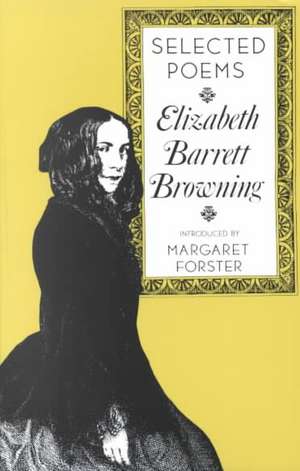
Elizabeth Barrett Browning
Autor Elizabeth Barrett Browningen Limba Engleză Paperback – aug 1988
'How do I love thee? Let me count the ways'
Elizabeth Barrett Browning was a poet of passion, wit and conscience. She was also a woman who wrote to speak the truth about everything she knew - and she knew just what it was like to be a thinking woman in a society that wanted women to be weak. The eldest of twelve children, she wrote poetry from the age of eleven, and became a highly successful poet in her lifetime - and remains very much loved today.
She was also a strong advocate for human rights, campaigning to abolish slavery and child labour, and her three-part poem A Curse for a Nation is a powerful polemic against the slave trade.
'I heard an angel speak last night, and he said "write! Write a nation's curse for me, and send it over the western sea" '
| Toate formatele și edițiile | Preț | Express |
|---|---|---|
| Paperback (2) | 38.89 lei 3-5 săpt. | +20.77 lei 4-10 zile |
| Orion Publishing Group – 28 sep 2023 | 38.89 lei 3-5 săpt. | +20.77 lei 4-10 zile |
| BROADVIEW PR – 30 iul 2009 | 233.93 lei 3-5 săpt. | +73.58 lei 4-10 zile |
| Hardback (1) | 59.03 lei 3-5 săpt. | +17.24 lei 4-10 zile |
| Mount Orleans Press – 27 iun 2019 | 59.03 lei 3-5 săpt. | +17.24 lei 4-10 zile |
Preț: 225.02 lei
Puncte Express: 338
Preț estimativ în valută:
39.80€ • 46.09$ • 34.56£
39.80€ • 46.09$ • 34.56£
Carte indisponibilă temporar
Doresc să fiu notificat când acest titlu va fi disponibil:
Se trimite...
Specificații
ISBN-13: 9780801837548
ISBN-10: 0801837545
Pagini: 352
Dimensiuni: 132 x 201 x 37 mm
Greutate: 0.36 kg
Editura: Johns Hopkins University Press
Locul publicării:Baltimore, United States
ISBN-10: 0801837545
Pagini: 352
Dimensiuni: 132 x 201 x 37 mm
Greutate: 0.36 kg
Editura: Johns Hopkins University Press
Locul publicării:Baltimore, United States
V-ar putea interesa
-
 -23%Preț: 908.48 lei1179.84 lei
 -
 Gender and Discourse in Victorian Literature and ArtAntony H. HarrisonPreț: 348.55 lei
 -
 The Elusive PuffinBeverly TaylorPreț: 94.66 lei
 -
 The Poetical Works of Elizabeth Barrett BrowningElizabeth Barrett BrowningPreț: 46.76 lei
 -
 Los Secretos del Poeta: Para Abrir Los Cielos a Mi Favor; Y Que Se Abran a Favor del Que Clama, y Busca.Jose Guadalupe Galindo RealPreț: 136.84 lei
 -
 Pinceladas del almaGisela GuillénPreț: 119.11 lei
 -
 The Letters of Elizabeth Barrett Browning Volume IElizabeth Barrett BrowningPreț: 99.06 lei
 -
 Preț: 95.36 lei
 -
 Nuestro Maravilloso MundoHéctor Pereyra SuárezPreț: 72.32 lei
 -
 Twisted WisdomLance D. FarmerPreț: 96.63 lei
 -
 Michael Field: The PoetKatherine Bradley-16%Preț: 234.63 lei280.82 lei
 -
 Epistles On Women and Other WorksLucy Aikin-17%Preț: 241.47 lei291.16 lei
 -
 Poems, in Two VolumesWilliam Wordsworth-9%Preț: 199.39 lei218.13 lei
 -
 In MemoriamLord Tennyson Alfred-12%Preț: 157.33 lei179.24 lei
 -
 -11%Preț: 142.10 lei160.10 lei
 -
 NiayaAmaya Enya OrtizPreț: 73.34 lei
 -
 Preț: 92.81 lei
 -
 199 Japanese Names for Japanese TreesSascha Aurora AkhtarPreț: 122.89 lei
 -
 My SeaborgiumAlicia Rebecca MyersPreț: 48.53 lei
 -
 Poems That BleedGlenda FrazierPreț: 55.50 lei
 -
 Anna Und Die Fremde Frau: EnViola Trüb-GirardiPreț: 164.14 lei
Recenzii
"The array of works offered is a rich one, from the religious to the romantic, the sentimental to the socially astute... In providing as representative a sample as possible without including the prefaces or extracts from the longer poems, Forster has succeeded admirably." -- Victorian Studies
Textul de pe ultima copertă
The volume illustrates Browning's development as a poet and reveals her contribution to feminist literature. The poems selected here include early verses published in 1826, when the poet was twenty, as well as the last poems she wrote before her death in 1861.
Cuprins
Acknowledgements
Abbreviations, Primary Sources, and Website
Note on Citation Practices and EBB’s Punctuation
Illustrations
Preface: About this Edition
EBB: A Brief Chronology
Introduction
1. Early Works
5. From Poems (1850)
I Religion
I From The Liberty Bell
III Responses to “The Runaway Slave at Pilgrim’s Point” and“Hiram Powers’ Greek Slave”
Abbreviations, Primary Sources, and Website
Note on Citation Practices and EBB’s Punctuation
Illustrations
Preface: About this Edition
EBB: A Brief Chronology
Introduction
1. Early Works
- Unpublished Juvenilia
- On the Cruelty of Forcement to Man Alluding to the Press Gang
- Fragment of an “Essay on Woman”
- From An Essay on Mind, with Other Poems (1826)
- Stanzas on the Death of Lord Byron
- A Romance of the Ganges
The Virgin Mary to the Child Jesus
Felicia Hemans: To L.E.L.
- From the Preface
From A Drama of Exile
Sonnets - The Soul’s Expression
On a Portrait of Wordsworth by B.R. Haydon
Past and Future
Grief
To George Sand: A Desire
To George Sand: A Recognition - The Romaunt of the Page
Lady Geraldine’s Courtship
From A Vision of Poets
The Cry of the Children
Bertha in the Lane
Catarina to Camoens
The Romance of the Swan’s Nest
5. From Poems (1850)
- Flush or Faunus
Hiram Powers’ Greek Slave
The Runaway Slave at Pilgrim’s Point
A Reed
Sonnets from the Portuguese
- Advertisement to the First Edition
Part I
Part II
- Preface
The Dance
A Curse for a Nation
- Lord Walter’s Wife
Bianca among the Nightingales
A Musical Instrument
Mother and Poet
- From William Michael Rossetti, Some Reminiscences of William Michael Rossetti (1906)
- From Edgar Allan Poe, Broadway Journal (4 and 11 January 1845)
- From Frederick Rowton, The Female Poets of Great Britain (1853)
- From the English Woman’s Journal (7 August 1861)
- From [William Stigand], Edinburgh Review (July-October 1861)
- From [Gerald Massey], The North British Review (February-May 1862)
- From Peter Bayne, Two Great Englishwomen: Mrs Browning and Charlotte Brontë (1881)
- From Edmund Gosse, Critical Kit-Kats (1896)
- From G.K. Chesterton, The Victorian Age in Literature (1913)
- From Virginia Woolf, The Second Common Reader (1931)
I Religion
- From The Guardian (22 January 1851)
- From Samuel B. Holcombe, Southern Literary Messenger (December 1861)
- From [Hannah Lawrance], The British Quarterly Review (October 1865)
- From The True Mary (1868)
- From Peter Bayne, Two Great Englishwomen: Mrs Browning and Charlotte Brontë (1881)
- From Frances Trollope, The Life and Adventures of Armstrong (1844)
- From On the Employment of Children and Young Persons (1841)
I From The Liberty Bell
- From George S. Burleigh, “The Worth of the Union” (1845)
- Martha Hempstead, “The Fugitive” (1845)
- Maria Lowell, “The Slave-mother” (1846)
- From William Lloyd Garrison, “The American Union” (1845)
III Responses to “The Runaway Slave at Pilgrim’s Point” and“Hiram Powers’ Greek Slave”
- The Literary World on “Hiram Powers’ Greek Slave” and “The Runaway Slave at Pilgrim’s Point” (1851)
- Charlotte Forten on “The Runaway Slave at Pilgrim’s Point” (1854)
- From [Giuseppe Mazzini], Westminster Review (April 1852)
- From The Athenaeum (7 June 1851)
- From The Leader (14 June 1851)
- From The Spectator (28 June 1851)
- From Eclectic Review (September 1851)
- From [Henry Fothergill Chorley], The Athenaeum (17 March 1860)
- From [Henry Fothergill Chorley], The Athenaeum (7 April 1860)
- From The Atlas (24 March 1860)
- From [William Edmondstoune Aytoun], Blackwood’s Edinburgh Magazine (April 1860)
- Inscription on the Brownings’ home, Casa Guidi (1861)
Notă biografică
Elizabeth Barrett Browning was an English poet of the Victorian era, popular in Britain and the United States during her lifetime. Born in County Durham, the eldest of 12 children, Elizabeth Barrett wrote poetry from the age of 11.