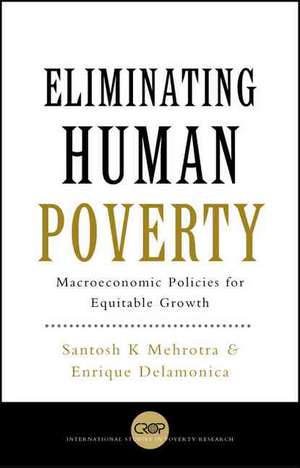
Eliminating Human Poverty: Macroeconomic and Social Policies for Equitable Growth: International Studies in Poverty Research
Autor Santosh Mehrotra, Enrique Delamonicaen Limba Engleză Paperback – 19 apr 2007
Their analysis, which departs from the dominant macro-economic paradigm, deploys the results of broad-ranging research they led at UNICEF and UNDP, investigating the record on basic social services of some 30 developing countries. In seeking to learn from these new data, they develop an analytical argument around two potential synergies: at the macro level, between poverty reduction, human development and economic growth, and at the micro level, between interventions to provide basic social services. Policymakers, they argue, can integrate macro-economic and social policy. Fiscal, monetary, and other macro-economic policies can be compatible with social sector requirements. They make the case that policymakers have more flexibility than is usually presented by orthodox writers and international financial institutions, and that if policymakers engaged in alternative macro-economic and growth-oriented policies, this could lead to the expansion of human capabilities and the fulfillment of human rights. This book explores some of these policy options.
The book also argues that more than just additional aid is needed. Specific strategic shifts in the areas of aid policy, decentralized governance, health and education policy and the private-public mix in service provision are a prerequisite to achieve the goals of human development. The combination of governance reforms and fiscal and macro-economic policies outlined in this book can eliminate human poverty in the span of a generation.
Din seria International Studies in Poverty Research
- 16%
 Preț: 259.52 lei
 - 15%
 Preț: 201.09 lei
 - 17%
 Preț: 246.11 lei
 - 15%
 Preț: 264.87 lei
 -
 Preț: 244.18 lei
 - 25%
 Preț: 241.25 lei
 - 23%
 Preț: 263.98 lei
 - 16%
 Preț: 255.64 lei
 - 16%
 Preț: 260.33 lei
 - 23%
 Preț: 260.96 lei
 - 17%
 Preț: 203.16 lei
 - 25%
 Preț: 204.56 lei
 - 17%
 Preț: 201.30 lei
 -
 Preț: 210.78 lei
 - 20%
 Preț: 200.71 lei
 - 20%
 Preț: 174.43 lei
 - 20%
 Preț: 186.01 lei
 - 40%
 Preț: 491.60 lei
 - 33%
 Preț: 560.94 lei
Preț: 268.18 lei
Preț vechi: 344.81 lei
-22%
Puncte Express: 402
Carte disponibilă
Livrare economică 10-24 noiembrie
Livrare prin curier în România Termenul estimat este afișat lângă disponibilitate.
Transport gratuit de la 400.00 lei Plată online sau ramburs, în funcție de opțiunile comenzii.
Retur gratuit în 14 zile Comandă securizată și suport în română.
Specificații
ISBN-13: 9781842777732
ISBN-10: 1842777734
Pagini: 448
Dimensiuni: 156 x 232 x 24 mm
Greutate: 0.68 kg
Editura: Bloomsbury Publishing
Colecția Zed Books
Seria International Studies in Poverty Research
Locul publicării:London, United Kingdom
ISBN-10: 1842777734
Pagini: 448
Dimensiuni: 156 x 232 x 24 mm
Greutate: 0.68 kg
Editura: Bloomsbury Publishing
Colecția Zed Books
Seria International Studies in Poverty Research
Locul publicării:London, United Kingdom
V-ar putea interesa
-
 -28%Preț: 457.10 lei634.34 lei
 -
 -31%Preț: 932.89 lei1355.79 lei
 -
 -21%Preț: 352.64 lei447.90 lei
 -
 Favela: Four Decades of Living on the Edge in Rio de JaneiroJanice Perlman-12%Preț: 271.78 lei307.87 lei
 -
 Fighting Poverty TogetherA. Karnani-8%Preț: 454.60 lei494.13 lei
 -
 Democracy Without DecencyWilliam M. EpsteinPreț: 276.35 lei
 -
 Demanding the LandPaul DoshPreț: 294.46 lei
 -
 Banerjee, A: Poor EconomicsAbhijit V. Banerjee-31%Preț: 60.15 lei86.94 lei
 -
 Preț: 274.55 lei
 -
 Collateral DamageZygmunt BaumanPreț: 135.39 lei
 -
 -27%Preț: 998.96 lei1362.05 lei
 -
 Slumming It: The Tourist Valorization of Urban PovertyFabian Frenzel-15%Preț: 145.65 lei170.78 lei
 -
 Making Poverty: A HistoryThomas Lines-12%Preț: 172.93 lei195.45 lei
 -
 -23%Preț: 260.96 lei340.37 lei
 -
 From Poverty to PowerDuncan GreenPreț: 261.95 lei
Cuprins
Introduction
Part I: Macroeconomic Policies
1. Integrating macroeconomic and social policies to trigger synergies
2. Macroeconomic policies and institutions for pro-poor growth
Part II: Public expenditure on basic health services
3. The inadequacy of public spending on basic social services
4. The distribution of benefits of health and education spending
5. Policies to enhance efficiency and improve delivery in the public provision of basic social services
6. Governance reforms to address the systemic problems of state provision of basic services
7. Promoting complementarity between public and private provision
Part III: Mobilizing domestic and external resources
8. Taxation and mobilization of additional resources for public social services
9. The consistency between aid and trade policies and the Millennium Goals
Conclusion
Part I: Macroeconomic Policies
1. Integrating macroeconomic and social policies to trigger synergies
2. Macroeconomic policies and institutions for pro-poor growth
Part II: Public expenditure on basic health services
3. The inadequacy of public spending on basic social services
4. The distribution of benefits of health and education spending
5. Policies to enhance efficiency and improve delivery in the public provision of basic social services
6. Governance reforms to address the systemic problems of state provision of basic services
7. Promoting complementarity between public and private provision
Part III: Mobilizing domestic and external resources
8. Taxation and mobilization of additional resources for public social services
9. The consistency between aid and trade policies and the Millennium Goals
Conclusion
Recenzii
This book is the blueprint for eradicating world poverty in the 21st century. Forget Stiglitz, move on from Sachs: this book based on over a decade of committed work in UNDP and UNICEF marks the real turning point away from neo-liberalism in the global discourse about economic and social policy.
This is an excellent, timely book...Innovative, clearly written, readable and draws on a comprehensive range of research.
This book gets to the core of what will be needed to revive economic growth after the slowdown in much of the developing world over the last 25-30 years - by reversing the deflationary tendency of much contemporary macroeconomic policy.
This book has an ambitious agenda. It offers a framework for conceptualizing macroeconomic policies on the assumption that people matter. The authors demonstrate a sure grasp of the complexities of policy-making to reduce poverty. This book offers an indispensable guide to policy makers and development practitioners.
A vital reference for donors, NGOs and others wanting to see the MDGs achieved - but uncertain how much it will cost. The analysis and 30 country case-studies provide important evidence and hard analysis to fill the gap between over-simple estimates of costs and over-cautious pessimism on policies.
This is an excellent, timely book...Innovative, clearly written, readable and draws on a comprehensive range of research.
This book gets to the core of what will be needed to revive economic growth after the slowdown in much of the developing world over the last 25-30 years - by reversing the deflationary tendency of much contemporary macroeconomic policy.
This book has an ambitious agenda. It offers a framework for conceptualizing macroeconomic policies on the assumption that people matter. The authors demonstrate a sure grasp of the complexities of policy-making to reduce poverty. This book offers an indispensable guide to policy makers and development practitioners.
A vital reference for donors, NGOs and others wanting to see the MDGs achieved - but uncertain how much it will cost. The analysis and 30 country case-studies provide important evidence and hard analysis to fill the gap between over-simple estimates of costs and over-cautious pessimism on policies.