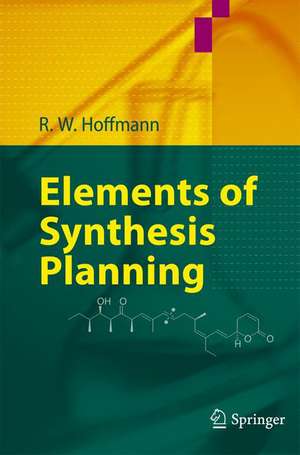
Elements of Synthesis Planning
Autor R. W. Hoffmannen Limba Engleză Paperback – 21 ian 2009
În literatura academică dedicată chimiei organice, observăm adesea o fragmentare între învățarea reacțiilor individuale și aplicarea lor strategică în asamblarea moleculelor complexe. Elements of Synthesis Planning vine să completeze exact această lacună, oferind un cadru riguros pentru transformarea unei structuri țintă ipotetice într-un plan de lucru viabil. Descoperim aici o abordare care nu se limitează la inventarierea reacțiilor, ci prioritizează logica din spatele selecției blocurilor de construcție și a secvențelor de reacție optime.
Subliniem faptul că R. W. Hoffmann tratează sinteza ca pe un proces de inginerie moleculară, unde eficiența este dictată de modul în care sunt gestionate grupurile funcționale și centrele stereogene. Structura volumului reflectă o progresie logică: de la seturi de legături orientate pe schelet și grupuri funcționale, până la utilizarea strategică a grupelor protectoare și ierarhizarea planurilor de sinteză. Un aspect distinctiv este includerea capitolului despre sinteza asistată de calculator, reflectând tranziția domeniului către metodele moderne de analiză. Găsim în această ediție din 2009 și o secțiune valoroasă de soluții la problemele propuse, transformând textul dintr-o expunere teoretică într-un instrument de lucru activ.
În contextul operei autorului, această lucrare reprezintă o evoluție spre sistematizarea pedagogică, spre deosebire de alte contribuții din portofoliul Springer, precum Der Boden in Seiner Chemischen und Biologischen Beschaffenheit, care explorează chimia în contexte istorice sau naturale. Cartea reprezintă o alternativă viabilă la A Holistic Approach to Organic Synthesis de Philip Garner pentru cursurile de chimie organică avansată, cu avantajul unei structuri mai analitice, axate pe ierarhizarea planurilor de sinteză și pe rezolvarea de probleme specifice.
Preț: 438.75 lei
Carte tipărită la comandă
Livrare economică 06-20 iunie
Specificații
ISBN-10: 3540792198
Pagini: 240
Ilustrații: X, 227 p. 297 illus.
Dimensiuni: 155 x 235 x 13 mm
Greutate: 0.41 kg
Ediția:2009
Editura: Springer
Locul publicării:Berlin, Heidelberg, Germany
V-ar putea interesa
-
 Organic Chemistry Demystified 2/EDaniel BlochPreț: 253.37 lei
 -
 Pyridines: From Lab to ProductionEric F.V. Scriven-31%Preț: 846.25 lei1229.70 lei
 -
 Organic Crystal ChemistryJ. B. Garbarczyk-23%Preț: 261.94 lei340.07 lei
 -
 Solutions Manual to accompany Organic ChemistryJonathan Clayden-21%Preț: 378.74 lei480.92 lei
 -
 -15%Preț: 519.81 lei611.54 lei
 -
 Nomenclature of Organic ChemistryHenri A Favre-14%Preț: 1375.96 lei1599.95 lei
 -
 Every Molecule Tells a StorySimon Cotton-9%Preț: 827.44 lei909.28 lei
 -
 Advanced Practical Organic ChemistryJohn Leonard-15%Preț: 656.39 lei772.22 lei
 -
 -11%Preț: 512.46 lei575.80 lei
 -
 Polymer Synthesis: Theory and PracticeDietrich Braun-15%Preț: 577.31 lei679.19 lei
Public țintă
GraduateDe ce să citești această carte
Recomandăm această carte studenților de la masterat și doctorat care doresc să stăpânească arta planificării sintezei organice. Dincolo de memorarea reacțiilor, cititorul câștigă capacitatea de a descompune logic molecule complexe și de a evalua critic diferite rute sintetice. Este un instrument esențial pentru oricine dorește să treacă de la execuția de laborator la proiectarea autonomă a secvențelor sintetice, beneficiind de expertiza clară a lui R. W. Hoffmann.
Descriere scurtă
Cuprins
Recenzii
“The text is recommended for those with a strong foundation in organic chemistry. … The book would be quite helpful for those who plan syntheses on a regular basis … . The text is a useful addition to the library of any synthetic organic chemist or to select undergraduate and graduate curricula. … Readers will certainly learn more about the chemistry, the logic, and the art of planning a novel synthesis and contributing to a vast and interesting field.” (Bridget G. Trogden, Journal of Chemical Education, Vol. 88, 2011)
From an undergraduate learning perspective the concept of synthesis planning or retrosynthesis can appear to be a daunting prospect. The idea of being asked to think backwards for many is a big leap, despite the vast majority already possessing a well-stocked chemical toolbox and being more than capable to explain a multitude of complex mechanistic transformations. In Elements of synthesis planning, a reworked translation of his original German text, Reinhard Hoffmann sets out to 'demystify' the art of synthetic planning, which is an essential and vital skill practised every day throughout the worldwide organic chemistry community.
In 12 clear and logical chapters, Hoffmann takes the reader from the basic concepts of retrosynthesis (use of synthons, identifying key bond disconnections, unmasking symmetry elements etc) to dedicated chapters on the application of chiral building blocks, strategic planning of complex synthetic sequences and the synthesis of polycyclic ring systems. In the final chapter, all these concepts are brought together to elegantly compare several individual approaches to one of five representative natural products, highlighting the tactics and strategies employed.
As such, this text would ideally complement an advanced undergraduate course on complex organic synthesis, which is beyond the level of most standard organic chemistrytextbooks. It would also prove highly useful to postgraduates at the beginning of their research careers in synthesis to inspire creativity and maybe put their ideas into practice.
Gordon Florence , Chemistry World, 2009, 6(8), p. 63