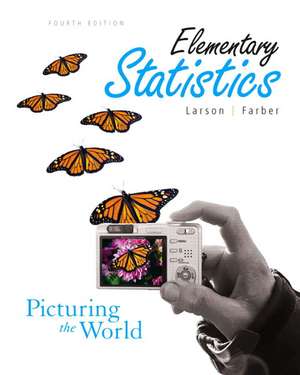
Elementary Statistics: Picturing the World: United States Edition
Autor Ron Larson, Betsy Farberen Limba Engleză Mixed media product – 27 dec 2007
În cadrul programelor de studiu universitare, cursul introductiv de statistică reprezintă adesea puntea necesară între rigoarea matematică și aplicabilitatea practică în științele sociale sau economice. Elementary Statistics: Picturing the World, Global Edition ocupă un loc central în acest curriculum, fiind conceput special pentru studenții care au nevoie de o abordare bazată pe algebră, dar orientată spre intuiție vizuală. Subliniem faptul că această a opta ediție rafinează metoda „picturing the world”, utilizând un design care corelează conținutul teoretic cu exemple grafice pe fiecare pagină, făcând materialul extrem de digerabil.
Descoperim aici o structură logică, organizată în două mari secțiuni: Statistica Descriptivă, care acoperă clasificarea datelor și măsurile de tendință centrală, și Probabilitatea, unde sunt explorate distribuțiile discrete și normale. Această progresie asigură că studentul stăpânește mai întâi instrumentele de observare înainte de a trece la modelele predictive. Cititorii familiarizați cu Elementary Statistics de Mario F. Triola vor aprecia aici accentul pus pe instrucțiunile „stepped-out” (pas cu pas), care ghidează rezolvarea problemelor cu o precizie mai mare decât în manualele tehnice standard.
Reținem, de asemenea, integrarea robustă a resurselor digitale. Față de abordarea pur teoretică din alte lucrări ale lui Ron Larson, precum Calculus, acest volum pune un accent deosebit pe instrumente precum StatCrunch și noile „Tech Tips”. Această ediție globală menține standardul de claritate specific autorului, dar îl adaptează pentru o audiență internațională, oferind un echilibru între exercițiile tradiționale și analiza datelor reale.
Preț: 742.29 lei
Preț vechi: 964.01 lei
-23%
Carte indisponibilă temporar
Specificații
ISBN-10: 0132424339
Pagini: 792
Dimensiuni: 216 x 276 x 32 mm
Greutate: 1.87 kg
Ediția:Nouă
Editura: Pearson Education
Colecția Pearson Education
Locul publicării:Upper Saddle River, United States
De ce să citești această carte
Recomandăm acest volum studenților și autodidacților care doresc să înțeleagă statistica fără a se pierde în demonstrații matematice abstracte. Prin utilizarea exemplelor din viața reală și a unui format vizual aerisit, Elementary Statistics: Picturing the World, Global Edition transformă analiza datelor dintr-o corvoadă într-o abilitate practică. Este resursa ideală pentru a câștiga încredere în utilizarea software-ului statistic și în interpretarea corectă a informațiilor din mediul înconjurător.
Despre autor
Ron Larson este doctor în matematică, titlu obținut la University of Colorado în 1970, și este în prezent profesor la Penn State University. Cu o carieră de peste patru decenii, Larson este autorul principal a peste 24 de manuale matematice, de la nivel gimnazial până la calcul universitar, fiind recunoscut pentru capacitatea de a simplifica concepte complexe. Betsy Farber, coautoarea sa, aduce o experiență pedagogică vastă acumulată la Bucks County Community College. Împreună, au creat o metodologie didactică ce pune accent pe claritate și pe succesul studentului în înțelegerea matematicii aplicate.
Descriere
Offering the most accessible approach to statistics, with a strong visual/graphical emphasis, this text offers a vast number of examples on the premise that students learn best by "doing". The fourth edition features many updates and revisions that place increased emphasis on interpretation of results and critical thinking in addition to calculations. This emphasis on "statistical literacy" is reflective of the GAISE recommendations.
Datasets and other resources (where applicable) for this book are available here.
Cuprins
1. Introduction to Statistics.
An Overview of Statistics. Data Classification. Case Study: Rating Television Shows in the United States. Experimental Design.
2. Descriptive Statistics.
Frequency Distributions and Their Graphs. More Graphs and Displays. Measures of Central Tendency. Measures of Variation. Case Study: Earnings of Athletes. Measures of Position.
3. Probability.
Basic Concepts of Probability. Conditional Probability and the Multiplication Rule. The Addition Rule. Case Study: Probability and Parking Lot Strategies. Additional Topics in Probability and Counting.
4. Discrete Probability Distributions.
Probability Distributions. Binomial Distributions. Case Study: Binomial Distribution of Airplane Accidents. More Discrete Probability Distributions.
5. Normal Probability Distributions.
Introduction to Normal Distributions and the Standard Normal Distribution. Normal Distributions: Finding Probabilities. Normal Distributions: Finding Values.
Case Study: Birth Weights in America. Sampling Distributions and The Central Limit Theorem. Normal Approximations to Binomial Distributions.
6. Confidence Intervals.
Confidence Intervals for the Mean (Large Samples). Case Study: Shoulder Heights of Appalachian Black Bears. Confidence Intervals for the Mean (Small Samples). Confidence Intervals for Population Proportions. Confidence Intervals for Variance and Standard Deviation.
7. Hypothesis Testing with One Sample
Introduction to Hypothesis Testing. Hypothesis Testing for the Mean (Large Samples). Case Study: Human Body Temperature: What's Normal? Hypothesis Testing for the Mean (Small Samples). Hypothesis Testing for Proportions. Hypothesis Testing for the Variance and Standard Deviation.
8. Hypothesis Testing with Two Samples.
Testing the Difference Between Means (Large Independent Samples). Case Study: Oatbran and Cholesterol Level. Testing the Difference Between Means (Small Independent Samples). Testing the Difference Between Means (Dependent Samples). Testing the Difference Between Proportions.
9. Correlation and Regression.
Correlation. Linear Regression. Case Study: Correlation of Body Measurements. Measures of Regression and Prediction Intervals. Multiple Regression.
10. Chi-Square Tests and the F-Distribution.
Goodness of Fit. Independence. Case Study: Traffic Safety Facts. Comparing Two Variances. Analysis of Variance.
11. Nonparametric Tests.
The Sign Test. The Wilcoxon Tests. Case Study: Health and Nutrition. The Kruskal-Wallis Test. Rank Correlation. Runs Test.
Appendix A.
Alternative Presentation of the Standard Normal Distribution. Standard Normal Distribution Table (0-to-z). Alternate Presentation of the Standard Normal Distribution.
Appendix B.
Tables.
Notă biografică
Betsy Farber received her Bachelor's degree in mathematics form Penn State University and Master's degree in mathematics from the College of New Jersey. Since 1976, she has been teaching all levels of mathematics at Bucks County Community College in Newton, Pennsylvania, where she currently holds the rank of professor. She is particularly interested in developing new ways to make statistics relevant and interesting to her students and has been teaching statistics in many different modes - with TI-83/84, with MINITAB, and by distance learning as well as in the traditional classroom.
Caracteristici
~Enhances students’ understanding of examples, and then gives them the opportunity to try one themselves right away.
Highly graphical approach—Incorporates more than 750 graphical displays (more than twice as many as most introductory texts).
~Helps students “picture” and understand the story told by the data, and presents corresponding graphs in place to prevent students from having to flip back and forth between pages.
Balanced Approach: the text strikes a balance between computation, decision making and conceptual understanding (as endorsed by the GAISE recommendations).
A Large Variety of Real-World Applications to illustrate to students the relevance of the material they are learning.
Over 1,900 exercises that help students build basic skills and vocabulary, use and interpret concepts, and extend concepts.
Full-page chapter case study–Includes actual data from a real-world context, along with a series of thought-provoking questions designed to illustrate important concepts of the chapter and to provide students motivation for the statistical concepts they are learning. Approximately 30% of the chapter case studies have been updated for the 4th edition.
~The case studies can be used as a springboard for group or individual projects to encourage critical thinking and classroom discussion.
“Picturing the World” mini case studies–Illustrates the important concept or concepts of each section, and concludes with a question that links to the content.
~Underscores the real-world importance of understanding statistics, and promotes classroom discussion and student projects.
Real Statistics/Real Decisions–Features a full-page, real-life situation accompanied by exercises. Approximately 30% of the Real Statistics/Real Decisions have been updated.
~Prompts students to use the concepts in the chapter to make decisions.
Flexible technology–Allows the text to be used in courses with no more technology than a scientific calculator, or in courses that require frequent use of sophisticated technology tools.
~Provides students with an understanding of the mathematical concepts behind the instant answer that technology tools provide. Gives instructors the freedom to determine the degree of technological dependency their individual course will require.
~Many sections contain a worked example that shows how technology can be used to calculate formulas, perform tests, or display data. Screen displays from MINITAB, Excel and the TI-83/84 are given.
Technology project in each chapter–Approximately 30% of the technology projects have been updated. Each chapter has a full page technology project using tools from MINITAB, Excel and TI-83/84.
~Gives students additional insight into the way technology is used to handle large data sets or complex, real-life questions. Provides more depth for instructors and students seeking to increase the technology flavor of the course.
Uses and Abuses–Includes a full page in each chapter that summarizes the uses of chapter concepts, as well as a description of common misuses. Each “abuse” is accompanied by one or more exercises. Occasionally, these also include a discussion of ethical issues. Approximately 30% of the Uses and Abuses have been updated.
Chapter Summary, Review Exercises, and Quiz–Each chapter concludes with a Chapter Summary that answers the question What did you learn? Each topic in the summary listing is correlated to the appropriate chapter example(s) and chapter exercise(s). Also, the chapter summary contains a list of the formulas covered in the chapter.
~Gives students a convenient study aid and opportunity to test their knowledge of the chapter.
Caracteristici noi
Stronger Emphasis upon critical thinking skills — Makes students better problem solvers by following the recommendations of the GAISE report (Guidelines for Assessment and Instruction in Statistical Education).
- Emphasize statistical literacy and develop statistical thinking: The authors accomplish this through their examples and "Picturing the World" studies. The examples, with worked-out solutions, show students the process of statistical thinking. Many examples include an interpretation step that offers a further insight or reflection on the concept presented in the example. The Picturing the World studies provides the basis for a class discussion of a concept and allows the instructor to assess and give feedback to students' thinking.
- Use Real Data - new and updated data in the examples, exercises, Case Studies, "Real Statistics-Real Decisions", and "Picturing the World" studies, motivate students to learn statistical concepts in a real-world setting.
- Stress Conceptual Understanding rather than mere knowledge of procedures - More examples have an "interpretation" step to help focus students beyond the calculations on the actual meaning and/ or application of the solution.
- Foster Active Learning in the Classroom - Activities have been added to this new edition. They integrate the use of applets and facilitate opportunities for hands-on learning.
- Use Technology for Developing Conceptual Understanding and Analyzing Data - Updated technology and additional output screens are included to allow students to focus more on the underlying ideas rather than on the calculations. Access to electronic data sets allow students to focus on the analysis of large data sets instead of inputting the data.
- Use Assessments to Improve and Evaluate Student Learning - Chapter Tests and cumulative review exercises assess student's understanding of concepts and techniques presented
- MyStatLab -- Powered by CourseCompass and MathXL, MyStatLab provides a rich and flexible set of course materials for the Larson/Farber textbook, along with course management tools that make it easy to customize an online course. MyMathLab includes tutorials, a multimedia textbook, online gradebook, and assessment capabilities, along with an online Student Solutions Manual, Pearson Tutor Center, technology manual and video lectures.
- “Notes to the Instructor” -- Appear at the beginning of each chapter (in the AIE), providing suggestions and insights on how to teach the concepts within that chapter. This resource will be of particular help to teachers that are new to teaching statistics and/ or experienced teachers looking for fresh ideas.
- Chapter Quiz Prep Videos -- Contained on a CD within the student text and the Student Study Pack. Also offered through MyStatLab. Video of an instructor walking through and solving the end of chapter quizzes. These help students study and prepare for tests and exams.
- Student Solutions Manual -- Includes complete worked-out solutions to all of the Try It Yourself exercises, the odd-numbered exercises, and all of the Chapter Quiz exercises.
- CD Lecture Series -- A comprehensive set of CD-ROMs, tied to the textbook, containing short video clips of an instructor working every Try It Yourself exercise.
- Technology Manual -- Tutorial instruction and worked-out examples for the TI-83 Calculator, Excel, and MINITAB.
Applets: Approximately 14 applets are included on the text CD and available within MyStatLab. Applets have great value because they allow students to explore certain concepts interactively rather than by using a static text figure. For example, creating a sampling distribution is accomplished more readily with applets than with a static text figure.
The book has been split into 4 Parts. At the conclusion of each Part, there is a cumulative set of exercises. These cumulative exercises cover multiple topics to ensure comprehension. of the important concepts and, also, which technique to implement.
20% REVISED exercises [over 1900 exercises] and 20% NEW examples [over 660] — Increased breadth and depth of exercises.
~Gives instructors a wide variety of problems to assign and shows students a diverse range of interesting real-life applications.
~Divides exercises into three different types. Using and Interpreting Concepts is a new exercise category:
-Building Basic Skills and Vocabulary—Short answer, true and false, or vocabulary exercises.
-Using and Interpreting Concepts—Skill or word problems that emphasize critical thinking. [New exercise type]
-Extending Concepts–More challenging exercises that go beyond the material presented in the section.
New Chapter Openers (Ch. 1-3,5,9, and 11)– Each chapter begins with a two-page visual description of a real-life problem that is revisited, in concept, later in the chapter.
~Shows students how the chapter fits into the bigger picture of statistics by connecting it to topics learned in earlier chapters, and then gives them an overview of the chapter in the context of the real world data presented.
Chapter Specific Changes:
- Expanded coverage of Experimental Design in Chapter 1 (1.3)
- Moved the Fundamental Counting Principle from 3.4 to 3.1.
- Added technology output screens throughout the text.