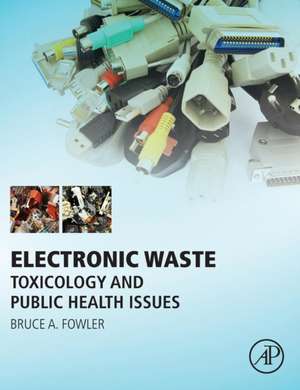
Electronic Waste: Toxicology and Public Health Issues
Autor Bruce A. Fowleren Limba Engleză Hardback – 20 apr 2017
To provide readers with potential solutions to this global problem, Dr. Fowler presents risk assessment approaches using chemicals, mixtures, biomarkers, susceptibility factors, and computational toxicology. He discusses how to translate the information gathered through risk assessment into safe and effective international policies.
The final chapter is devoted to future research directions. This is a timely and useful resource for all those concerned with the health issues surrounding e-waste management and proper disposal, including toxicologists, public health and policy officials, environmental scientists, and risk assessors.
- Offers a well-researched, single authored book and draws attention to the need for better and more informed risk assessment and policymaking in this area
- Emphasizes the transference of electronic waste (e-waste) to developing countries where populations of concern include children working in recycling activities and impoverished groups with poor nutritional status and limited access to medical resources
- Reviews, in detail, the issue of exposure to chemical mixtures as a central feature of e-waste due to the presence of a number of organic and inorganic chemicals in modern electronic devices
Preț: 650.89 lei
Preț vechi: 843.86 lei
-23%
Puncte Express: 976
Carte tipărită la comandă
Livrare economică 23 noiembrie-07 decembrie
Livrare prin curier în România Termenul estimat este afișat lângă disponibilitate.
Transport gratuit pentru acest produs Plată online sau ramburs, în funcție de opțiunile comenzii.
Retur gratuit în 14 zile Comandă securizată și suport în română.
Specificații
ISBN-13: 9780128030837
ISBN-10: 0128030836
Pagini: 100
Dimensiuni: 191 x 235 x 11 mm
Greutate: 0.4 kg
Editura: ELSEVIER SCIENCE
ISBN-10: 0128030836
Pagini: 100
Dimensiuni: 191 x 235 x 11 mm
Greutate: 0.4 kg
Editura: ELSEVIER SCIENCE
Cuprins
1. Magnitude of the Global E-Waste Problem
2. Metals, Metallic Compounds, Organic Chemicals, and E-Waste Chemical Mixtures
3. Toxicology of E-Waste Chemicals—Mechanisms of Action
4. Populations at Special Risk
5. Risk Assessment/Risk Communication Approaches for E-Waste Sites
6. Translation of Risk Assessment Information Into Effective International Policies and Actions
7. Current E-Waste Data Gaps and Future Research Directions
2. Metals, Metallic Compounds, Organic Chemicals, and E-Waste Chemical Mixtures
3. Toxicology of E-Waste Chemicals—Mechanisms of Action
4. Populations at Special Risk
5. Risk Assessment/Risk Communication Approaches for E-Waste Sites
6. Translation of Risk Assessment Information Into Effective International Policies and Actions
7. Current E-Waste Data Gaps and Future Research Directions