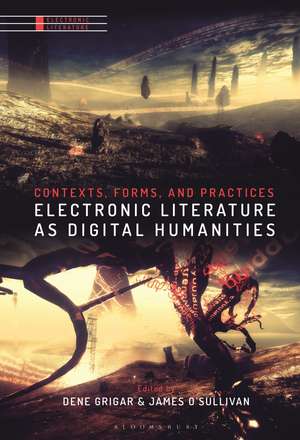
Electronic Literature as Digital Humanities: Contexts, Forms, and Practices: Electronic Literature
Editat de Professor Dene Grigar, Dr. James O’Sullivanen Limba Engleză Paperback – 25 aug 2022
Acest volum colectiv, publicat sub egida Bloomsbury Academic, se prezintă ca un companion academic esențial pentru înțelegerea literaturii născute digital. Notăm cu interes abordarea editorilor Dene Grigar și James O’Sullivan, care refuză o definiție prescriptivă în favoarea unei explorări ontologice a textului aflat la intersecția dintre literar și algoritmic. Reținem faptul că această lucrare poziționează literatura electronică drept un pilon central al Digital Humanities, sintetizând cele două direcții adesea separate ale domeniului: critica teoretică și construcția de artefacte digitale.
Din punct de vedere structural, volumul este organizat riguros pentru a facilita progresia de la istorie la practică. Prima secțiune, „Contexts”, analizează evoluția domeniului, de la originile literaturii electronice și festivalurile de e-poezie, până la spațiile literare cyberfeministe și manifestările corporale în mediul digital. Cea de-a doua parte, „Forms”, se concentrează pe specificitatea mediului, investigând relația cu sunetul, arta ambientală și noile frontiere deschise de realitatea augmentată. Această organizare permite cititorului să urmărească tranziția de la baze instituționale la experimente estetice aplicate.
Extinde cadrul propus de Electronic Literature – New Horizons for the Literary de N. Katherine Hayles prin integrarea unor date noi din „momentul DH” actual, punând un accent mai mare pe colaborarea dintre artiști și cercetători. În timp ce lucrarea lui Hayles servea drept o introducere sistematică în domeniu, acest volum colectiv adâncește dimensiunea practică și politică, explorând cum comunitățile și bazele de date au modelat un câmp literar internațional, similar modului în care The Bloomsbury Handbook of Electronic Literature cartografiază diversitatea formelor contemporane.
Preț: 217.50 lei
Preț vechi: 290.18 lei
-25%
Carte tipărită la comandă
Livrare economică 07-21 decembrie
Specificații
ISBN-10: 1501373897
Pagini: 392
Ilustrații: 22 bw illus
Dimensiuni: 148 x 226 x 22 mm
Greutate: 0.52 kg
Editura: Bloomsbury Publishing
Colecția Bloomsbury Academic
Seria Electronic Literature
Locul publicării:New York, United States
V-ar putea interesa
-
 MotherhoodSheila Heti-19%Preț: 64.36 lei79.10 lei
 -
 A Sand BookAriana Reines-27%Preț: 78.73 lei108.50 lei
 -
 Uncreative WritingKenneth GoldsmithPreț: 132.27 lei
 -
 EssaysLydia Davis-15%Preț: 126.65 lei148.85 lei
 -
 The Collected Stories of Lydia DavisLydia Davis-26%Preț: 71.69 lei96.93 lei
 -
 Third World Women and the Politics of FeminismChandra Talpade MohantyPreț: 188.31 lei
 -
 this bridge we call home: radical visions for transformationGloria Anzaldúa-15%Preț: 470.21 lei553.18 lei
 -
 Furious Flower: Seeding the Future of African American PoetryDr. Joanne V. GabbinPreț: 234.75 lei
 -
 DeviationsGayle S RubinPreț: 212.17 lei
 -
 Essays TwoLydia DavisPreț: 141.59 lei
 -
 Vibrant Death: A Posthuman Phenomenology of MourningProfessor Nina Lykke-32%Preț: 584.81 lei864.97 lei
 -
 -24%Preț: 185.09 lei244.04 lei
 -
 -13%Preț: 166.26 lei190.39 lei
 -
 -42%Preț: 145.99 lei252.13 lei
 -
 More Posthuman GlossaryProfessor Rosi Braidotti-13%Preț: 164.98 lei189.55 lei
 -
 Materialist Phenomenology: A Philosophy of PerceptionProfessor Manuel DeLanda-19%Preț: 168.98 lei209.60 lei
 -
 This Bridge Called My BackCherríe MoragaPreț: 256.18 lei
 -
 Post-Digital: Dialogues and Debates from electronic book reviewProfessor Joseph Tabbi-59%Preț: 1374.71 lei3389.35 lei
 -
 This Wound Is a WorldBilly-Ray BelcourtPreț: 83.79 lei
 -
 The Right to Sex: Shortlisted for the Orwell Prize 2022Amia Srinivasan-32%Preț: 53.81 lei79.10 lei
 -
 Crying in H MartMichelle Zauner-39%Preț: 47.92 lei78.75 lei
 -
 The Pain JournalBob FlanaganPreț: 109.37 lei
 -
 The Violence of Financial Capitalism, New EditionChristian MarazziPreț: 71.99 lei
 -
 Last Days at Hot SlitAndrea Dworkin-14%Preț: 102.61 lei119.25 lei
 -
 The Cybernetic HypothesisTiqqun-16%Preț: 73.95 lei88.41 lei
 -
 Bee ReavedDodie BellamyPreț: 106.50 lei
 -
 Preț: 112.92 lei
 -
 -30%Preț: 68.89 lei98.67 lei
 -
 Fetishism and Curiosity: Cinema and the Mind's EyeLaura Mulvey-25%Preț: 174.01 lei233.20 lei
De ce să citești această carte
Această culegere de studii se adresează studenților și cercetătorilor din domeniul studiilor media și literare care doresc să înțeleagă cum tehnologia transformă actul scrierii. Cititorul câștigă o perspectivă actualizată asupra literaturii digitale, învățând să analizeze operele nu doar ca texte, ci ca sinteze între cod și expresie culturală. Este resursa ideală pentru a naviga între teorie și practica algoritmică a literaturii moderne.
Descriere
The domain of DH is typically segmented into the two seemingly disparate strands of criticism and building, with scholars either studying the synthesis between cultural expression and screens or the use of technology to make artifacts in themselves. This book regards electronic literature as fundamentally DH in that it synthesizes these two constituents. Electronic Literature as Digital Humanities provides a context for the development of the field, informed by the forms and practices that have emerged throughout the DH moment, and finally, offers resources for others interested in learning more about electronic literature.
The ebook editions of this book are available open access under a CC BY-NC-ND 3.0 licence on www.bloomsburycollections.com.
Cuprins
Electronic Literature as Digital Humanities: An Introduction
Dene Grigar
Section I Contexts
1. The Origins of Electronic Literature: An Overview
Giovanna di Rosario, Nohelia Meza, and Kerri Grimaldi
2. Third-Generation Electronic Literature
Leonardo Flores
3. Toys and Toons: From Hispanic Literary Traditions to a Global E-Lit Landscape
Élika Ortega and Alex Saum-Pascual
4. Community, Institution, Database: Tracing the Development of an International Field through ELO, ELMCIP, and CELL
Davin Heckman
5. The E-Poetry Festivals: Celebration, Art, and Imagination in Community
Loss Pequeño Glazier
6. Cyberfeminist Literary Space: Performing the Electronic Manifesto
Carolyn Guertin
7. Bodies in E-Lit
Astrid Ensslin, Carla Rice, Sarah Riley, Christine Wilks, Megan Perram, Hannah Fowlie, Lauren Munro and K. Alysse Bailey
Section II Forms
8. Ambient Art and Electronic Literature
Jim Bizzocchi
9. Electronic Literature and Sound
John F. Barber
10. Augmented Reality
Anne Karhio
11. Artistic and Literary Bots
Leonardo Flores
12. Consuming the Database: The Reading Glove as a Case Study of Combinatorial Narrative
Theresa Jean Tanenbaum and Karen Tanenbaum
13. Hypertext Fiction Ever After
Stuart Moulthrop
14. Place Taking Place: Temporary Poetic Theaters
Judd Morrissey
15. Kinetic Poetry
Álvaro Seiça
16. Kinepoeia in Animated Poetry
Dene Grigar
17. Mobile Electronic Literature
Jeneen Naji
18. The Voice of the Polyrhetor: Physical Computing and the (e-)Literature of Things
Helen J. Burgess
19. Having Your Story and Eating It Too: Affect and Narrative in Recombinant Fiction
Will Luers
Section III Practices
20. Challenges to Archiving and Documenting Born-Digital Literature: What Scholars, Archivists, and Librarians Need to Know
Dene Grigar
21. Holes as a Collaborative Project
Graham Allen
22. Publishing Electronic Literature
James O'Sullivan
23. E-Lit after Flash: The Rise (and Fall) of a "Universal" Language
Anastasia Salter and John Murray
24. Learning as You Go: Inventing Pedagogies for Electronic Literature
Davin Heckman
Section IV Artist Interventions
25. My cODEwORk ARTicle
Michael J. Maguire
26. Locative Narrative
Jeremy Hight
27. Come Play Netprov!: Recipes for an Evolving Practice
Rob Wittig and Mark C. Marino
28. A Collective Imaginary: A Published Conversation
Kate Pullinger and Kate Armstrong
29. Addressing Torture in Iraq through Critical Digital Media Art-Hearts and Minds: The Interrogations Project
Roderick Coover, Scott Rettberg, Daria Tsoupikova and Arthurh Nishimoto
30. Poetic Playlands: Poetry, Interface, and Video Game Engines
Jason Nelson
31. A Way Is Open: Allusion, Authoring System, Identity, and Audience in Early Text-Based Electronic Literature
Judy Malloy
Index
Recenzii
As digital humanities scholarship becomes increasingly involved with digital arts and culture, this publication offers a treasure trove of examples of the integration of these fields. In their collection, Electronic Literature as Digital Humanities: Contexts, Forms, and Practices, Dene Grigar and James O'Sullivan have assembled a variety of scholarly approaches to the natural relationship between electronic literature and digital humanities. The essays expand on traditional strategies in humanities research such as deep history, tracing both the print and computer origins of e-lit, and the extent of global presence. The works also examine remarkable instances of digital practice and form. The scope and the specificity of the book make it an excellent resource for researchers.
After Goethe imagined a world literature in formation, Karl Marx predicted its rise, and Franco Moretti mapped its whereabouts, is such a thing realizable at last in digital environments? Is electronic literature, ignored by English Departments and all but a few Creative Writing Programs, ready to be integrated into the Digital Humanities? There is certainly no shortage of candidates for an emerging world literature in this gathering of multi-national talents by Dene Grigar and James O'Sullivan; no shortage of languages, cultural backgrounds, heritage and creative contexts. Emerging genres like Interactive Fiction are said to express a multivariate world mode (Montfort), one that could well replace national one-sidedness and resituate local literatures. We are beginning now to look at literary works written in the form of a computer program. Recombinant, database, codework and network fictions (Seaman, Manovich, Marino, Ciccoricco); collective imaginaries (Pullinger and Armstrong); aesthetic animism (Jhave); nonlinear, nonconscious, affective, and emergent significations (Hayles, Rettberg and Coover); sound no less than sighted texts (Luers). We have here, in this volume, sustained scholarly engagement with locative media, spatial narratives, augmented realities that display an aesthetic, geographical, and linguistic diversity never so apparent in earlier formations of the "Humanities." At the least, there will be (as there have always been) literary suggestions of "some world other than the one we inhabit" (Moulthrop).