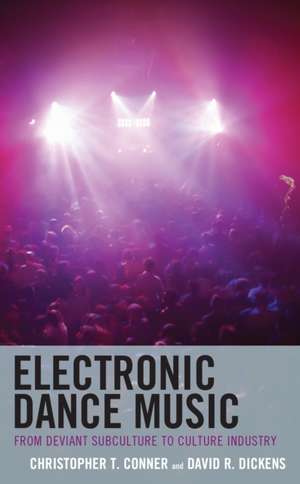
Electronic Dance Music: From Deviant Subculture to Culture Industry: Critical Perspectives on Music and Society
Autor Christopher T. Conner, David R. Dickensen Limba Engleză Hardback – 28 feb 2023
Check out an interview with the author on the New Books Network podcast here: https://newbooksnetwork.com/electronic-dance-music
| Toate formatele și edițiile | Preț | Express |
|---|---|---|
| Paperback (1) | 207.08 lei 6-8 săpt. | |
| Bloomsbury Publishing – 29 ian 2025 | 207.08 lei 6-8 săpt. | |
| Hardback (1) | 489.99 lei 6-8 săpt. | |
| Bloomsbury Publishing – 28 feb 2023 | 489.99 lei 6-8 săpt. |






Preț: 489.99 lei
Preț vechi: 715.96 lei
-32%
Puncte Express: 735
Preț estimativ în valută:
86.77€ • 101.34$ • 75.38£
86.77€ • 101.34$ • 75.38£
Carte tipărită la comandă
Livrare economică 21 februarie-07 martie
Preluare comenzi: 021 569.72.76
Specificații
ISBN-13: 9781793620392
ISBN-10: 1793620393
Pagini: 150
Ilustrații: 30 b/w photos;
Dimensiuni: 158 x 238 x 15 mm
Greutate: 0.38 kg
Editura: Bloomsbury Publishing
Colecția Lexington Books
Seria Critical Perspectives on Music and Society
Locul publicării:New York, United States
ISBN-10: 1793620393
Pagini: 150
Ilustrații: 30 b/w photos;
Dimensiuni: 158 x 238 x 15 mm
Greutate: 0.38 kg
Editura: Bloomsbury Publishing
Colecția Lexington Books
Seria Critical Perspectives on Music and Society
Locul publicării:New York, United States
Cuprins
Contents
Acknowledgments
Introduction
Chapter 1. Phase I: Beginnings (1980s-1995)
Chapter 2. Phase II: The Rise of the Rave Outlaw (1995-2009)
Chapter 3. Phase III: EDM as Culture Industry (2010-2022)
Conclusion
Appendix: The Rave Act
References
About the Authors
Acknowledgments
Introduction
Chapter 1. Phase I: Beginnings (1980s-1995)
Chapter 2. Phase II: The Rise of the Rave Outlaw (1995-2009)
Chapter 3. Phase III: EDM as Culture Industry (2010-2022)
Conclusion
Appendix: The Rave Act
References
About the Authors
Recenzii
This is a careful review of the rave scene and EDM culture as it has evolved over time. The authors should be commended for their astute sociological analysis, which should be helpful in college classrooms across the US.
Making sense of and clearly mapping EDM's key historical transitions, Conner and Dickens have filled in gaps of much-needed research in dance music literature. In fun and accessible prose, we get rich and textured analyses of interviews with fans, promoters, and DJs, documents from industry insiders, and media portrayals of the subculture. Without a doubt, this book will be central to dance music debates and discussions for years to come.
Electronic Dance Music: From Deviant Subculture to Culture Industry pulsates with the raw, crackling energy of the subcultures this book engages. Offering a comprehensive investigation into the evolution of EDM subcultures in the United States and Europe, Christopher T. Conner and David R. Dickens expose EDM's transition from a countercultural movement originating within Black and Latinx queer subcultures to the mainstream cultural industry fueling the economic and cultural transformation of cities. Beautifully researched and filled with colorful interviews from tastemakers within the EDM world, this book will not only become the definitive study of EDM culture; it will also make its mark as a canonical text for any student interested in the sociological study of culture, subcultures, and music.
Electronic Dance Music: From Deviant Subculture to Culture Industry is a thorough and scholarly work. In a series of three chronological essays, Conner and Dickens detail a full picture of the electronic music story, including its influences, technological components, characters, successes, and troubles. The book examines some of the little reported nuances of the industry related to culture, from its marginalization to eventual popularization.
Readers hoping for solutions to the problems of subcultural appropriation and the commodifying of resistance to the dominant social order may be left feeling disappointment, but that is arguably the authors' point. Rather than suggesting that solutions exist, Conner and Dickens use the concept of culture industry to systematically articulate how and why spaces of resistance are socially constructed and transformed into sources of marginalization for disenfranchised people and groups. [Any] weaknesses are, in truth, rather trivial when considering the book's important contributions to our sociological understandings of how culture is used to socially construct resistance as deviant and to undermine solidarity among marginalized groups. As such, it is very well suited for use in a variety of courses, including those that focus on cultural sociology, deviance, race, and Queer studies.
Making sense of and clearly mapping EDM's key historical transitions, Conner and Dickens have filled in gaps of much-needed research in dance music literature. In fun and accessible prose, we get rich and textured analyses of interviews with fans, promoters, and DJs, documents from industry insiders, and media portrayals of the subculture. Without a doubt, this book will be central to dance music debates and discussions for years to come.
Electronic Dance Music: From Deviant Subculture to Culture Industry pulsates with the raw, crackling energy of the subcultures this book engages. Offering a comprehensive investigation into the evolution of EDM subcultures in the United States and Europe, Christopher T. Conner and David R. Dickens expose EDM's transition from a countercultural movement originating within Black and Latinx queer subcultures to the mainstream cultural industry fueling the economic and cultural transformation of cities. Beautifully researched and filled with colorful interviews from tastemakers within the EDM world, this book will not only become the definitive study of EDM culture; it will also make its mark as a canonical text for any student interested in the sociological study of culture, subcultures, and music.
Electronic Dance Music: From Deviant Subculture to Culture Industry is a thorough and scholarly work. In a series of three chronological essays, Conner and Dickens detail a full picture of the electronic music story, including its influences, technological components, characters, successes, and troubles. The book examines some of the little reported nuances of the industry related to culture, from its marginalization to eventual popularization.
Readers hoping for solutions to the problems of subcultural appropriation and the commodifying of resistance to the dominant social order may be left feeling disappointment, but that is arguably the authors' point. Rather than suggesting that solutions exist, Conner and Dickens use the concept of culture industry to systematically articulate how and why spaces of resistance are socially constructed and transformed into sources of marginalization for disenfranchised people and groups. [Any] weaknesses are, in truth, rather trivial when considering the book's important contributions to our sociological understandings of how culture is used to socially construct resistance as deviant and to undermine solidarity among marginalized groups. As such, it is very well suited for use in a variety of courses, including those that focus on cultural sociology, deviance, race, and Queer studies.