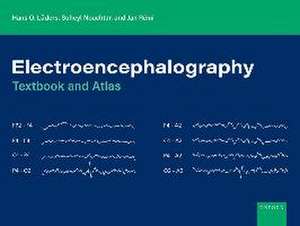
Electroencephalography: Textbook and Atlas
Autor Hans O. Lüders, Soheyl Noachtar, Jan Rémien Limba Engleză Hardback – 21 noi 2024
Electroencephalography (EEG) is one of the oldest neurophysiological techniques used to evaluate brain activity and is a cornerstone of technical diagnostics in neurology. The technical advancement of electroencephalography in the last few decades, however, asks for a new approach to EEG reading. This textbook and atlas provides a systematic approach to normal and abnormal EEG patterns, serving as an instructional guide for the beginner in EEG and an essential reference for the experienced EEG reader. Containing about 400 figures illustrating typical EEG patterns which are also available online in reformatted referential and bipolar montages, this book covers how electrical waves are generated into the brain, the equipment required to record electrical brain waves (including the set-up of EEG machines, electrodes, and procedures), biological and non-biological disturbances called artifacts in EEG recordings, and differentiation of normal and abnormal patterns in EEG. The reader will be introduced to a systematic analysis of EEG interpretation by defining the characteristics of the EEG patterns (polarity, localization, frequency, modulation etc.) and their clinical meaning, making this an essential text that should be on the bookshelf of every medical professional using EEG.
Preț: 1658.93 lei
Preț vechi: 1746.24 lei
-5%
Carte disponibilă
Livrare economică 17 noiembrie-01 decembrie
Specificații
ISBN-10: 0197502334
Pagini: 520
Dimensiuni: 231 x 297 x 31 mm
Greutate: 2.22 kg
Editura: Oxford University Press
Colecția OUP USA
Locul publicării:New York, United States
Notă biografică
Hans Lüders, MD, PhD is a Professor of Neurology at University Hospitals Cleveland Medical Center at Case Western Reserve University School of Medicine. Dr. Lüders' primary interest is epilepsy and clinical neurophysiology, developing the 4-dimensional classification of epilepsies and the pure semiological classification of epileptic seizure. He pioneered the use of subdural electrodes to evaluate patients with medically intractable epilepsy who are candidates for surgery and was the first to describe the basal temporal language area, the basal temporal alexia center, and the primary and supplementary negative motor area.Soheyl Noachtar, MD, is Professor of Neurology at the Ludwig Maximilians University of Munich (LMU-Munich) and the former Head of the Epilepsy Center of the University of Munich Hospital. He holds certification from the American Board of Clinical Neurophysiology and is a certified neurologist and psychiatrist by the German Chamber of Physicians. After a fellowship withHans Lüders at the Cleveland Clinic Foundation, he was appointed chairman of the EEG department and a founding member and co-director of the Department of Epilepsy Surgery at the Bethel Epilepsy Center in Bielefeld, Germany. His research interests are clinical epileptology, seizure semiology, EEG, and epilepsy surgery.Jan Rémi, MD, is Professor of Neurology, the current Head of the Epilepsy Center of the University of Munich Hospital and the Vice-Chair of the Department of Neurology at LMU-Munich. He is a board certified neurologist and is the current head of the EEG Commission of the German Society for Clinical Neurophysiology. He was trained at the LMU Munich and had research stays in Parma, Italy and Coimbra, Portugal. His research interests are general epileptology, epilepsy surgery, EEG, seizure semiology, sleep, circadian rhythms, intensive care neurology, and brain death diagnostics.