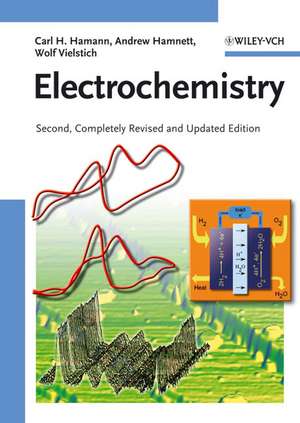
Electrochemistry
Autor Carl H. Hamann, Andrew Hamnett, Wolf Vielstichen Limba Engleză Hardback – 23 feb 2007
În peisajul academic actual, unde stocarea energiei și știința materialelor dictează direcțiile de cercetare, Electrochemistry se poziționează ca o resursă fundamentală pentru programele de licență și masterat în chimie, fizică și inginerie chimică. Această a doua ediție, complet revizuită, răspunde nevoii de interconectare între principiile teoretice ale chimiei fizice și aplicațiile tehnice emergente. Ne-a atras atenția modul în care autorii reușesc să integreze discipline moderne, precum nanotehnologia, într-un cadru conceptual care rămâne fidel rigorii clasice. Considerăm că forța acestui volum rezidă în echilibrul dintre teorie și experiment. Structura narativă a cărții urmează o progresie logică: începe cu fundamentele conductivității electrice și interacțiunile interionice, trece prin structura stratului dublu la interfețele de fază și culminează cu aplicații industriale complexe și metode analitice. Prezența celor 250 de ilustrații și 35 de tabele facilitează înțelegerea unor mecanisme de reacție adesea abstracte. Cartea completează perspectiva oferită de Principles and Applications of Electrochemistry de D.R. Crow, adăugând o analiză mult mai detaliată a metodelor moderne de investigație, precum spectroelectrochimia, care lipsesc din textele introductive standard. Față de lucrarea anterioară a autorului Carl H. Hamann, Elektrochemie, acest volum în limba engleză extinde discuția spre pilele de combustie și coroziune, reflectând expertiza sa vastă în termodinamica sistemelor ireversibile. Rezultatul este un manual dens, dar accesibil, care transformă electrochimia dintr-o nișă a chimiei fizice într-un pilon interdisciplinar esențial pentru viitorii specialiști în energie.
Preț: 535.38 lei
Preț vechi: 601.54 lei
-11%
Carte disponibilă
Livrare economică 26 octombrie-09 noiembrie
Livrare express 10-16 octombrie pentru 64.84 lei
Specificații
ISBN-10: 352731069X
Pagini: 532
Ilustrații: 250 Abb., 35 Tabellen
Dimensiuni: 175 x 250 x 34 mm
Greutate: 1.12 kg
Ediția:2., vollst. überarb. und aktualis. A
Editura: Wiley-VCH GmbH
Locul publicării:Weinheim, Germany
V-ar putea interesa
-
 -13%Preț: 429.85 lei493.98 lei
 -
 Photodegradation of Water PollutantsMartin M. Halmann-18%Preț: 1608.68 lei1961.80 lei
 -
 Atomic Layer Deposition for SemiconductorsCheol Seong Hwang-18%Preț: 1056.91 lei1288.91 lei
 -
 Introduction to Ionic LiquidsMichael FreemantlePreț: 348.80 lei
 -
 ElectrocatalysisMinhua Shao-18%Preț: 2094.75 lei2554.57 lei
 -
 Electrochemistry in Ionic LiquidsAngel A. J. Torriero-15%Preț: 651.13 lei766.03 lei
 -
 -15%Preț: 618.91 lei728.14 lei
 -
 Three-Dimensional Integration of SemiconductorsKazuo Kondo-15%Preț: 656.41 lei772.25 lei
 -
 Electrochemistry in a Divided WorldFritz Scholz-20%Preț: 666.16 lei832.70 lei
 -
 Morphology of Electrochemically and Chemically Deposited MetalsKonstantin I. Popov-15%Preț: 654.27 lei769.73 lei
 -
 Ionic Liquid PropertiesYizhak Marcus-18%Preț: 897.28 lei1094.24 lei
 -
 Luminescence in ElectrochemistryFabien Miomandre-18%Preț: 1079.21 lei1316.10 lei
 -
 Electrochemical Science for a Sustainable SocietyKohei Uosaki-15%Preț: 647.94 lei762.28 lei
 -
 ElektrochemieCarl H. Hamann-8%Preț: 453.24 lei492.65 lei
 -
 -18%Preț: 950.87 lei1159.59 lei
 -
 -18%Preț: 1060.72 lei1293.56 lei
Public țintă
Students in Chemistry, Lecturers in Chemistry, Students in Physics, Lecturers in Physics, Physical Chemists, Materials Scientists, LibrariesDe ce să citești această carte
Această ediție este esențială pentru studenții și cercetătorii care au nevoie de o punte între teoria electrochimică și aplicațiile practice în baterii sau senzori. Cititorul câștigă o înțelegere clară a interfețelor electrod/electrolit prin prisma metodelor moderne de analiză. Este recomandarea noastră pentru oricine dorește să stăpânească fundamentele necesare în dezvoltarea tehnologiilor verzi și a materialelor avansate.
Despre autor
Carl H. Hamann este un fizician de renume, doctor în științe și profesor de chimie fizică aplicată la Universitatea din Oldenburg din 1975. Cu o pregătire interdisciplinară vastă în matematică, fizică și economie, Hamann și-a dedicat cariera cercetării pilelor de combustie, cineticii adsorbției și fluxurilor turbulente. A publicat peste 80 de articole de specialitate, fiind considerat o autoritate în termodinamica sistemelor ireversibile și electrochimia tehnică. Alături de Andrew Hamnett și Wolf Vielstich, el aduce în această lucrare o experiență didactică și experimentală acumulată pe parcursul a câtorva decenii de activitate academică la cel mai înalt nivel.
Notă biografică
Cuprins
Preface xiii
List of Symbols and Units xv
1 Foundations, Definitions and Concepts 1
1.1 Ions, Electrolytes and the Quantisation of Electrical Charge 1
1.2 Transition from Electronic to Ionic Conductivity in an Electrochemical Cell 3
1.3 Electrolysis Cells and Galvanic Cells: The Decomposition Potential and the Concept of EMF 4
1.4 Faraday's Laws 7
1.5 Systems of Units 9
2 Electrical Conductivity and Interionic Interactions 13
2.1 Fundamentals 13
2.2 Empirical Laws of Electrolyte Conductivity 21
2.3 Ionic Mobility and Hittorf Transport 27
2.4 The Theory of Electrolyte Conductivity: The Debye-Hückel-Onsager Theory of Dilute Electrolytes 38
2.5 The Concept of Activity from the Electrochemical Viewpoint 46
2.6 The Properties of Weak Electrolytes 61
2.7 The Concept of pH and the Idea of Buffer Solutions 64
2.8 Non-aqueous Solutions 66
2.9 Simple Applications of Conductivity Measurements 71
3 Electrode Potentials and Double-Layer Structure at Phase Boundaries 77
3.1 Electrode Potentials and their Dependence on Concentration, Gas Pressure and Temperature 77
3.2 Liquid-junction Potentials 105
3.3 Membrane Potentials 112
3.4 The Electrolyte Double-Layer and Electrokinetic Effects 115
3.5 Potential and Phase Boundary Behaviour at Semiconductor Electrodes 133
3.6 Simple Applications of Potential Difference Measurements 139
4 Electrical Potentials and Electrical Current 157
4.1 Cell Voltage and Electrode Potential during Current Flow: an Overview 157
4.2 The Electron-transfer Region of the Current-Potential Curve 162
4.3 The Concentration Overpotential - The Effect of Transport of Material on the Current-Voltage Curve 185
4.4 The Effect of Simultaneous Chemical Processes on the Current Voltage Curve 203
4.5 Adsorption Processes 207
4.6 Electrocrystallisation - Metal Deposition and Dissolution 213
4.7 Mixed Electrodes and Corrosion 225
4.8 Current Flows on Semiconductor Electrodes 231
4.9 Bioelectrochemistry 241
5 Methods for the Study of the Electrode/Electrolyte Interface 251
5.1 The Measurement of Stationary Current-Potential Curves 251
5.2 Quasi-Stationary Methods 260
5.3 Electrochemical Methods for the Study of Electrode Films 291
5.4 Spectroelectrochemical and other Non-classical Methods 295
5.5 Preparation of Nanostructures, Combination of STM and UHV-Transfer 326
5.6 Optical Methods 328
6 Electrocatalysis and Reaction Mechanisms 339
6.1 On Electrocatalysis 339
6.2 The Hydrogen Electrode 341
6.3 The Oxygen Electrode 346
6.4 Methanol Oxidation 348
6.5 Carbon Monoxide Oxidation at Platinum Surfaces 358
6.6 Conversion of Chemical Energy of Ethanol into Electricity 364
6.7 Reaction Mechanisms in Electro-organic Chemistry 366
6.8 Oscillations in Electrochemical Systems 375
7 Solid and Molten-salt Ionic Conductors as Electrolytes 381
7.1 Ionically Conducting Solids 381
7.2 Solid Polymer Electrolytes (SPE's) 386
7.3 Ionically-conducting Melts 392
8 Industrial Electrochemical Processes 397
8.1 Introduction and Fundamentals 397
8.2 The Electrochemical Preparation of Chlorine and NaOH 404
8.3 The Electrochemical Extraction and Purification of Metals 414
8.4 Special Preparation Methods for Inorganic Chemicals 418
8.5 Electro-organic Synthesis 422
8.6 Modern Cell Designs 425
8.7 Future Possibilities for Electrocatalysis 428
8.8 Component Separation Methods 431
9 Galvanic Cells 439
9.1 Basics 440
9.2 Properties, Components and Characteristics of Batteries 441
9.3 Secondary Systems 450
9.4 Primary Systems other than Leclanché Batteries 464
9.5 Fuel Cells 468
9.6 Primary and Secondary Air Batteries 483
9.7 Efficiency of Batteries and Fuel Cells 486
9.8 Super-capacitors 487
10 Analytical Applications 491
10.1 Titration Processes using Electrochemical Indicators 491
10.2 Electro-analytical Methods 494
10.3 Electrochemical Sensors 505
Subject Index 521
Descriere scurtă
They cover the physical-chemical fundamentals as well as such modern methods of investigation as spectroelectrochemistry and mass spectrometry, electrochemical analysis and production methods, as well as fuel cells and micro- and nanotechnology.
The result is a must-have for advanced chemistry students as well as those studying chemical engineering, materials science and physics.