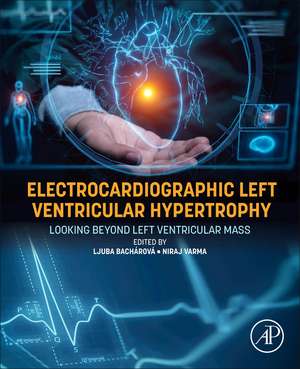
Electrocardiographic Left Ventricular Hypertrophy: Looking Beyond Left Ventricular Mass
Editat de Ljuba Bachárová, Niraj Varmaen Limba Engleză Paperback – 14 noi 2025
This book recognizes and fulfills the urgent need to change the classical diagnostic paradigms of ECG diagnosis in LVH. To do so, it turns attention to so-called false-negative ECG findings that in truth provide valuable information that largely overlooked. When used to their fullest potential, these results can be used for enhanced diagnosis, selection of targeted therapy and cardiovascular risk assessment.
- Provides an understanding of the underlying electrical phenomena in Left Ventricular Hypertrophy (LVH), along with their diagnostic and prognostic importance
- Presents new insights regarding the electrical properties of hypertrophied myocardium, indicating future research and clinical applications
- Addresses controversies around so-called "false negative" ECG results in LVH diagnosis, thereby preventing the dangers of incorrect evaluation and increased risk of death
Preț: 836.52 lei
Preț vechi: 1226.68 lei
-32%
Puncte Express: 1255
Carte tipărită la comandă
Livrare economică 21 noiembrie-05 decembrie
Livrare prin curier în România Termenul estimat este afișat lângă disponibilitate.
Transport gratuit pentru acest produs Plată online sau ramburs, în funcție de opțiunile comenzii.
Retur gratuit în 14 zile Comandă securizată și suport în română.
Specificații
ISBN-13: 9780443339271
ISBN-10: 0443339279
Pagini: 348
Dimensiuni: 191 x 235 x 21 mm
Greutate: 0.77 kg
Editura: ELSEVIER SCIENCE
ISBN-10: 0443339279
Pagini: 348
Dimensiuni: 191 x 235 x 21 mm
Greutate: 0.77 kg
Editura: ELSEVIER SCIENCE
Cuprins
1. Introduction
2. Electrocardiographic criteria for left ventricular hypertrophy diagnosis
3. ST segment strain pattern in left ventricular hypertrophy
4. QT interval dynamics in left ventricular hypertrophy
5. Epidemiology and prognosis of left ventricular hypertrophy through electrocardiography: from Minnesota Code to artificial intelligence
6. Echocardiographic diagnosis of left ventricular hypertrophy and its compatibility with electrocardiographic criteria: the “false negative and false positive” electrocardiography
7. Addition of serum biomarkers carboxyterminal propeptide of procollagen type I (PICP) and NT-proBNP levels to electrocardiography criteria for detection of left ventricular hypertrophyl
8. The discrepancy between wall thickness, myocardial mass, and ECG appearances in young patients with cardiomyopathies
9. Electrocardiographic and echocardiographic differences in the athlete’s heart: a special category
10. Electrocardiographic left ventricular hypertrophy and stroke
11. Evolving left ventricular hypertrophy: heart failure
12. How far should blood pressure be lowered in middle-aged and elderly patients with hypertension and ECG-LVH? Experiences from LIFE and VALUE
13. Surgical approaches in hypertrophic cardiomyopathy treatment
14. Genetic factors influencing clinical phenotype and electrocardiographic features in left ventricular hypertrophy
15. Artificial intelligence for detecting left ventricular hypertrophy using electrocardiography
16. Technical considerations in the automated ECG diagnosis of left ventricular hypertrophy
17. Myocardial hypertrophy and ischemia: mechanisms of electrophysiological abnormalities
18. Effect of volumetric and conductivity changes in the left ventricle on QRS complex morphology in simulations
19. The variety of QRS patterns in left ventricular hypertrophy and their electrophysiological interpretation
20. Increased LV mass, electrical remodeling, and surface ECG conduction abnormalities in heart failure: implications for implantable defibrillators and cardiac resynchronization therapy
2. Electrocardiographic criteria for left ventricular hypertrophy diagnosis
3. ST segment strain pattern in left ventricular hypertrophy
4. QT interval dynamics in left ventricular hypertrophy
5. Epidemiology and prognosis of left ventricular hypertrophy through electrocardiography: from Minnesota Code to artificial intelligence
6. Echocardiographic diagnosis of left ventricular hypertrophy and its compatibility with electrocardiographic criteria: the “false negative and false positive” electrocardiography
7. Addition of serum biomarkers carboxyterminal propeptide of procollagen type I (PICP) and NT-proBNP levels to electrocardiography criteria for detection of left ventricular hypertrophyl
8. The discrepancy between wall thickness, myocardial mass, and ECG appearances in young patients with cardiomyopathies
9. Electrocardiographic and echocardiographic differences in the athlete’s heart: a special category
10. Electrocardiographic left ventricular hypertrophy and stroke
11. Evolving left ventricular hypertrophy: heart failure
12. How far should blood pressure be lowered in middle-aged and elderly patients with hypertension and ECG-LVH? Experiences from LIFE and VALUE
13. Surgical approaches in hypertrophic cardiomyopathy treatment
14. Genetic factors influencing clinical phenotype and electrocardiographic features in left ventricular hypertrophy
15. Artificial intelligence for detecting left ventricular hypertrophy using electrocardiography
16. Technical considerations in the automated ECG diagnosis of left ventricular hypertrophy
17. Myocardial hypertrophy and ischemia: mechanisms of electrophysiological abnormalities
18. Effect of volumetric and conductivity changes in the left ventricle on QRS complex morphology in simulations
19. The variety of QRS patterns in left ventricular hypertrophy and their electrophysiological interpretation
20. Increased LV mass, electrical remodeling, and surface ECG conduction abnormalities in heart failure: implications for implantable defibrillators and cardiac resynchronization therapy