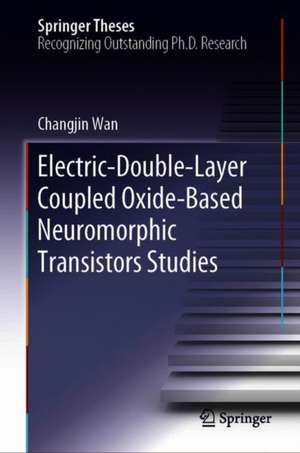
Electric-Double-Layer Coupled Oxide-Based Neuromorphic Transistors Studies: Springer Theses
Autor Changjin Wanen Limba Engleză Hardback – 5 feb 2019
To replicate the robust, plastic and fault-tolerant computational power of the human brain, the emulation of essential synaptic plasticity and computation of neurons/synapse by electronic devices are generally considered to be key steps. The book shows that the formation of an EDL at the dielectric/channel interface that slightly lags behind the stimuli can be attributed to the electrostatic coupling between ions and electrons; this mechanism underlies the emulation of short-term synaptic behaviors. Furthermore, it demonstrates that electrochemical doping/dedoping processes in the semiconducting channel by penetrated ions from electrolyte can be utilized for the emulation of long-term synaptic behaviors. Lastly, it applies these synaptic transistors in an artificial visual system to demonstrate the potential for constructing neuromorphic systems. Accordingly, the book offers a unique resource on understanding the brain-machine interface, brain-like chips, artificial cognitive systems, etc.
Din seria Springer Theses
- 18%
 Preț: 906.80 lei
 - 15%
 Preț: 661.49 lei
 - 15%
 Preț: 638.81 lei
 - 18%
 Preț: 1015.11 lei
 -
 Preț: 391.04 lei
 - 18%
 Preț: 1072.78 lei
 - 18%
 Preț: 972.22 lei
 - 18%
 Preț: 1182.27 lei
 -
 Preț: 393.91 lei
 -
 Preț: 375.86 lei
 - 18%
 Preț: 1076.54 lei
 -
 Preț: 384.20 lei
 - 18%
 Preț: 1352.59 lei
 - 18%
 Preț: 1348.61 lei
 - 18%
 Preț: 1068.71 lei
 - 18%
 Preț: 972.16 lei
 - 15%
 Preț: 650.72 lei
 - 15%
 Preț: 642.59 lei
 - 18%
 Preț: 1078.31 lei
 -
 Preț: 373.40 lei
 - 15%
 Preț: 623.27 lei
 -
 Preț: 374.23 lei
 - 15%
 Preț: 614.78 lei
 - 15%
 Preț: 619.58 lei
 - 15%
 Preț: 620.03 lei
 - 18%
 Preț: 964.49 lei
 - 15%
 Preț: 619.14 lei
 - 18%
 Preț: 1172.17 lei
 - 18%
 Preț: 973.50 lei
 - 18%
 Preț: 1080.53 lei
 - 18%
 Preț: 1186.50 lei
 - 18%
 Preț: 960.54 lei
 - 15%
 Preț: 617.77 lei
 - 18%
 Preț: 1345.25 lei
 - 18%
 Preț: 918.64 lei
 - 15%
 Preț: 618.91 lei
 - 18%
 Preț: 999.32 lei
 - 18%
 Preț: 1172.94 lei
 - 15%
 Preț: 621.42 lei
 - 15%
 Preț: 624.65 lei
 - 15%
 Preț: 644.88 lei
 - 18%
 Preț: 749.08 lei
 -
 Preț: 390.55 lei
 -
 Preț: 373.68 lei
 - 18%
 Preț: 1067.54 lei
 - 18%
 Preț: 759.82 lei
 - 15%
 Preț: 614.32 lei
 - 15%
 Preț: 618.21 lei
 - 15%
 Preț: 615.02 lei
 - 15%
 Preț: 639.92 lei
Preț: 660.61 lei
Preț vechi: 777.18 lei
-15%
Puncte Express: 991
Carte tipărită la comandă
Livrare economică 23 noiembrie-07 decembrie
Livrare prin curier în România Termenul estimat este afișat lângă disponibilitate.
Transport gratuit pentru acest produs Plată online sau ramburs, în funcție de opțiunile comenzii.
Retur gratuit în 14 zile Comandă securizată și suport în română.
Specificații
ISBN-13: 9789811333132
ISBN-10: 9811333130
Pagini: 132
Ilustrații: XXI, 107 p. 77 illus., 70 illus. in color.
Dimensiuni: 160 x 241 x 13 mm
Greutate: 0.32 kg
Ediția:1st ed. 2019
Editura: Springer
Colecția Springer Theses
Seria Springer Theses
Locul publicării:Singapore, Singapore
ISBN-10: 9811333130
Pagini: 132
Ilustrații: XXI, 107 p. 77 illus., 70 illus. in color.
Dimensiuni: 160 x 241 x 13 mm
Greutate: 0.32 kg
Ediția:1st ed. 2019
Editura: Springer
Colecția Springer Theses
Seria Springer Theses
Locul publicării:Singapore, Singapore
Cuprins
Introduction.- Fabrications and characterizations of oxide-based EDL transistors.- Synaptic emulations based on oxide-based EDL transistors.- Neuromorphic computing applications based on oxide-based EDL transistors.- Summary and prospect.
Textul de pe ultima copertă
This book focuses on essential synaptic plasticity emulations and neuromorphic computing applications realized with the aid of three-terminal synaptic devices based on ion-coupled oxide-based electric-double-layer (EDL) transistors.
To replicate the robust, plastic and fault-tolerant computational power of the human brain, the emulation of essential synaptic plasticity and computation of neurons/synapse by electronic devices are generally considered to be key steps. The book shows that the formation of an EDL at the dielectric/channel interface that slightly lags behind the stimuli can be attributed to the electrostatic coupling between ions and electrons; this mechanism underlies the emulation of short-term synaptic behaviors. Furthermore, it demonstrates that electrochemical doping/dedoping processes in the semiconducting channel by penetrated ions from electrolyte can be utilized for the emulation of long-term synaptic behaviors. Lastly, it applies these synaptic transistors in an artificial visual system to demonstrate the potential for constructing neuromorphic systems. Accordingly, the book offers a unique resource on understanding the brain-machine interface, brain-like chips, artificial cognitive systems, etc.
To replicate the robust, plastic and fault-tolerant computational power of the human brain, the emulation of essential synaptic plasticity and computation of neurons/synapse by electronic devices are generally considered to be key steps. The book shows that the formation of an EDL at the dielectric/channel interface that slightly lags behind the stimuli can be attributed to the electrostatic coupling between ions and electrons; this mechanism underlies the emulation of short-term synaptic behaviors. Furthermore, it demonstrates that electrochemical doping/dedoping processes in the semiconducting channel by penetrated ions from electrolyte can be utilized for the emulation of long-term synaptic behaviors. Lastly, it applies these synaptic transistors in an artificial visual system to demonstrate the potential for constructing neuromorphic systems. Accordingly, the book offers a unique resource on understanding the brain-machine interface, brain-like chips, artificial cognitive systems, etc.
Caracteristici
Nominated as an excellent doctoral dissertation by the University of Chinese Academy of Sciences Reports, for the first time as a PhD thesis, on essential synaptic plasticity emulations and neuromorphic computing applications realized with the aid of three-terminal synaptic devices Introduces readers to the design, fabrication, characterization and modeling of synaptic devices Demonstrates the potential applications of synaptic devices in neuromorphic systems