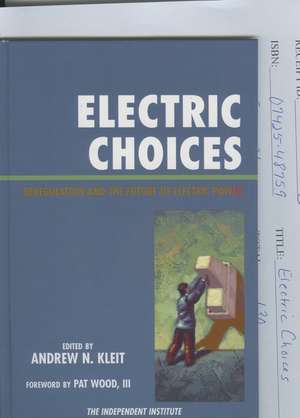
Electric Choices: Deregulation and the Future of Electric Power
Editat de Andrew N. Kleit Cuvânt înainte de Pat Wood III Contribuţii de Timothy J. Brennan, Timothy J. Considine, Terry Daniel, David E. Dismukes, Joseph Doucet, Michael Giberson, William W. Hogan, L Lynne Kiesling, Craig S. Pirrong, Andre Plourde, Stephen J. Rassenti, Vernon L. Smith, Bart J. Wilsonen Limba Engleză Paperback – 9 noi 2006
In general, deregulation results in lower prices, more product choices, and more rapid technological advances. Conversely, rate regulation has inherent flaws, including the encouragement of waste and inefficiency, and a retarding of innovation. There is little doubt to the contributors of this book that putting regulation aside offers enormous efficiency gains in the production of electricity.
But can market forces handle the delicate matter of transmitting electricity when the simple model of supply and demand must be more precise than other goods and services? How much regulation does the electric industry need? The essays in this timely collection explore these difficult questions and propose a new, market-based plan to improve America's electrical future.
Published in cooperation with The Independent Institute.
Preț: 351.89 lei
Preț vechi: 463.26 lei
-24%
Puncte Express: 528
Carte disponibilă
Livrare economică 07-21 noiembrie
Livrare prin curier în România Termenul estimat este afișat lângă disponibilitate.
Transport gratuit de la 400.00 lei Plată online sau ramburs, în funcție de opțiunile comenzii.
Retur gratuit în 14 zile Comandă securizată și suport în română.
Specificații
ISBN-13: 9780742548763
ISBN-10: 0742548767
Pagini: 242
Ilustrații: illustrations
Dimensiuni: 146 x 224 x 18 mm
Greutate: 0.38 kg
Editura: Bloomsbury Publishing
Colecția Rowman & Littlefield
Locul publicării:New York, United States
ISBN-10: 0742548767
Pagini: 242
Ilustrații: illustrations
Dimensiuni: 146 x 224 x 18 mm
Greutate: 0.38 kg
Editura: Bloomsbury Publishing
Colecția Rowman & Littlefield
Locul publicării:New York, United States
Cuprins
Chapter 1 1 Introduction
Chapter 2 2 Can Electricity Restructuring Survive? Lessons from California and Pennsylvania
Chapter 3 3 The Role of Retail Pricing in Electricity Restructuring
Chapter 4 4 Using Experiments to Inform the Privatization/Deregulation Movement in Electricity
Chapter 5 5 The Alberta Experience
Chapter 6 6 Transactions Costs and the Organization of Coordination Activities in Power Markets
Chapter 7 7 Market-Based Transmission Investments and Competitive Electricity Markets
Chapter 8 8 Checking for Market Power in Electricity: The Perils of Price-Cost Margins
Chapter 9 9 The Role of Distributed Energy Resources in a Restructured Power Industry
Chapter 10 10 Blackout Economics
Chapter 2 2 Can Electricity Restructuring Survive? Lessons from California and Pennsylvania
Chapter 3 3 The Role of Retail Pricing in Electricity Restructuring
Chapter 4 4 Using Experiments to Inform the Privatization/Deregulation Movement in Electricity
Chapter 5 5 The Alberta Experience
Chapter 6 6 Transactions Costs and the Organization of Coordination Activities in Power Markets
Chapter 7 7 Market-Based Transmission Investments and Competitive Electricity Markets
Chapter 8 8 Checking for Market Power in Electricity: The Perils of Price-Cost Margins
Chapter 9 9 The Role of Distributed Energy Resources in a Restructured Power Industry
Chapter 10 10 Blackout Economics
Recenzii
The excellent book Electric Choices describes the promises of electricity deregulation, the mistakes made in the past, and the path to workable competition in this industry. Highly recommended.
This excellent book provides an agenda out of the impasse in which the U.S. has found itself following the California energy debacle and the wider crisis in electric power. Electric Choices is a must read.
Electric Choices should be mandatory reading for anyone interested in the electricity industry, and who wants to learn from the mistakes California made. These leading experts explain why and how well-run markets are the best deal electricity customers are going to find.
Electric Choices is a superb book that addresses what we have learned from restructuring experiences to date and presents important methods from economics with which to analyze these basic questions.
Electric Choices provides theoretical, experimental, and empirical support for forging ahead to achieve efficiencies that will not come about in a regulated environment where utilities expect to recover their costs plus profit and have few incentives to respond energetically to customer demand. This book will move the reader beyond the electricity-restructuring impasse in the aftermath of the California debacle and the Northeast Blackout to find areas where deregulation is likely to be desirable.
Electric Choices is a first-rate book featuring some of the nation's leading energy analysts and belongs on the bookshelf of every scholar, policy wonk, and utility executive.
This collection by leading authorities on electricity industry restructuring should be valuable reading for those interested in learning from previous successes and failures in this important area of public policy. It contains both broader analytical pieces and case studies in the U.S. and abroad. The papers provide not only specific policy reforms but also methods by which to design and evaluate them. The coverage is broad, including creation of pricing innovations, demand-side behavior, the role of coordinating agents, investment decisions, distributed generation, and reliability. The volume should be of interest to analysts, business managers in a variety of industries, electricity customers, and public-policy makers. I recommend this book to all those interested in exploring both the larger issues and the subtleties of the topic, no matter which side of the policy debate they favor.
This insightful work covers the major challenges still facing electricity restructuring, showing both the dangers and possibilities associated with regulatory change. Its breadth is impressive, as there are contributions on such diverse topics as market design, wholesale market power, transmission investment, system reliability, demand-side management, and the role of distributed generation.
Contributors to this volume are of high qualtiy and offer signicant insight into the way forward in the electric utility industry. This publication should be of interest to scholars, utility executives, and policy makers. Highly recommended.
This excellent book provides an agenda out of the impasse in which the U.S. has found itself following the California energy debacle and the wider crisis in electric power. Electric Choices is a must read.
Electric Choices should be mandatory reading for anyone interested in the electricity industry, and who wants to learn from the mistakes California made. These leading experts explain why and how well-run markets are the best deal electricity customers are going to find.
Electric Choices is a superb book that addresses what we have learned from restructuring experiences to date and presents important methods from economics with which to analyze these basic questions.
Electric Choices provides theoretical, experimental, and empirical support for forging ahead to achieve efficiencies that will not come about in a regulated environment where utilities expect to recover their costs plus profit and have few incentives to respond energetically to customer demand. This book will move the reader beyond the electricity-restructuring impasse in the aftermath of the California debacle and the Northeast Blackout to find areas where deregulation is likely to be desirable.
Electric Choices is a first-rate book featuring some of the nation's leading energy analysts and belongs on the bookshelf of every scholar, policy wonk, and utility executive.
This collection by leading authorities on electricity industry restructuring should be valuable reading for those interested in learning from previous successes and failures in this important area of public policy. It contains both broader analytical pieces and case studies in the U.S. and abroad. The papers provide not only specific policy reforms but also methods by which to design and evaluate them. The coverage is broad, including creation of pricing innovations, demand-side behavior, the role of coordinating agents, investment decisions, distributed generation, and reliability. The volume should be of interest to analysts, business managers in a variety of industries, electricity customers, and public-policy makers. I recommend this book to all those interested in exploring both the larger issues and the subtleties of the topic, no matter which side of the policy debate they favor.
This insightful work covers the major challenges still facing electricity restructuring, showing both the dangers and possibilities associated with regulatory change. Its breadth is impressive, as there are contributions on such diverse topics as market design, wholesale market power, transmission investment, system reliability, demand-side management, and the role of distributed generation.
Contributors to this volume are of high qualtiy and offer signicant insight into the way forward in the electric utility industry. This publication should be of interest to scholars, utility executives, and policy makers. Highly recommended.