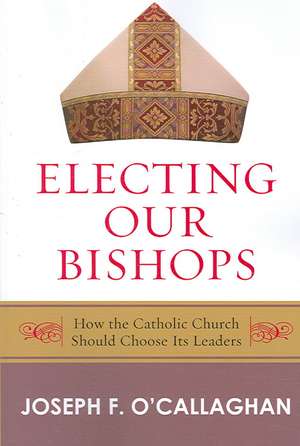
Electing Our Bishops: How the Catholic Church Should Choose Its Leaders
Autor Joseph O'Callaghanen Limba Engleză Paperback – 14 mar 2007
Preț: 220.37 lei
Preț vechi: 292.82 lei
-25%
Puncte Express: 331
Carte tipărită la comandă
Livrare economică 30 noiembrie-14 decembrie
Livrare prin curier în România Termenul estimat este afișat lângă disponibilitate.
Transport gratuit de la 400.00 lei Plată online sau ramburs, în funcție de opțiunile comenzii.
Retur gratuit în 14 zile Comandă securizată și suport în română.
Specificații
ISBN-13: 9780742558205
ISBN-10: 0742558207
Pagini: 195
Dimensiuni: 153 x 229 x 14 mm
Greutate: 0.32 kg
Editura: Bloomsbury Publishing
Colecția Rowman & Littlefield
Locul publicării:New York, United States
ISBN-10: 0742558207
Pagini: 195
Dimensiuni: 153 x 229 x 14 mm
Greutate: 0.32 kg
Editura: Bloomsbury Publishing
Colecția Rowman & Littlefield
Locul publicării:New York, United States
V-ar putea interesa
-
 Jesuit Guide to (Almost) Everything PBJames MartinPreț: 130.69 lei
 -
 The PopesRt Hon/Viscount John Julius Norwich-18%Preț: 100.93 lei123.17 lei
 -
 Newman: A Short IntroductionOwen Chadwick-21%Preț: 71.04 lei89.97 lei
 -
 Beyond BeliefColm O'gorman-26%Preț: 69.08 lei93.54 lei
 -
 Dark Mysteries of the VaticanH. Paul Jeffers-24%Preț: 75.60 lei99.09 lei
 -
 Preț: 110.93 lei
 -
 Marthe Robin and the Foyers of CharityMartin BlakePreț: 76.68 lei
 -
 Consoling the Heart of JesusMichael Gaitley-8%Preț: 102.62 lei111.06 lei
 -
 -27%Preț: 68.17 lei93.00 lei
Cuprins
Chapter 1 Bishop and People: A Bond of Trust
Chapter 2 Election of Bishops in the Early Church
Chapter 3 Royal Nomination of Bishops in the Early Middle Ages
Chapter 4 To the Eve of the Protestant Reformation
Chapter 5 From the Protestant Reformation to Vatican II
Chapter 6 Contemporary Appointment of Bishops
Chapter 7 "Is He Worthy?"
Chapter 8 Re-Membering a Dis-Membered Church
Chapter 2 Election of Bishops in the Early Church
Chapter 3 Royal Nomination of Bishops in the Early Middle Ages
Chapter 4 To the Eve of the Protestant Reformation
Chapter 5 From the Protestant Reformation to Vatican II
Chapter 6 Contemporary Appointment of Bishops
Chapter 7 "Is He Worthy?"
Chapter 8 Re-Membering a Dis-Membered Church
Recenzii
The choice of bishops in the Catholic Church is controversial as a result of episcopal handling of the sexual abuse scandal. Joseph F. O'Callaghan proposes returning to a practice found in some locales in the early centuries of the church-the popular election of bishops. O'Callaghan shows the complexities of this process over the centuries and suggests ways in which the practice could be implemented. Even those who differ with his proposal-as I do-will find food for thought in this sweeping historical survey of a vital church matter.
This story will startle those twenty-first-century Catholics who think the Church's current power pyramid has been in place from the beginning. O'Callaghan wakes us from that fairy tale with some well-documented history and, in some marvelously shocking chapters, how the people were cut out of the political process. To his credit, O'Callaghan, a man who loves his Church, doesn't leave us lamenting this sorry history. He tells us how we can turn the Church's pyramid on its pointy little head: by electing our bishops-a scripturally, historically, and theologically correct route that will lead us to an accountable Church.
In the ongoing struggle for a more adult and more accountable church, O'Callaghan restores to us a mine of historical information about a tradition of governance and shared responsibility that today's church sorely needs. All those with a concern for the future of our church owe him an immense debt of gratitude.
Electing Our Bishops is historically sound, very clearly written, and just the kind of popular writing we need about central issues in the church. This is a valuable work for everyone interested in the life of the U.S. church.
[O'Callaghan] has written a book that should be required reading for canonists, ecclesiologists, historians, and hierarchs themselves.
An excellent and thorough history of the way bishops were chosen - from the time Mattias was selected by the apostles to replace Judas to the present time.
Joseph O'Callaghan's Electing Our Bishops is part history and part argument. Its argument gives the book its title. . . . O'Callaghan develops Celestine's principle. . . . Until as recently as 1999, this was also Cardinal Joseph Ratzinger's opinion...It seems clear, especially in the wake of the sex-abuse cover-up, that the present way of doing things [electing bishops] is dysfunctional...O'Callaghan's provocative study encourages us to think hard about ways to change the system.
This is by far the most complete and thoughtful examination of the election of bishops over the 2000 years of the Church's existence. It is replete with footnotes to the original sources and most recent works and has a short bibliography. Novices to the topic will find this book clear and well-organized and more advanced researchers will find a critical apparatus that does not disappoint. All in all, this is a valuable addition to the literature and a useful resource for the reform movement.
Lucidly written and cogently argued.
This story will startle those twenty-first-century Catholics who think the Church's current power pyramid has been in place from the beginning. O'Callaghan wakes us from that fairy tale with some well-documented history and, in some marvelously shocking chapters, how the people were cut out of the political process. To his credit, O'Callaghan, a man who loves his Church, doesn't leave us lamenting this sorry history. He tells us how we can turn the Church's pyramid on its pointy little head: by electing our bishops-a scripturally, historically, and theologically correct route that will lead us to an accountable Church.
In the ongoing struggle for a more adult and more accountable church, O'Callaghan restores to us a mine of historical information about a tradition of governance and shared responsibility that today's church sorely needs. All those with a concern for the future of our church owe him an immense debt of gratitude.
Electing Our Bishops is historically sound, very clearly written, and just the kind of popular writing we need about central issues in the church. This is a valuable work for everyone interested in the life of the U.S. church.
[O'Callaghan] has written a book that should be required reading for canonists, ecclesiologists, historians, and hierarchs themselves.
An excellent and thorough history of the way bishops were chosen - from the time Mattias was selected by the apostles to replace Judas to the present time.
Joseph O'Callaghan's Electing Our Bishops is part history and part argument. Its argument gives the book its title. . . . O'Callaghan develops Celestine's principle. . . . Until as recently as 1999, this was also Cardinal Joseph Ratzinger's opinion...It seems clear, especially in the wake of the sex-abuse cover-up, that the present way of doing things [electing bishops] is dysfunctional...O'Callaghan's provocative study encourages us to think hard about ways to change the system.
This is by far the most complete and thoughtful examination of the election of bishops over the 2000 years of the Church's existence. It is replete with footnotes to the original sources and most recent works and has a short bibliography. Novices to the topic will find this book clear and well-organized and more advanced researchers will find a critical apparatus that does not disappoint. All in all, this is a valuable addition to the literature and a useful resource for the reform movement.
Lucidly written and cogently argued.