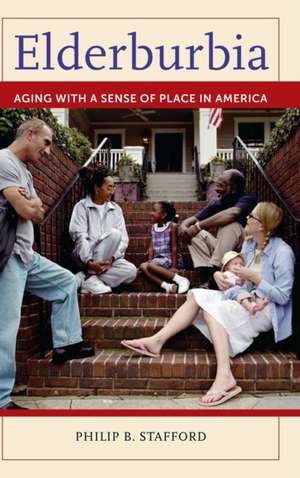
Elderburbia: Aging with a Sense of Place in America
Autor Philip B. Stafford Cuvânt înainte de Scott Russell Sandersen Limba Engleză Hardback – 13 oct 2009
Elderburbia: Aging with a Sense of Place in America argues that aging is not about time and the body, but about place and relationships. Drawing on the fascinating, multidisciplinary field of ethnography, it gives readers a deeper understanding of how the aging experience is shaped by where people call home, as well as a look at what makes a place well-suited for post-retirement living.
Elderburbia combines cutting-edge scholarship with practical advice. The book provides an introduction to pivotal research on the broad subject of aging and place, including studies of migration and relocation. It also takes readers inside innovative elder-friendly community planning around the United States, particularly AdvantAge-an initiative to help counties, cities, and towns prepare for the growing number of older adults who are "aging in place," as opposed to moving to retiree-only communities. Everyone from individuals and families to social workers, activists, and city officials will find this a helpful, enlightening resource.
Preț: 356.43 lei
Preț vechi: 515.71 lei
-31%
Puncte Express: 535
Carte tipărită la comandă
Livrare economică 07-21 decembrie
Livrare prin curier în România Termenul estimat este afișat lângă disponibilitate.
Transport gratuit de la 400.00 lei Plată online sau ramburs, în funcție de opțiunile comenzii.
Retur gratuit în 14 zile Comandă securizată și suport în română.
Specificații
ISBN-13: 9780313364365
ISBN-10: 0313364362
Pagini: 208
Ilustrații: 9 bw illus
Dimensiuni: 156 x 235 x 25 mm
Greutate: 0.48 kg
Ediția:New.
Editura: Bloomsbury Publishing
Colecția Praeger
Locul publicării:New York, United States
ISBN-10: 0313364362
Pagini: 208
Ilustrații: 9 bw illus
Dimensiuni: 156 x 235 x 25 mm
Greutate: 0.48 kg
Ediția:New.
Editura: Bloomsbury Publishing
Colecția Praeger
Locul publicării:New York, United States
V-ar putea interesa
-
 The Psychology of Ageing: From Mind to SocietyGary ChristopherPreț: 339.93 lei
 -
 The SAGE Handbook of Social GerontologyDale DanneferPreț: 472.55 lei
 -
 China, Aging & TheoryJason L Powell-26%Preț: 395.07 lei531.57 lei
 -
 -31%Preț: 92.02 lei132.50 lei
 -
 Dementia, Culture and Ethnicity: Issues for AllJulia Botsford-23%Preț: 283.69 lei367.85 lei
 -
 -23%Preț: 229.02 lei297.66 lei
 -
 Ageing and TechnologyEmma Domínguez-Rué-18%Preț: 300.70 lei366.87 lei
Recenzii
A leader of aging, disability, and community based in Indiana, Stafford contributes only slightly, he says, to fuller discussions elsewhere about how American suburbs will have to be retrofitted for the elderly. His main concern is about the places older people call home, about homemaking in a sense of dwelling and belonging rather than cooking and cleaning. Among his topics are locating old age, memory and the creation of place, aging in third places, new forms of association in old age, and design guidelines for the new elderburbia.
Elderburbia couldn't be a timelier book, as planning departments across the country are in the process of evaluating the demographics and health and housing needs of their age 65 and older population.
[O]ffers a take on getting old that gets away from the dreary options that dominate popular discourse: fade away, unloved, in a substandard nursing home or exercise hard enough, eat right enough, and save money enough to remain middle-aged up to the end. Stafford argues we should be thinking instead about the importance of place, and he takes a close look at why some places work better than others in helping elders thrive.
"An anthropologist with a folklorist's sensibility, Phil Stafford has written a book that is unique in the literature of gerontology. Folklorists will appreciate Stafford's sensitivity to performance (formulaic speech and genre), artistry, and tradition, as well as the centrality of community and a shared history. . . . Stafford offers an especially thoughtful look at memory as a cultural resource, personal, but perhaps more importantly, shared. . . . This book contains some poignant insights into the experience of aging, particularly in the book's final chapter. . . . [I]t will speak to all of us who care deeply about our place in community, especially as we seek ways to age in place 'in its profound sense'".
Elderburbia couldn't be a timelier book, as planning departments across the country are in the process of evaluating the demographics and health and housing needs of their age 65 and older population.
[O]ffers a take on getting old that gets away from the dreary options that dominate popular discourse: fade away, unloved, in a substandard nursing home or exercise hard enough, eat right enough, and save money enough to remain middle-aged up to the end. Stafford argues we should be thinking instead about the importance of place, and he takes a close look at why some places work better than others in helping elders thrive.
"An anthropologist with a folklorist's sensibility, Phil Stafford has written a book that is unique in the literature of gerontology. Folklorists will appreciate Stafford's sensitivity to performance (formulaic speech and genre), artistry, and tradition, as well as the centrality of community and a shared history. . . . Stafford offers an especially thoughtful look at memory as a cultural resource, personal, but perhaps more importantly, shared. . . . This book contains some poignant insights into the experience of aging, particularly in the book's final chapter. . . . [I]t will speak to all of us who care deeply about our place in community, especially as we seek ways to age in place 'in its profound sense'".