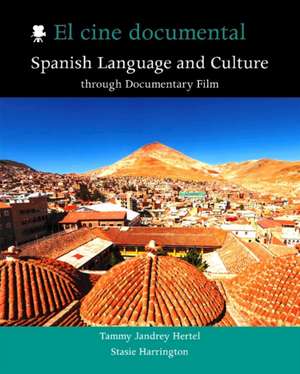
El cine documental: Spanish Language and Culture through Documentary Film
Autor Tammy Jandrey Hertel, Stasie Harringtones Limba Spaniolă Paperback – 7 noi 2016
El cine documental is an innovative intermediate/advanced textbook that provides students with the tools needed to communicate accurately and appropriately in Spanish. Learning is centered on cultural themes related to thought-provoking documentaries from around the Spanish-speaking world. Through the culturally rich and linguistically authentic medium of documentary film, El cine documental provides the experience of listening to many varieties of authentic speech in context, and stimulates conversation and critical thinking by immersing students in the target cultures. Organized to provide scaffolding for students as they develop their skills in listening, speaking, reading, and writing, each chapter includes five sections: Ver, Leer, Escuchar, Escribir, and Expandir.
Features:
The Documentary Films:
Features:
- Authentic, engaging, culturally rich materials that develop students’ translingual and transcultural competence and prepare them for participation in a global society. Authentic input related to each chapter theme is provided in the form of:
- a documentary film depicting contemporary and historical topics from a variety of Spanish-speaking countries. Themes include the environment; sports; globalization; poverty, hopes, and dreams; immigration; human rights; war and peace; and feminism.
- a reading from a variety of genres: blog posts, newspaper articles, poetry, and short stories.
- video interviews that students conduct with native Spanish speakers from the local community and a contemporary song related to the chapter theme.
- Pre-, during, and post-viewing/reading/listening activities that guide and scaffold students’ interaction with multimedia input (films, readings, and songs) and develop their language skills. All activities are contextualized, meaningful, and directly related to the chapter themes.
- End-of-chapter, learner-driven activities that require students to demonstrate their ability to integrate and put into practice their linguistic skills and cultural knowledge and understanding via oral presentations, debates, and a process-oriented writing assignment with a real-world purpose and audience.
- An electronic workbook with detailed grammatical explanations for each grammar topic (four per chapter) and auto-correcting practice activities that provide additional vocabulary exposure.
The Documentary Films:
- América Latina y el Caribe: Riqueza viva
- Rumbo a las grandes ligas / Road to the Big Leagues
- ¿Por qué quebró McDonald’s en Bolivia? / Fast Food off the Shelf
- La mina del diablo / The Devil’s Miner
- ¿Cuál es el camino a casa? / Which Way Home?
- Nuestros desaparecidos / Our Disappeared
- La Sierra
- Nosotras, centroamericanas
Preț: 510.66 lei
Preț vechi: 555.06 lei
-8%
Puncte Express: 766
Carte disponibilă
Livrare economică 06-20 noiembrie
Livrare prin curier în România Termenul estimat este afișat lângă disponibilitate.
Transport gratuit pentru acest produs Plată online sau ramburs, în funcție de opțiunile comenzii.
Retur gratuit în 14 zile Comandă securizată și suport în română.
Specificații
ISBN-13: 9781585108251
ISBN-10: 1585108251
Pagini: 272
Ilustrații: heavily illustrated
Dimensiuni: 203 x 254 x 2 mm
Greutate: 0.66 kg
Editura: Hackett Publishing Company,Inc
Colecția Focus
Locul publicării:United States
ISBN-10: 1585108251
Pagini: 272
Ilustrații: heavily illustrated
Dimensiuni: 203 x 254 x 2 mm
Greutate: 0.66 kg
Editura: Hackett Publishing Company,Inc
Colecția Focus
Locul publicării:United States
V-ar putea interesa
-
 Introducción al análisis lingüístico del discurso en españolIker Zulaica HernándezPreț: 383.07 lei
 -
 Manual para la formacion de profesores de espanolCristina Sanz-19%Preț: 430.84 lei531.89 lei
 -
 De Pelicula!: Spanish Conversation through FilmMary McVey Gill-23%Preț: 229.51 lei297.97 lei
 -
 Cultura y cine: Hispanoamérica hoyMary McVey Gill-18%Preț: 334.24 lei408.69 lei
 -
 Cinema for Spanish ConversationMary McVey Gill-26%Preț: 482.96 lei648.67 lei
 -
 Cahier Inglés Falsos PrincipiantesHelene Bauchart-10%Preț: 95.26 lei106.33 lei
 -
 Cahier Inglés IntermedioHelene Bauchart-10%Preț: 95.26 lei106.33 lei
 -
 Espacios literarios B1. Callejón con salidaElsa OsorioPreț: 87.86 lei
 -
 Preț: 98.97 lei
 -
 Preț: 126.35 lei
 -
 Preț: 128.18 lei
 -
 Perspectivas ¡Ya! A1. Kurs- und Arbeitsbuch, VokabeltaschenbuchAraceli Vicente ÁlvarezPreț: 310.72 lei
 -
 Perspectivas ¡Ya! A2. Kurs- und Arbeitsbuch mit VokabeltaschenbuchSara Amann-MarínPreț: 308.86 lei
 -
 Saber leerInstituto CevantesPreț: 120.16 lei
 -
 Preț: 179.04 lei
 -
 Nos vemos hoy 2 - Cuaderno de ejercicios + audio MP3. A2Celia Jaen RodrigoPreț: 232.53 lei
 -
 Nuevo Prisma C1 Workbook Plus Eleteca and Audio CD: Answers BookGenis Castro NiubóPreț: 187.97 lei
 -
 VAMOS AL CINE (Nivel B1-C2)Noemi CamaraPreț: 275.37 lei
Recenzii
"This is a very compact but effective text that powerfully supports language learning via activities and exercises based on authentic documentaries. . . . The book does total justice to what it sets out to do by treating cutting edge topics such as the environment, globalization, war and peace, immigration, human rights, feminism, sports, and poverty and hope. . . . The material is designed to ensure the rapid development of students' Spanish vocabulary and communicative abilities. The contents, design and approach prepare them to be not just more effective communicators but also more aware global citizens. The method is eminently suitable for any passionate instructor of Spanish. The price is very affordable for students."
—Dr. Shonu Nagia, Professor of Foreign Languages, Louisana State University at Alexandria
—Dr. Shonu Nagia, Professor of Foreign Languages, Louisana State University at Alexandria
"El cine documental is an innovative intermediate/advanced textbook that focuses on communication while increasing students' cultural awareness. All the materials used are authentic, which allows students to explore common trends in Latin America and experience different dialects. At the core of each chapter is a documentary film, but other authentic materials such as readings and songs are included too. One of the most innovative features of El cine documental is that it introduces students to culturally relevant topics in an interesting and engaging manner. It is not always easy to introduce the realities of Latin America to U.S. students but El cine documental provides students with the background and the tools necessary to successfully discuss topics such as human rights, child poverty, violence, and gender inequalities. El cine documental is designed with intermediate/advanced students in mind. Students at this level need to refine their reading and writing skills. The authors' approach to writing is particularly interesting. They emphasize writing as a process and walk students through the steps that should be followed. Another important aspect is that students are required to write a wide range of documents. This should help them get ready for upper-level or more advanced courses where writing tends to be a key component. Also, students at the intermediate/advanced level need to improve and expand their vocabulary. El cine documental introduces students to the vocabulary needed to understand the documentary and to discuss the topic. The culminating activities included at the end of each chapter provide meaningful ways for students to reflect on their learning and to put everything into perspective. Reflecting on the learning process is an important component of any course and this is the goal of the last three sections of the chapter: an expansion section that asks students to work on a formal presentation of a topic related to the chapter theme; a debate, which forces students to consider the main theme from different perspectives; and the diario (diary) section, which allows students to reflect on what they have learned. El cine documental is certainly a unique an innovative textbook, which can easily be adapted to be used in conversation and/or composition classes. It provides students and instructors with ample opportunities to discuss relevant cultural topics while working on all skills."
—Isabel Álvarez, University of Wisconsin Oshkosh
"El cine documental is one of the most engaging textbooks to teach about contemporary issues in Latin America. My students are able to learn the material assigned and, by means of powerful documentaries, connect with real people and tangible challenges. Moreover, the vocabulary and grammar section allow them to continue improving their Spanish proficiency."
—Osvaldo Di Paolo Harrison, Austin Peay State University