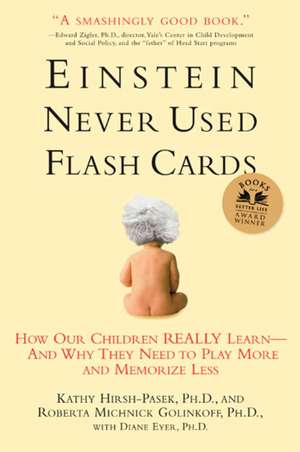
Einstein Never Used Flashcards
Autor Kathy Hirsh-Pasek, Roberta Michnick Golinkoff, Diane Eyeren Limba Engleză Paperback – 25 aug 2004
Bazându-ne pe studiile ample de psihologie cognitivă și neuroștiințe citate în Einstein Never Used Flashcards, putem afirma că presiunea actuală pentru performanță academică timpurie ignoră mecanismele naturale de dezvoltare ale creierului infantil. Această ediție reprint, publicată de Harmony/Rodale/Convergent, servește drept un argument riguros împotriva „industrializării” educației timpurii, unde jucăriile high-tech și exercițiile repetitive au înlocuit explorarea liberă. Notăm cu interes modul în care autoarele descompun mitul conform căruia memorarea rapidă a unor date izolate ar echivala cu succesul pe termen lung; din contră, datele arată că instruirea academică rigidă la vârste fragede poate diminua entuziasmul pentru învățare. Structura lucrării este una pragmatică, oferind nu doar teorie, ci și 40 de activități specifice care demonstrează cum conceptele matematice sau lingvistice pot fi internalizate natural prin joc. Comparabil cu The Power of Play de David Elkind în ceea ce privește pledoaria pentru timpul nestructurat, volumul de față se distinge prin ancorarea mai profundă în protocoale de cercetare din laboratoarele de limbaj și dezvoltare. Față de Play = Learning, care explorează fenomenul la nivel sistemic, Einstein Never Used Flashcards acționează ca un ghid aplicat pentru părinți și educatori, traducând jargonul academic în soluții cotidiene. În contextul operei lor, această carte reprezintă fundamentul pe care s-au clădit lucrările ulterioare, precum How Babies Talk sau Becoming Brilliant. Dacă în How Babies Talk accentul era pus strict pe achiziția limbajului, aici perspectiva se lărgește, acoperind întreg spectrul de abilități necesare secolului XXI. Credem că relevanța acestui text rămâne constantă, oferind o alternativă validată științific la curentul „accelerării” care domină astăzi grădinițele.
Preț: 106.43 lei
Carte disponibilă
Livrare economică 17 noiembrie-01 decembrie
Specificații
ISBN-10: 1594860688
Pagini: 302
Dimensiuni: 161 x 228 x 21 mm
Greutate: 0.45 kg
Ediția:Reprint
Editura: Harmony/Rodale/Convergent
V-ar putea interesa
-
 Becoming a Word Learner: A Debate on Lexical AcquisitionRoberta Micknick Golinkoff-15%Preț: 220.31 lei260.72 lei
 -
 -30%Preț: 733.83 lei1048.72 lei
 -
 A Mandate for Playful Learning in Preschool: Presenting the EvidenceKathy Hirsh-Pasek-23%Preț: 275.69 lei358.00 lei
 -
 -29%Preț: 371.54 lei521.29 lei
 -
 Action Meets Word: How Children Learn VerbsKathy Hirsh-Pasek-30%Preț: 427.86 lei613.08 lei
 -
 How Babies TalkRoberta Michnick GolinkoffPreț: 156.44 lei
 -
 The Origins and Growth of CommunicationLynne Feagans-31%Preț: 453.62 lei655.34 lei
 -
 -35%Preț: 34.01 lei52.66 lei
 -
 Preț: 139.49 lei
De ce să citești această carte
Această carte este esențială pentru părinții și educatorii care doresc să protejeze copilăria de presiunile academice premature. Cititorul câștigă o înțelegere clară a modului în care copiii învață de fapt, primind instrumente practice (cele 40 de jocuri) pentru a stimula inteligența fără a sacrifica bucuria jocului. Este o lectură care elimină vinovăția părinților și oferă o strategie bazată pe dovezi pentru dezvoltarea cognitivă sănătoasă.
Despre autor
Kathy Hirsh-Pasek, Ph.D., este profesor la Temple University și o autoritate recunoscută în psihologia dezvoltării, fiind implicată în cele mai mari studii americane privind îngrijirea copilului. Roberta Michnick Golinkoff, Ph.D., deține o catedră la University of Delaware și este laureată a bursei Guggenheim, specializându-se în lingvistică și psihologie. Împreună, cele două cercetătoare au revoluționat modul în care publicul larg înțelege învățarea timpurie, fiind prezente constant în media academică și populară pentru a promova importanța jocului. Diane Eyer, colegă la Temple University, completează echipa cu expertiza sa în legătura mamă-copil.
Recenzii
"Explodes over-hyped education myths and tells you why relaxing and reclaiming your child's childhood is the best way to nuture his growing mind." --"Parenting "magazine
"A valuable message..." -- "Publishers Weekly"
Descriere
In this book two highly credentialed child psychologists offer a compelling indictment of the growing trend toward accelerated learning. It's a message that stressed-out parents are craving to hear: Letting tots learn through play is not only okay-it's better than drilling academics!
Drawing on overwhelming scientific evidence from their own studies and the collective research results of child development experts, and addressing the key areas of development-math, reading, verbal communication, science, self-awareness, and social skills-the authors explain the process of learning from a child's point of view. They then offer parents 40 age-appropriate games for creative play. These simple, fun--yet powerful exercises work as well or better than expensive high-tech gadgets to teach a child what his ever-active, playful mind is craving to learn.
Kathy Hirsh-Pasek, Ph.D., is a member of the psychology department at Temple University, where she directs the Infant Language Laboratory and participated in one of the nation's largest studies of the effects of child care. The mother of three sons, she also composes and performs children's music.
Roberta Michnick Golinkoff, Ph.D., is the H. Rodney Sharp Professor in the School of Education at the University of Delaware, where she holds a joint appointment with the departments of linguistics and psychology and directs the Infant Language Project. She has also been a recipient of the John Simon Guggenheim Memorial Fellowship and is the mother of a son and a daughter.
Together, Hirsh-Pasek and Golinkoff were featured on the PBS "Human Language" series and are the co-authors of "How Babies Talk."
Diane Eyer, Ph.D., is a member of the psychology department at Temple University and also the author of "Motherguilt" and "Mother-Infant Bonding."
After decades of research, scientists and child development experts have come to a clear conclusion: Play is the best way for our children to learn. Experts have found that children who are prematurely pushed into regimented academic instruction display less creativity and enthusiasm for learning in later years, and that children who memorize isolated facts early in life show no better long-term retention than their peers. However, children who learn through play develop social and emotional skills, which are critical for long-term success.
Somewhere along the line, this important book argues, we've gotten off track by stressing academic products and programs to our preschoolers. Thankfully, Hirsh-Pasek and Golinkoff have a simple remedy--go play--for our children that is based on overwhelming scientific evidence from their own studies and the collective research results of child development experts.
"Einstein Never Used Flash Cards" goes beyond debunking the myths spread by the accelerated-learning industry. Parents, educators, and other readers will find a practical guide to introducing complex concepts through smart, simple, and loving play. For every key area of a child's development (speech, reading, math, social skills, self-awareness, and intelligence), this study aims to show how a child's mind actually learns. The book also offers useful exercises--40 in all--that are meant to highlight childrens' emerging skills and while helping them prepare for tomorrow.
"Although parents know that the early years are learning years, just what that means has been confusing--until now. "Einstein Never Used Flash Cards" makes practical sense of the vast number of technical studies and the hyperbole of advertising claims. It explains in clear, compelling, and scientific terms how learning really takes place. This book is a must-read for parents, grandparents, teachers, caregivers, pediatricians, and policy makers--in other words, all those who care about (and for) the next generation of children."--Ellen Galinsky, president and cofounder of the Families and Work Institute in New York City
"An elegant summary of what mind and brain science can tell us about child development and learning. The reasonable and reassuring implications the authors draw from this research provide a much-needed corrective to the hype and distortions all too prevalent in the popular media. Finally, the truth!"--John T. Bruer, Ph.D., President of the James S. McDonnell Foundation and author of "The Myth of the First Three Years"
"Parents eager to know what to do--and even more important, what "not" to do--to help their children discover and take advantage of their hidden talents will find this well-written book a treasure trove of information and advice. A trustworthy parenting resource from two highly respected scholars!"--Linda Acredolo, Ph.D., professor of psychology at the University of California, Davis, and author of "Baby Signs" and "Baby Minds"
"Although parents know that the early years are learning years, just what that means has been confusing--until now. "Einstein Never Used Flash Cards" makes practical sense of the vast number of technical studies and the hyperbole of advertising claims. It explains in clear, compelling, and scientific terms how learning really takes place. This book is a must-read for parents, grandparents, teachers, caregivers, pediatricians, and policy makers--in other words, all those who care about (and for) the next generation of children."--Ellen Galinsky, president and cofounder of the Families and Work Institute in New York City