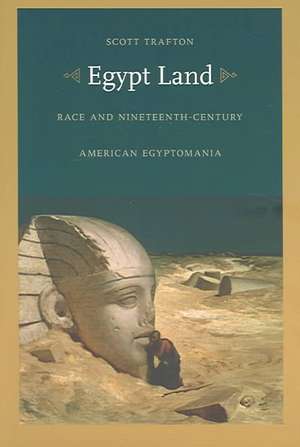
Egypt Land
Autor Scott Traftonen Limba Engleză Paperback – 19 noi 2004
Bazându-ne pe cercetările interdisciplinare publicate de Duke University Press, descoperim în Egypt Land o analiză riguroasă a modului în care obsesia Americii secolului al XIX-lea pentru Egiptul antic a servit drept paravan și instrument pentru dezbaterile despre rasă. Autorul Scott Trafton demonstrează că interesul pentru piramide și faraoni nu a fost doar o modă estetică, ci o manifestare profundă a tensiunilor sociale într-o națiune divizată de sclavie. Ne-a atras atenția modul în care Trafton documentează o dublă proiecție: pe de o parte, elitele albe vedeau în Egipt un model de putere imperială, iar pe de altă parte, populația de culoare și aboliționiștii se identificau cu exodul sclavilor din țara faraonilor. Structura lucrării este remarcabilă prin capacitatea de a conecta domenii aparent disparate. Apreciem rigoarea cu care sunt analizate de la măsurătorile craniometrice ale vremii până la proza lui Edgar Allan Poe sau construcția Monumentului Washington. Această ediție în format paperback oferă o perspectivă critică asupra „Egiptomaniei”, integrând 16 ilustrații care susțin argumentele despre ascensiunea științelor rasializate și a literaturii de aventură imperialistă. Ca alternativă la Race and Vision in the Nineteenth-Century United States de Shirley Samuels pentru cursurile de istorie culturală sau studii americane, Egypt Land aduce avantajul unei focalizări specifice pe simbolistica egipteană ca „pivot” al identității naționale, oferind o coeziune tematică mai strânsă între arta vizuală și discursul politic al epocii. Textul este academic, dens, dar esențial pentru înțelegerea rădăcinilor ideologice ale rasismului american.
Preț: 297.54 lei
Carte tipărită la comandă
Livrare economică 30 noiembrie-14 decembrie
Specificații
ISBN-10: 0822333627
Pagini: 376
Ilustrații: 16 illustrations
Dimensiuni: 154 x 227 x 22 mm
Greutate: 0.51 kg
Ediția:New.
Editura: Duke University Press
V-ar putea interesa
-
 Hidden FiguresMargot Lee ShetterlyPreț: 92.15 lei
 -
 Texas RisingStephen L MoorePreț: 109.77 lei
 -
 KissingerNiall Ferguson-16%Preț: 118.02 lei141.07 lei
 -
 Ronald ReaganMichael Schaller-19%Preț: 79.66 lei98.75 lei
 -
 Preț: 106.98 lei
 -
 The N WordJabari AsimPreț: 107.13 lei
 -
 The Imperial PresidencyArthur Meier Jr. SchlesingerPreț: 186.59 lei
 -
 Preț: 363.89 lei
 -
 Constituent MomentsJason FrankPreț: 288.24 lei
 -
 Into the ArchiveKathryn BurnsPreț: 249.08 lei
 -
 Making a New WorldJohn TutinoPreț: 352.03 lei
 -
 Venezuela's Bolivarian DemocracyDavid SmildePreț: 292.20 lei
 -
 Preț: 258.24 lei
 -
 Preț: 446.59 lei
 -
 Black Hawk and the Warrior's PathRoger L NicholsPreț: 281.86 lei
 -
 All Our RelationsWinona LadukePreț: 111.87 lei
 -
 The Secret Societies of All Ages & Countries (Two Volumes in One)Charles William HeckethornPreț: 245.18 lei
 -
 Rio de JaneiroLuiz Eduardo SoaresPreț: 115.70 lei
De ce să citești această carte
Recomandăm această carte cercetătorilor și studenților la istorie sau studii culturale care doresc să înțeleagă cum simbolurile antice au fost folosite pentru a justifica sau contesta sclavia în America. Cititorul câștigă o perspectivă nouă asupra modului în care arhitectura și literatura pot ascunde anxietăți politice majore. Este un studiu de referință despre cum o civilizație dispărută a devenit oglinda conflictelor interne ale unei națiuni moderne.
Despre autor
Scott Trafton este profesor asistent de engleză și studii afro-americane la Universitatea George Mason din Fairfax, Virginia. Expertiza sa se concentrează pe intersecția dintre literatură, istorie culturală și dinamica rasială în Statele Unite. Prin lucrarea de față, Trafton s-a impus ca o voce importantă în analiza critică a modului în care elementele de istorie antică sunt recontextualizate în discursurile moderne despre putere și identitate etnică.
Descriere scurtă
"