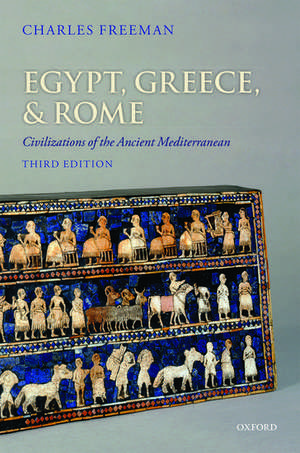
Egypt, Greece, and Rome: Civilizations of the Ancient Mediterranean
Autor Charles Freemanen Limba Engleză Paperback – 27 mar 2014
Preț: 356.21 lei
Puncte Express: 534
Carte în stoc
Livrare din stoc 16 octombrie
Livrare prin curier în România Termenul estimat este afișat lângă disponibilitate.
Transport gratuit de la 400.00 lei Plată online sau ramburs, în funcție de opțiunile comenzii.
Retur gratuit în 14 zile Comandă securizată și suport în română.
Specificații
ISBN-13: 9780199651924
ISBN-10: 0199651922
Pagini: 824
Ilustrații: Contains numerous halftones, colour plates, maps, and line drawings
Dimensiuni: 162 x 234 x 44 mm
Greutate: 1.38 kg
Ediția:3rd edition
Editura: OUP OXFORD
Colecția OUP Oxford
Locul publicării:Oxford, United Kingdom
ISBN-10: 0199651922
Pagini: 824
Ilustrații: Contains numerous halftones, colour plates, maps, and line drawings
Dimensiuni: 162 x 234 x 44 mm
Greutate: 1.38 kg
Ediția:3rd edition
Editura: OUP OXFORD
Colecția OUP Oxford
Locul publicării:Oxford, United Kingdom
V-ar putea interesa
-
 -31%Preț: 918.69 lei1333.64 lei
 -
 -18%Preț: 71.41 lei87.05 lei
 -
 The Republic in Danger: Drusus Libo and the Succession of TiberiusAndrew Pettinger-31%Preț: 898.32 lei1307.67 lei
 -
 Oracles, Curses, and Risk Among the Ancient GreeksEsther Eidinow-25%Preț: 637.24 lei849.89 lei
 -
 -19%Preț: 367.67 lei455.01 lei
 -
 Conversation and Self-Sufficiency in PlatoA. G. Long-29%Preț: 522.03 lei732.14 lei
 -
 Helen of Troy: Beauty, Myth, DevastationRuby Blondell-11%Preț: 370.22 lei415.95 lei
 -
 Angels in Late Ancient ChristianityEllen Muehlberger-31%Preț: 662.30 lei960.94 lei
 -
 A New History of Early ChristianityCharles FreemanPreț: 116.75 lei
 -
 Preț: 177.56 lei
 -
 Paideia and Cult – Christian Initiation in Theodore of MopsuestiaDaniel L. SchwartzPreț: 188.90 lei
 -
 The Closing Of The Western MindCharles FreemanPreț: 145.50 lei
 -
 Aksum and NubiaGeorge HatkePreț: 481.20 lei
 -
 A Companion to Late AntiquityPhilip RousseauPreț: 416.72 lei
 -
 Hannibal and MeAndreas KluthPreț: 151.89 lei
 -
 Preț: 121.00 lei
Recenzii
Charles Freeman is my favourite universal historian of the ancient world, which he interprets in the broadest geographical and temporal senses ... This new edition of Egypt, Greece, and Rome cannot be recommended too highly as the one-stop shop for all historically curious travellers in these eternally and endlessly fascinating lands.
Freeman's survey of the ancient world is a remarkable achievement ... The book is written in a clear and approachable style ideally suited to the target audience, which is defined as the general reader and students in need of a foundation text to guide them into the study of the great and important cultures of antiquity. This new edition will certainly ensure that Freeman's study will continue to hold its place as a classic introduction to the ancient world in all its aspects.
This admirably ambitious work provides a very useful introduction to three of the great civilizations of the Ancient World: Egypt, Greece, and Rome. Charles Freeman should be applauded for having taken on this gargantuan task.
Charles Freeman's work on updating this, the third edition of Egypt, Greece and Rome, has ensured this book continues to be a must-read, offering clear insights into the latest thinking and discoveries about the ancient Mediterranean world in an engaging and thought-provoking manner.
an enormously ambitious book ... The text is approachable and readable. It can be used both for sustained study as well as for idle browsing and dipping into. It is informative, succinct. There are no tedious digressions or woolly bits. It offers an opinion where an opinion is useful but does not dogmatically press an agenda. For the general reader, it is difficult to imagine how it could have been better done.
Freeman is to be commended for the scope and detail of the work ... [it] is beautifully illustrated and written in clear and clever prose. Freeman writes with the authority not only of a historian, but also an archaeologist ... and a traveler who has trod the well-worn paths of our ancient forebears. His rigorous approach ensures that the book will continue to be an authoritative survey of the history and culture of the Mediterranean and Middle Eastern regions.
Freeman's survey of the ancient world is a remarkable achievement ... The book is written in a clear and approachable style ideally suited to the target audience, which is defined as the general reader and students in need of a foundation text to guide them into the study of the great and important cultures of antiquity. This new edition will certainly ensure that Freeman's study will continue to hold its place as a classic introduction to the ancient world in all its aspects.
This admirably ambitious work provides a very useful introduction to three of the great civilizations of the Ancient World: Egypt, Greece, and Rome. Charles Freeman should be applauded for having taken on this gargantuan task.
Charles Freeman's work on updating this, the third edition of Egypt, Greece and Rome, has ensured this book continues to be a must-read, offering clear insights into the latest thinking and discoveries about the ancient Mediterranean world in an engaging and thought-provoking manner.
an enormously ambitious book ... The text is approachable and readable. It can be used both for sustained study as well as for idle browsing and dipping into. It is informative, succinct. There are no tedious digressions or woolly bits. It offers an opinion where an opinion is useful but does not dogmatically press an agenda. For the general reader, it is difficult to imagine how it could have been better done.
Freeman is to be commended for the scope and detail of the work ... [it] is beautifully illustrated and written in clear and clever prose. Freeman writes with the authority not only of a historian, but also an archaeologist ... and a traveler who has trod the well-worn paths of our ancient forebears. His rigorous approach ensures that the book will continue to be an authoritative survey of the history and culture of the Mediterranean and Middle Eastern regions.
Notă biografică
Charles Freeman is a freelance academic historian who worked on his first archaeological dig, a first century AD Roman villa, in Italy as far back as 1966. Following many years of wandering in the Mediterranean, he has been leading study tours of Italy, Greece and Turkey for the past ten years. In 2005, Charles was appointed as Historical Consultant to the prestigious Blue Guides and has written introductions and sections of several of the most recent editions. He is also author of Sites of Antiquity: Fifty Sites that Explain the Classical World (2009), a full illustrated survey that might be seen as a companion to Egypt, Greece and Rome.
Cuprins
- Dedication
- Foreword to the Third edition
- Author's Preface
- Acknowledgements
- List of Plates
- List of Maps
- List of Figures
- 1: Approaching the Ancient World
- 2: The Birth of Civilization: The Ancient Near East, 5000- 1200 BC
- 3: Pyramids and Power, the Creation of an Egyptian State, 3500-1985 BC
- 4: Stability and Expansion, Egypt in the Middle and New Kingdoms, 1985- 1000 BC
- Interlude 1: The Amarna Letters
- 5: Living in New Kingdom Egypt
- 6: The Ancient Near East, 1200- 500 BC
- 7: 'The Sea between the Lands', the Mediterranean as the Cradle of the Classical World
- 8: Civilizations of the Bronze Age Aegean, 2000 -1100 BC
- 9: The Birth of a New Greece 1100 - 700 BC
- 10: 'Travelling Heroes', The Greeks in a Wider World, 800-600 BC
- Interlude 2: Sappho and Lyric Poetry
- 11: Hoplites and Tyrants: The Emergence of the City State
- 12: Craftsmanship and Creativity in Archaic Greece
- 13: The Persian Wars
- 14: The Greek Way of Life
- 15: Experiencing the Supernatural: the Spiritual World of the Greeks
- Interlude 3: 'After this all becomes possible.' Creating Classical Art, 500 - 460 BC
- 16: Democracy and Empire, Athens in the Fifth Century
- 17: Rethinking the World: From Aeschylus to Aristotle
- Interlude 4: Rhetoric
- 18: The Struggle for Power, 431- 338 BC
- 19: Alexander the Great and the Transformation of the Greek World
- 20: Tensions and Creativity: The Hellenistic World, 323 -30 BC
- Interlude 5: Celts and Parthians
- 21: The Etruscans and Early Rome
- 22: Rome Becomes a Mediterranean Power
- 23: Rome, A Republic Under Stress
- Interlude 6: Voices from the Republic
- 24: The Failure of Republican Politics
- Interlude 7: Women in the Roman Republic
- 25: Augustus and the Founding of Empire
- 26: Consolidating the Roman Empire, AD 14-161
- Interlude 8: The Sebasteion at Aphrodisias
- 27: Running and Defending an Empire
- 28: Social and Economic Life in the Empire
- Interlude 9: The Romans as Builders
- 29: The Flourishing of Greek Culture
- 30: An Empire in Crisis, AD 161-313
- 31: The Early Christian Communities, AD 33-313
- 32: Constantine and His Successors
- 33: The Christian Emperor
- 34: The Collapse of the Classical West, 395-600
- 35: The Emergence of the Byzantine Empire
- 36: Legacies
- What to Read Next
- Date Chart
- List of Events
- Index