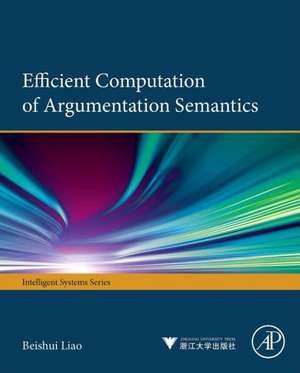
Efficient Computation of Argumentation Semantics
Autor Beishui Liaoen Limba Engleză Hardback – 14 ian 2014
The Series in Intelligent Systems publishes titles that cover state-of-the-art knowledge and the latest advances in research and development in intelligent systems. Its scope includes theoretical studies, design methods, and real-world implementations and applications. The series publishes titles in three core sub-topic areas: intelligent automation, intelligent transportation systems, and intelligent computing.
- The first book to cover new methods for computing static, dynamic, and partial argumentation systems
- Methods are applicable to development of systems and research areas in both AI and broader intelligent systems
- Provides the AI and IS community with insight into the critical field of efficient computation, with a focus on intelligent automation, intelligent transportation systems, and intelligent computing
Preț: 445.20 lei
Preț vechi: 634.18 lei
-30%
Puncte Express: 668
Carte tipărită la comandă
Livrare economică 23 noiembrie-07 decembrie
Livrare prin curier în România Termenul estimat este afișat lângă disponibilitate.
Transport gratuit pentru acest produs Plată online sau ramburs, în funcție de opțiunile comenzii.
Retur gratuit în 14 zile Comandă securizată și suport în română.
Specificații
ISBN-13: 9780124104068
ISBN-10: 0124104061
Pagini: 148
Ilustrații: 50 illustrations
Dimensiuni: 191 x 235 x 15 mm
Greutate: 0.48 kg
Editura: ELSEVIER SCIENCE
ISBN-10: 0124104061
Pagini: 148
Ilustrații: 50 illustrations
Dimensiuni: 191 x 235 x 15 mm
Greutate: 0.48 kg
Editura: ELSEVIER SCIENCE
V-ar putea interesa
-
 Gaussian Processes for Machine LearningCarl Edward Rasmussen-26%Preț: 350.95 lei477.34 lei
 -
 Pattern Recognition and Machine LearningChristopher M Bishop-20%Preț: 646.10 lei807.62 lei
 -
 Chips Challenging ChampionsJonathan Schaeffer-20%Preț: 436.47 lei545.60 lei
 -
 Connectionism and the MindBechtelPreț: 519.37 lei
 -
 Activity LearningDiane J Cook-9%Preț: 717.08 lei788.00 lei
 -
 Dragon Professional Individual for DummiesStephanie Diamond-20%Preț: 180.15 lei225.19 lei
 -
 Designing Voice User InterfacesCathy Pearl-20%Preț: 195.53 lei244.41 lei
 -
 Artificial Intelligence for Building Energy AnalysisFr'd'ric Magoul's-20%Preț: 923.76 lei1154.70 lei
 -
![INTRO GENETIC ALGOR SCI [W/ CD]](https://i2.books-express.ro/bt/9789810236021/intro-genetic-algor-sci-w-cd.jpg) INTRO GENETIC ALGOR SCI [W/ CD]Coley David APreț: 363.53 lei
INTRO GENETIC ALGOR SCI [W/ CD]Coley David APreț: 363.53 lei
Public țintă
Electrical and Electronic Engineers; Mechanical Engineers; Computer Engineers; Intelligent Systems specialists.Cuprins
- Argumentation semantics and their computation: An introduction
- Preliminaries
- Computing the semantics of dynamic argumentation systems: A division based approach
- Computing the semantics of static argumentation systems: A partition based approach
- Computing the partial semantics of argumentation: A localized approach
- Conclusions and future work