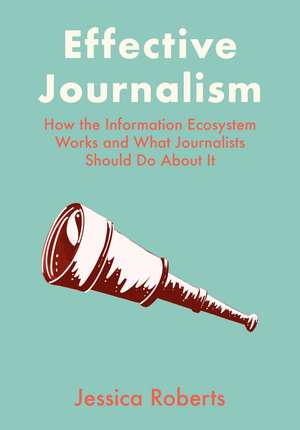
Effective Journalism
Autor Jessica Robertsen Limba Engleză Hardback – 8 apr 2024
Complementar volumului Informing the News de Thomas E. Patterson, care subliniază nevoia unei furnizări constante de știri relevante pentru democrație, Effective Journalism merge un pas mai departe. Dacă Patterson se concentrează pe calitatea conținutului, Jessica Roberts explorează mecanismele psihologice și tehnologice care fac ca acele știri, oricât de corecte ar fi, să nu mai ajungă eficient la public. Găsim aici o analiză onestă a realității actuale, care demontează mitul conform căruia „faptele vorbesc de la sine”. Această lucrare se plasează organic în contextul cercetărilor anterioare ale autoarei, fiind o evoluție a temelor explorate în American Journalism and "Fake News". În timp ce lucrarea precedentă se concentra pe fenomenul dezinformării, acest nou volum oferă un cadru de soluții concrete. Structura este riguroasă, împărțită în trei secțiuni critice: provocările ecosistemului (atenția digitală, algoritmii), barierele cognitive (emoția, bias-ul) și strategiile de remediere. Descoperim în paginile sale o abordare interdisciplinară ce îmbină teoriile comunicării cu psihologia cognitivă. Partea a doua este deosebit de utilă, explicând Modelul Procesului Dual și modul în care raționamentul motivat distorsionează percepția publicului. Spre deosebire de Overcoming Bias, care se axează pe subiectivitatea jurnalistului, cartea de față analizează cum interacționează tehnologia cu limitările creierului uman. Tonul este unul academic, dar extrem de aplicat, culminând cu soluții pentru cultivarea empatiei și strategii de demontare a informațiilor false, esențiale pentru redacțiile moderne ce doresc să-și reconstruiască relevanța.
Preț: 669.55 lei
Preț vechi: 869.55 lei
-23%
Carte disponibilă
Livrare economică 10-24 noiembrie
Livrare express 27-31 octombrie pentru 35.57 lei
Specificații
ISBN-10: 1789389038
Pagini: 218
Dimensiuni: 175 x 250 x 16 mm
Greutate: 0.56 kg
Editura: Intellect Books
De ce să citești această carte
Pentru jurnaliștii și studenții la comunicare care observă că simpla publicare a adevărului nu mai este suficientă pentru a convinge. Cititorul va câștiga o înțelegere profundă a modului în care funcționează economia atenției și va învăța tehnici practice de combatere a dezinformării. Este un ghid strategic despre cum se poate construi o comunitate informată într-un mediu digital saturat de știri de tip junk.
Despre autor
Jessica Roberts este o cercetătoare și autoare preocupată de intersecția dintre jurnalism, etică și tehnologie. Portofoliul său academic și editorial este divers, incluzând analize fundamentale despre starea presei contemporane, precum American Journalism and "Fake News", dar și lucrări educaționale precum Teaching Science in Elementary Schools. Această versatilitate îi permite să abordeze subiecte complexe precum ecosistemul informațional dintr-o perspectivă pedagogică și analitică clară. Prin Effective Journalism, ea își consolidează rolul de observator critic al modului în care transformările digitale redefinesc responsabilitatea socială a presei în secolul XXI.
Descriere scurtă
Notă biografică
Cuprins
Introduction
PART I: STRUCTURAL CHALLENGES IN OUR INFORMATION ECOSYSTEM
1. Information Proliferation
2. The Attention Economy
3. Customization and Filters and Bots
4. The Competitive Advantage of Junk News
PART II: COGNITIVE AND AFFECTIVE BARRIERS TO PROCESSING INFORMATION
5. The Dual-Process Model
6. Motivated Reasoning and Bias
7. Emotion and Information
PART III: THE SOLUTIONS
8. New Movements in Journalism
9. Strategies to Effectively Debunk False Information
10. Empathy Cultivation and Building Community
11. Effective Journalism Practices
12. Solutions for Tech Companies, Government, and the Public
Conclusion
Index